
Research Signal – Source date 2025-12-02
CAR-T therapy has transformed treatment for some blood cancers, where engineered T cells can find and attack cells carrying a chosen marker. That success has encouraged researchers to test the approach in breast cancer, especially advanced disease for which systemic treatment remains difficult. But the early breast-cancer record is more modest: reports describe some local tumor effects and manageable treatment in small groups, while durable control remains unproven.
The central problem is not simply building a T cell that recognizes cancer. In a solid tumor, it must identify enough cancer cells, reach them, keep working in a hostile environment and persist long enough to matter. A December 2025 review of breast-cancer CAR-T research brings these steps together, from laboratory approaches to early clinical reports. It does not test a new treatment in patients.
Choosing a target is only the first step
A CAR, or chimeric antigen receptor, gives a T cell a designed way to recognize a molecule on a cell’s surface. Breast-cancer studies have explored targets including HER2, EGFR, ROR1 and c-Met, as well as MUC1 and Trop2. In laboratory and animal studies summarized by the review, CAR-T cells directed at some of these markers showed activity against breast-cancer cells.
That activity depends on the target being present where the engineered cell arrives. Breast tumors can vary in marker expression between cells, regions, lesions and stages of treatment. Some cells may carry abundant target while others carry little or none. If a CAR-T cell is designed for one marker, low-marker cells may escape recognition; cancer cells may also reduce or lose a target, leaving fewer cells visible to that treatment. The result is a moving target: selecting a promising marker does not guarantee that all cancer cells in a patient will display it consistently.
Reaching the tumor adds a physical obstacle
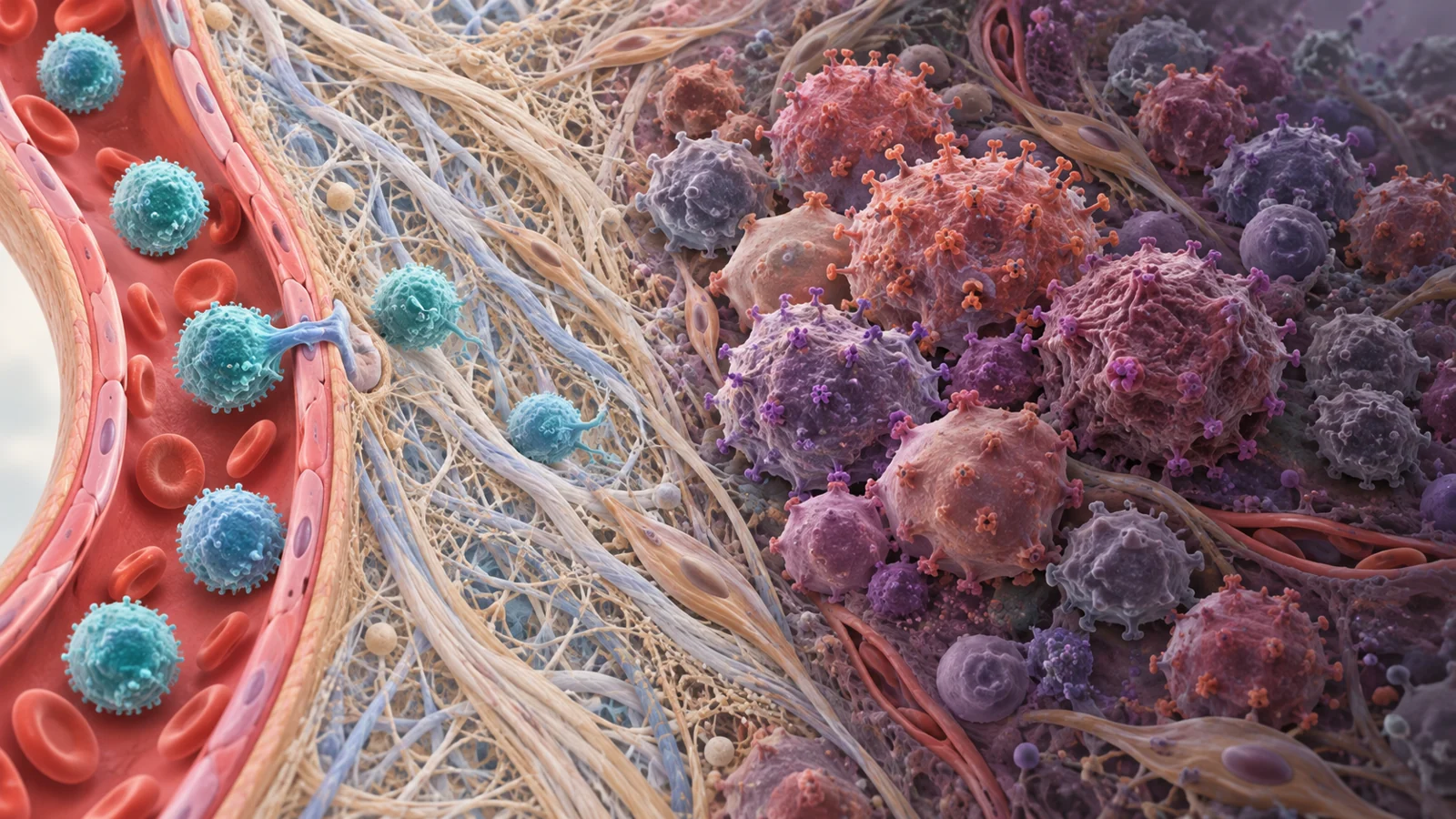
Blood cancers circulate through the same system that carries infused T cells. A breast tumor is a destination embedded in tissue. CAR-T cells traveling through the bloodstream must leave abnormal tumor vessels and move through the surrounding structure to reach cancer cells. The review describes vessel features and low levels of adhesion molecules that can make this passage difficult.
The tissue itself can add resistance. Cancer-associated fibroblasts can produce collagen and fibronectin, forming a dense extracellular matrix that impedes movement toward the tumor’s interior. Chemokines and their receptors also help direct immune-cell migration; a mismatch between the signals a tumor produces and the receptors on T cells can leave fewer cells entering the tumor.
Delivering cells locally is one way researchers have tried to change the route. The review lists early-phase studies of local or regional delivery, which may concentrate cells near a tumor and reduce the need for them to reach it from the circulation. This approach brings procedural constraints of its own: injection carries risks such as bleeding, infection or tumor rupture, and the technique can vary with tumor location. A shorter route to the target is not a simple substitute for reliable access across different sites.
A tumor can suppress cells after they arrive
Entry is not the end of the journey. The tumor microenvironment can weaken T cells through both other cells and local conditions. The review describes suppressive myeloid-derived cells, macrophages, regulatory T cells and fibroblasts. They can deprive T cells of nutrients, release inhibitory signals or help maintain the dense tissue barrier. Low oxygen and acidity can also impair T-cell survival and function, while inhibitory cytokines such as IL-4 and TGF-β can further dampen activity.
One experimental strategy attempts to make an inhibitory signal useful instead. Researchers engineered MUC1-targeting CAR-T cells to carry an inverted cytokine receptor that turns an IL-4 signal into an activating signal. In laboratory and animal work summarized by the review, these modified cells showed activity against breast-cancer cells. Another preclinical approach used a TGF-β pathway inhibitor to protect ROR1-targeting CAR-T cells from suppression in laboratory and three-dimensional tumor models. These are examples of mechanisms being tested, not evidence that either approach improves patient outcomes.
Even cells that recognize and enter a tumor may not remain effective. The review identifies limited persistence as another obstacle. Researchers have considered immune-checkpoint inhibitors to counter inhibitory signals, but combining treatments can add immune-related side effects, cost and treatment complexity. Safety controls such as suicide genes are also under study; activating them could curb excessive CAR-T activity, but might eliminate too many engineered cells and weaken the intended treatment. More activity is not automatically a better trade if control and persistence pull in opposite directions.
Early patient reports remain small and mixed
The clinical reports described in the review offer reasons to keep studying the approach, but they do not show broad or durable breast-cancer control. In one report involving six patients with metastatic breast cancer, c-Met-targeting CAR-T cells were injected at tumor sites. The review describes tumor necrosis and an immune response at those sites, with no serious adverse reactions reported in that small group. Local effects and tolerability are useful observations, but they do not by themselves show that disease was controlled across the body or over time.
A separate early ROR1 CAR-T study included patients with several solid cancers, not breast cancer alone. Across the mixed group, one of 18 patients achieved a partial response; the review also describes poor tumor infiltration in patients with triple-negative breast cancer and non-small-cell lung cancer. That result cannot be read as a breast-cancer response rate. Another report using c-Met CAR-T cells in a mixed group of patients with metastatic melanoma and triple-negative breast cancer found four patients with stable disease and three with progression. The supplied account does not assign those outcomes separately by cancer type.
These small, mixed reports sit far from the evidence needed to know whether a particular CAR-T design can reliably produce lasting benefit for people with breast cancer. They also reflect early treatment designs that the review says often used second-generation CARs, did not thoroughly explore dosing and tested CAR-T cells alone rather than in combinations. The reports describe what happened in particular early studies; they do not settle which target, delivery route or added treatment will work best.
Laboratory activity and clinical evidence answer different questions
A promising laboratory result shows that a proposed mechanism can have activity in the tested setting. It does not show how reliably engineered cells will reach varied tumors in people, persist there or control disease. A trial listing, meanwhile, shows that a study was registered or planned; it is not an outcome. Patient reports provide a closer view of treatment experience, but small groups and mixed cancer types limit what can be concluded about breast cancer specifically.
The gap matters because many strategies address one stage of the problem at a time. A target may look useful in a model while uneven expression limits recognition. Local delivery may increase proximity while leaving variation in tissue access. A cell engineered to resist suppression may still face persistence and safety tradeoffs. The review’s overall account is therefore exploratory: it gathers technical progress and early clinical experience, without establishing comparative superiority or routine readiness for breast-cancer treatment.
What breast cancer patients could gain
If researchers can make CAR-T cells recognize more of a patient’s cancer, reach tumor tissue and remain active without unacceptable harm, the approach could eventually add a treatment option for some people with advanced breast cancer. That would depend on solving several linked problems and confirming lasting benefit in breast-cancer-specific clinical evidence. For now, the early reports show why the idea is being tested—and how much must still work inside a solid tumor before it can change care.
Key Sources
- Primary source: The new era of immunotherapy for breast cancer: challenges and coping strategies of CAR-T cell therapy.
DOI or Journal Page · Review or Meta-Analysis · 2025-12-02
Keep exploring