
Research Signal – Source date 2022-02-01
A scoping review published in February 2022 describes a striking divide: CAR T cells have had remarkable results in blood malignancies, yet their impact against solid tumors has been poor. CAR T cells are T lymphocytes—immune cells—equipped with a chimeric antigen receptor that directs them toward cancer. The contrast raises a practical question: what must these cells manage inside a solid tumor that makes treatment harder?
The review points to four demands: the cells must grow, remain stable, reach the tumor, and then function within it. It also discusses combining CAR T therapy with other treatments as a possible way to address the challenge. These are directions for research, not evidence that a particular combination is already safe or effective for people with solid tumors.
A directed cell still has to complete the journey
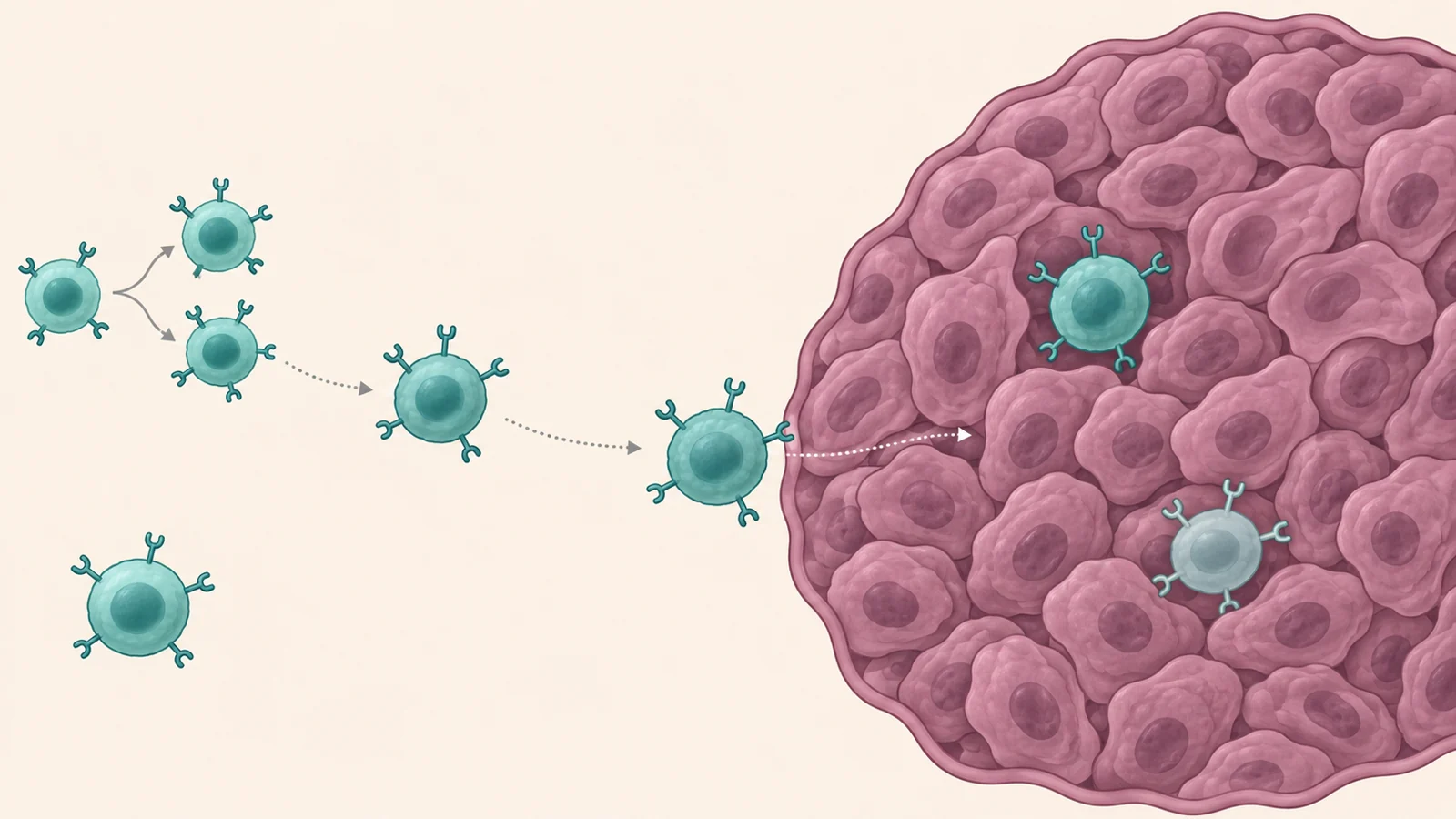
The receptor gives a T cell a way to be directed toward cancer, but direction alone is not the whole task. The review’s hurdle list spans what happens to the cells and whether they can get to and persist within the tumor. Each demand represents a different part of the problem.
First, the cells need growth: enough CAR T cells must develop to contribute to a response. They also need stability, so their therapeutic role can be maintained. Next comes trafficking—the ability to reach the tumor. Finally, the cells face questions of fate inside the tumor: what happens to them once they are there and whether they can remain useful.
The review identifies these hurdles without establishing which one is the main obstacle in any particular solid cancer. That matters because a strategy aimed at helping cells grow would address a different demand from one intended to improve their arrival or fate inside a tumor. A broad challenge can involve several steps, and the source does not rank them.
Why combinations enter the discussion
The authors propose pairing CAR T cells with chemotherapy, radiotherapy, immune-checkpoint inhibitors, or oncolytic viruses. The common idea is to use another treatment alongside the directed cells in an effort to improve their effectiveness against solid tumors.
Those options are not interchangeable, and the review’s discussion does not identify a winning regimen. The supplied evidence does not establish that any named pairing is safe and effective for patients with solid tumors. The combination proposal is best read as a research direction: a possible way to address the challenges CAR T cells face, with safety and effectiveness still requiring study.
The four hurdles help explain why simply adding another treatment is not enough to claim progress. A useful result would need to show that a specified approach can address a real limitation while also being safe and producing measurable activity in a defined solid tumor. The review offers the rationale and possible partners, not that demonstration.
Read the leukemia prediction in context
The review says CAR T success varies by disease and predicts rates of up to 90% in patients with leukemia. That figure is a prediction described by the authors, not an overall observed success rate supplied by the abstract. It also concerns leukemia; it cannot be carried over to solid tumors or used to estimate an individual patient’s outcome.
The more durable point in this review is the difference between disease settings. A result or forecast for a blood malignancy does not answer whether CAR T cells can meet the growth, stability, trafficking, and within-tumor demands posed by a solid cancer. The review’s account leaves that as a challenge for further research.
What this could make possible
For someone with a solid cancer, a dependable CAR T-based treatment that can work within the tumor would be a meaningful future option. Reaching that point would depend on overcoming the cell hurdles identified in the review and establishing a safe, effective treatment approach. The blood-versus-solid contrast, the four demands, and the proposed combination partners help explain the route; they do not show that this option is already available.
A nearer sign of progress would be a study planned in advance in one defined solid cancer that reports safety and any measurable tumor response to a specified CAR T approach or combination. Such a result would not settle every question, but it would move the discussion from a proposed strategy toward evidence about whether a particular approach can work in that setting.
Key Sources
- Primary source: Therapeutic potential of CAR T cell in malignancies: A scoping review.
DOI or Journal Page · Review or Meta-Analysis · 2022-02-01
Keep exploring