
Research Signal – Source date 2022-08-21
Replacing a car’s conventional plastic with a plant-derived material sounds like a straightforward environmental improvement. But an ingredient change has consequences well beyond where the raw material comes from. The finished part must withstand years of use, and someone must be able to handle it usefully when the vehicle is retired. A plastic designed to biodegrade presents a particularly demanding problem if that process begins during the car’s working life.
A review published August 21, 2022, in Polymers brings these questions together. It examines engineering plastics, recycled materials and alternatives made from renewable resources, connecting their potential uses with the difficulties of recovering automotive waste. Its examples span materials research, reported automotive applications and pilot projects, each offering a different kind of evidence.
The attraction starts with weight. Moving a vehicle’s mass requires energy, alongside demands from air resistance, accessories and powertrain losses. Substituting suitable plastics for heavier materials can reduce that demand. Yet the same choice adds another material to the vehicle’s eventual waste stream. Understanding the opportunity means following a component from its ingredients through manufacturing and use to its next destination.
Three different questions about the same plastic
Bio-based means made partly or wholly from renewable biological resources. The review discusses ingredients derived from sources such as starch, vegetable oils and cellulose. This describes where material comes from; it does not by itself establish how a finished component will break down or whether it has a smaller environmental footprint.
Biodegradable describes a material’s capacity to be broken down by microorganisms under particular conditions. Temperature, moisture, oxygen, acidity and the microbial population all affect the process. A plastic that biodegrades under industrial composting conditions may behave very differently elsewhere. Compostability adds requirements concerning breakdown within specified conditions and time, along with the suitability of the resulting material for plant growth.
Recyclable concerns whether discarded material can enter a process that recovers it for further use. That depends on its composition and on the available collection, sorting and processing system. Renewable origin, biodegradability and recyclability therefore answer separate questions. Calling something a “bioplastic” leaves too much unresolved to tell an engineer where it belongs in a car—or a recycler where it should go afterward.
The finished part has to earn its place
Automotive components face different combinations of force and temperature. The review describes strength, stiffness, impact resistance and the ability to deform without breaking as relevant properties. A material that performs well in one respect may still be unsuitable for a component with a different job.
Time matters too. Plastics have viscoelastic behavior, meaning their response to a load depends partly on how long it acts and at what temperature. Engineers also need to consider softening, thermal expansion, heat resistance and flammability. For biodegradable polymers, selecting the conditions under which breakdown occurs is part of this service-performance problem: useful degradation after disposal must not become premature deterioration in use.
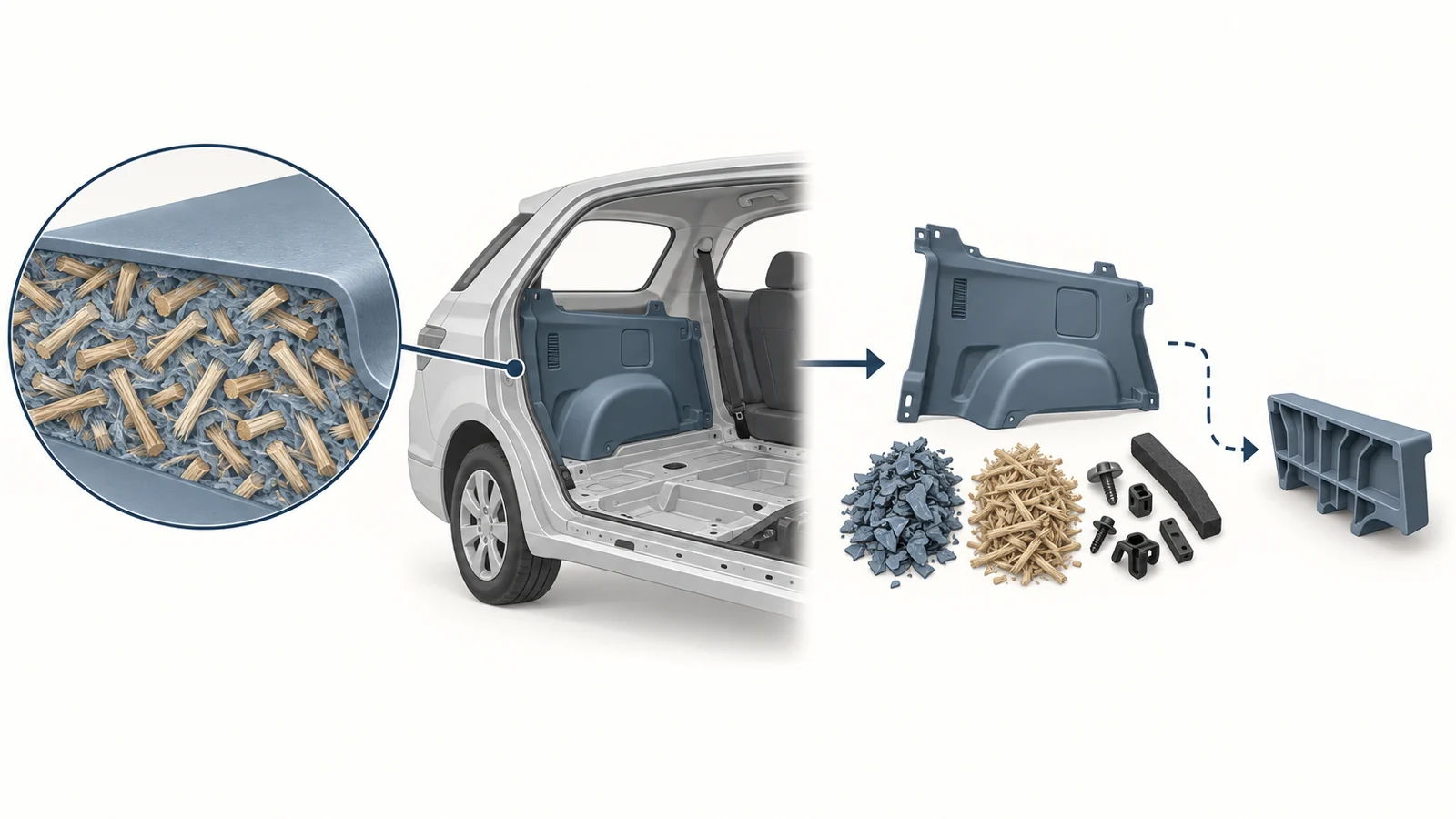
Reinforcement provides one way to adjust a material’s behavior. Plant fibers such as flax, hemp or kenaf can be embedded in a polymer matrix—the surrounding plastic that holds the composite together. The review discusses these fibers in matrices that include conventional plastics such as polypropylene. A plant fiber inside a panel does not make every constituent of that panel renewable or biodegradable.
The distinction matters because engineers use the combination for its properties. Fibers can contribute strength and stiffness relative to weight, while the polymer contributes its own mechanical behavior and allows the part to be formed. Blending, reinforcement and even painting can change performance. Assessing the finished formulation is more informative than judging it by its most appealing ingredient.
Manufacturing also constrains adoption. Many bioplastics can be processed with familiar technologies, including extrusion and injection molding. That compatibility offers a practical starting point, but the chosen material must still meet component requirements at a feasible manufacturing cost. An available molding method alone does not establish that a replacement is ready for every automotive application.
What happens after dismantling
The recovery problem begins before a plastic reaches a recycling machine. The review describes a sequence involving dismantling, removal of pollutants, shredding and further treatment. Cars contain mixtures of polymers, fibers, coatings, adhesives and other constituents. Separating useful material from those combinations can require specialized processes, especially where plastics and metals are joined.
Some of the ingredients that help a part perform also complicate its recovery. Flame retardants, stabilizers, fillers and contamination can limit which recycling processes work and which products the recovered material can become. Dismantling is expensive, and the review identifies vehicle designs that do not readily support it as an obstacle. A technically recoverable plastic may still be difficult to collect in sufficient quantity and purity at a workable price.
Mechanical recycling brings another change. Heat and shear—the forces applied as material is processed—can degrade polymers and their additives, while oxidation can further alter the material. The result may have different properties from the original plastic. The review discusses odor from recycled automotive polypropylene as one example of a quality problem that can restrict potential interior uses.
The next product therefore cannot simply be assumed to be the same as the first. One cited example combines waste automotive bumpers with sugarcane skin flour to make a composite with useful mechanical properties, but properties inferior to those of the original materials. That result points toward evaluating other applications rather than automatically returning the mixture to its former automotive role.
Quality loss is not the only possible outcome. The review also describes improvements achieved by blending or reinforcing particular recycled plastics, including increased toughness in a recycled polycarbonate blend. Recovery can involve reformulating a material for another useful job. Whether that job is another car part depends on the resulting properties and the requirements it must meet.
A carpet, a pilot and a composting alternative
The review’s examples show why “used again” can mean several different things. It reports recycled polyethylene terephthalate, or PET, fibers in molded automotive carpets. This is an example of recovered material finding an automotive use. By itself, that use does not establish a cycle in which discarded car parts repeatedly become equivalent new car parts.
A separate example concerns a chemical-recycling pilot launched by the Karlsruhe Institute of Technology and Audi in 2020. As described in the review, discarded automotive plastic parts, including fuel tanks and radiator grilles, are converted into pyrolysis oil. The intended next step is to use that material to make new automobile parts. The processing route and the goal of a car-part-to-car-part cycle are distinct stages; the pilot’s ambition should not be read as evidence of an industry-wide closed loop.
Biodegradable plastics introduce another choice. If a material can be composted, should that automatically be its destination? The review cites life-cycle assessments of polylactic acid, or PLA, in which recycling had a lower environmental impact than composting. Recovering usable material can extend its productive life even when biological breakdown is possible.
That comparison is specific to the cited PLA cases. It does, however, challenge the assumption that compostability always identifies the best end-of-life route. The practical obstacle described in the 2022 review is that compostable plastics occur in quantities too small for conventional mechanical-recycling plants to routinely process them, with adaptations still pending. A potentially favorable recycling option needs an actual collection and processing route before it can deliver that benefit.
Environmental gains depend on the whole route
Lighter weight, renewable ingredients and material recovery affect different parts of a component’s environmental performance. Reducing mass can lower energy demand while a vehicle operates. Renewable feedstock changes the source of its ingredients. Recycling can return material to production and reduce demand for new feedstock. None of those attributes alone determines the overall result.
The review makes this point relevant to electric vehicles as well. Lower mass matters to their energy requirements, but weight saving is not a sufficient measure of environmental achievement. Producing the material and component, using them and treating them after retirement all belong in the comparison.
The examples assembled in the paper also answer different questions. A stronger recycled blend demonstrates a material-property improvement. A carpet demonstrates an application. A recycling pilot explores a processing route, while a life-cycle assessment compares environmental burdens within its chosen scope. Combining those examples into a single ranking of virgin, recycled, bio-based and biodegradable plastics would erase the differences that make them useful.
Recovery economics adds a further constraint. Virgin material prices, sorting costs, labeling, demand for recovered plastics and the volume available for processing can all influence whether a technically promising route is used. A component can be attractive on the drawing board yet difficult to recover through the system that receives a retired vehicle.
What this could change
The practical possibility described by the 2022 review is a broader supply of useful automotive materials with less dependence on virgin fossil feedstock. Renewable ingredients could replace part of that input, while recovered plastics could supply material for new components or other products. Better separation and suitable reformulation could allow more retired automotive plastic to retain value instead of becoming an unusable mixed residue.
For manufacturers, that could mean making lightweight parts with a wider choice of feedstocks. For vehicle recyclers, it could create more viable destinations for plastics left after dismantling. Those benefits depend on finished parts meeting their service requirements and recovery processes delivering usable material at workable cost and environmental burden. If those conditions are met, a car’s plastic could contribute to lower demand for virgin fossil feedstock both when the component is first made and when its recovered material enters production again.
Key Sources
- Primary source: Engineering, Recyclable, and Biodegradable Plastics in the Automotive Industry: A Review.
DOI or Journal Page · Peer-Reviewed Paper · 2022-08-21
Keep exploring