
Research Signal – Source date 2021-05-10
For cancer vaccines being developed to treat tumors, releasing their ingredients for longer might keep the immune system engaged. But the same strategy could work against the response it is meant to build if exposure lasts too long. A review published on May 10, 2021, examines this timing problem alongside controlled-release materials designed to carry cancer-vaccine ingredients to the right place.
The idea addresses a practical weakness: many cancer vaccines require repeated injections to boost an immune response, while delivery systems may fail to produce a strong, lasting one. A local depot—a material that holds vaccine ingredients and releases them over time—could extend exposure or imitate booster doses. Whether it helps depends on what is released, where it goes and how long immune cells encounter it.
A vaccine needs a target cue and an immune prompt
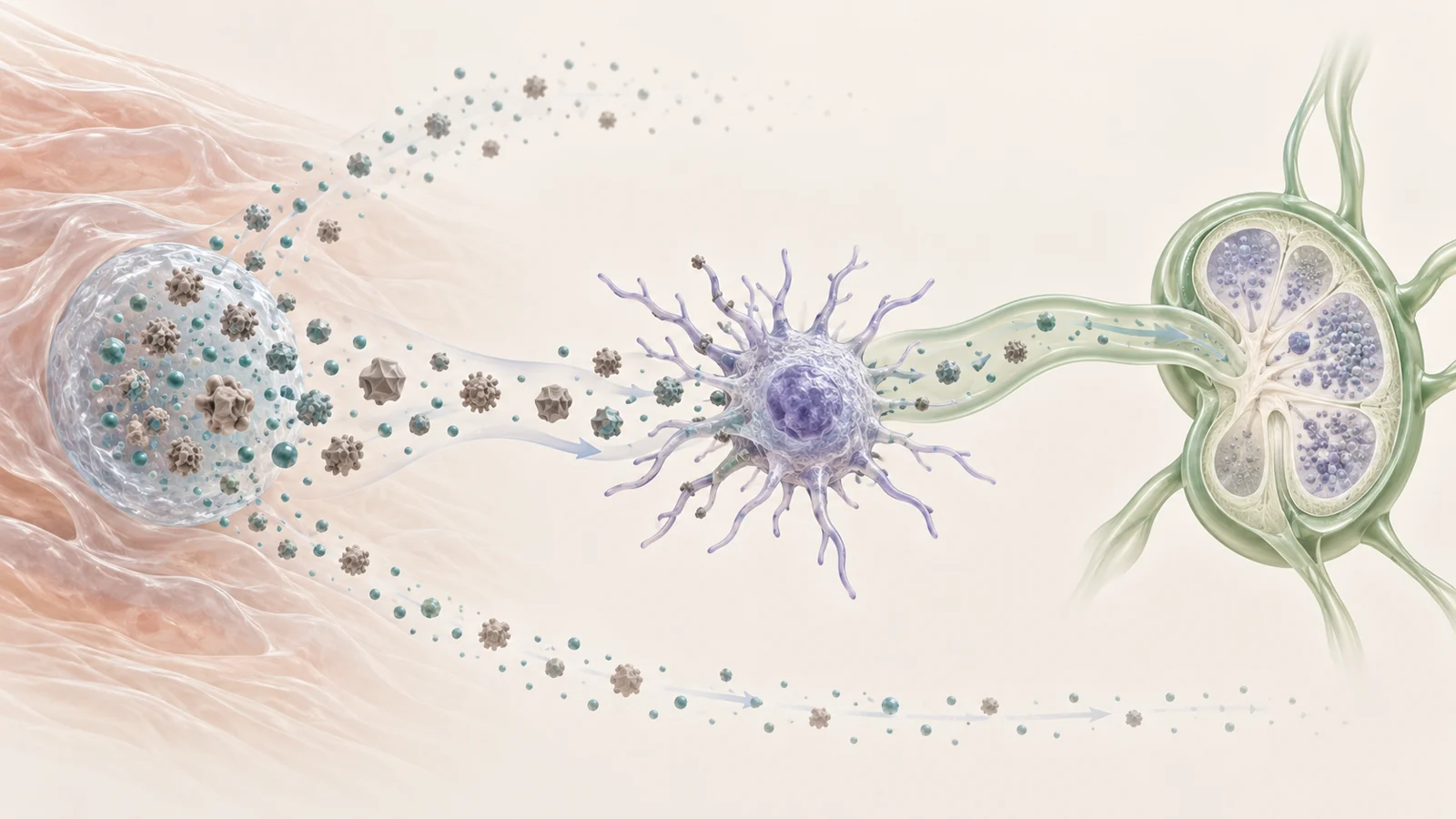
Cancer vaccines pair a tumor antigen with an adjuvant. An antigen is the target cue: it gives the immune system something to recognize. An adjuvant is an immune stimulus that helps strengthen or direct the response. Dendritic cells take up antigens and present them to T cells, which can then respond to the target.
Getting both ingredients to the right place matters. If too little reaches lymph nodes, where immune responses are organized, or if dendritic cells take up too little antigen, the intended response may be weak. The review describes ways researchers have tried to improve delivery, including particles designed to drain to lymph nodes and materials that help immune cells encounter vaccine cargo.
The target itself also affects the challenge. Tumor-associated antigens are shared by many tumors but can also occur in normal cells, and the review notes that immune tolerance to these self-like targets can limit responses. Neoantigens arise from tumor mutations and may be more specific to a particular tumor. The review presents them as promising candidates for personalized vaccines, while emphasizing that an antigen still needs a suitable way into the immune response.
Release timing can help or hinder
A controlled-release depot can keep antigen intact at a local site for a period, release ingredients continuously, or deliver them in pulses that resemble a prime-and-booster schedule. Some depots may also recruit antigen-presenting cells, including dendritic cells, toward the site. Together, these features could increase opportunities for immune cells to encounter the vaccine.
But more time is not automatically better. If antigen is released too quickly, it may clear from lymph nodes, potentially leaving a response that needs further injections. At the other extreme, very prolonged antigen presentation may exhaust or delete tumor-reactive T cells, or draw them toward the depot instead of the tumor. The review describes sustained release as potentially beneficial while warning that excessive duration can undermine antitumor immunity.
Antigen and adjuvant timing adds another constraint. An adjuvant released too quickly may be used up before it can support the response; released too slowly, it may fail to provide enough activation cues to immature dendritic cells. The ingredients therefore need to be coordinated, but the review does not identify a single schedule that suits different antigens, adjuvants and cancers.
Particles protect cargo, but making them can be hard on it
Polymer particles can carry antigens and adjuvants together and meter their release. The review discusses microparticles made from PLGA, a biodegradable polymer, among other delivery options. Particles may help localize cargo, but their preparation can expose protein antigens to organic solvents and high shear forces. Those conditions can cause proteins to aggregate or degrade, reducing their ability to serve as vaccine targets.
A second concern is the initial burst: some cargo near a particle’s surface can release quickly. The review cites estimates that this first-day burst can account for about a quarter of the total drug in PLGA microparticles. A burst may create unintended toxicity, while uneven release can frustrate the goal of controlled exposure. Researchers have explored ways to protect proteins during loading and reduce burst release, but those approaches also need reliable manufacturing and reproducible performance.
Injectable gels create a local reservoir
Injectable gels take a different approach. They can be delivered as a flowable material and then form a gel in the body, creating a reservoir at the injection site without the surgical placement needed for an implantable scaffold. Their ability to form locally makes them attractive for carrying antigens, immune stimuli or other vaccine components.
One example described in the review used a temperature-responsive gel that released an immune-cell-recruiting factor and particles carrying genetic instructions for the model antigen ovalbumin. In mice with B16/OVA melanoma tumors, the review reports that a single injection was associated with effective tumor inhibition. This is a useful illustration of the design, not evidence that the approach works as a cancer vaccine in patients: ovalbumin is a model antigen, and the result came from a mouse tumor model.
Gels also have practical limits. A rapid initial release can occur while the material changes from liquid to gel, and the final gel’s shape may affect how cargo leaves it. The review describes challenges with controlling release precisely, reaching deep tumors by injection, scaling up production, storage and sterilization. A promising local reservoir must be consistent as well as biologically useful.
Microneedles deliver through a different route
Microneedles are arrays of tiny needles that cross the outer skin and place vaccine cargo in or below layers rich in immune cells. They are not simply another shape for a depot: their central idea is to use the skin as the delivery route. The review describes solid, coated, dissolving and hollow versions, which can carry different vaccine formulations.
This route has drawn interest because it may reduce pain and could make self-administration more feasible. The review also describes preclinical and clinical exploration of microneedle-mediated vaccine candidates, but those reports do not establish patient benefit from controlled-release cancer vaccines. Shallow placement can bring more local reactions, and rigid materials such as metal, silicon or glass raise concerns about breakage; some materials may also provoke allergic reactions. Polymer needles can degrade in the body, but adding drugs or particles may weaken the needles’ ability to pierce skin. Design has to balance delivery, strength and safety.
A release curve is not the same as delivery in the body
A release profile measured outside the body may not match what happens after injection. In a dish, researchers can track how much material leaves a carrier under test conditions. Inside the body, the surrounding environment differs, and the important question is not only how much cargo leaves the depot but whether intact antigen reaches immune cells in a useful form.
The review describes fluorescence imaging as one way to estimate how much labeled antigen remains at a depot over time. That can show a changing signal, but fluorescence may fade and does not directly establish the amount or stability of antigen. Accurate measurement is especially difficult when the loaded amounts are small and release continues for a long time.
Many examples in the review use ovalbumin and established mouse tumor cell lines. Those models make it possible to study release and immune responses, but ovalbumin is exceptionally immunogenic in mouse experiments and may overstate the performance expected with real therapeutic antigens. Carrier designs, vaccine ingredients and measurements also differ across the examples. The review therefore offers design possibilities and cautions, not a clinical comparison that identifies a preferred platform. A therapeutic cancer vaccine mentioned in the review does not validate the controlled-release systems discussed here.
What better timing could change for cancer vaccines
A successful single-shot therapeutic vaccine could make it easier to coordinate a tumor-target cue and immune stimulation at the same site, sustain a useful antitumor response and reduce the need for repeat dosing. That possibility depends on getting the timing right for each vaccine, and on showing that the ingredients remain stable, the release works reliably inside the body, and production can be made safe and consistent at scale. Patient studies would still need to demonstrate a real benefit.
Key Sources
- Primary source: Hitchhiking on Controlled-Release Drug Delivery Systems: Opportunities and Challenges for Cancer Vaccines.
DOI or Journal Page · Review or Meta-Analysis · 2021-05-10
Keep exploring