
Research Signal – Source date 2025-01-01
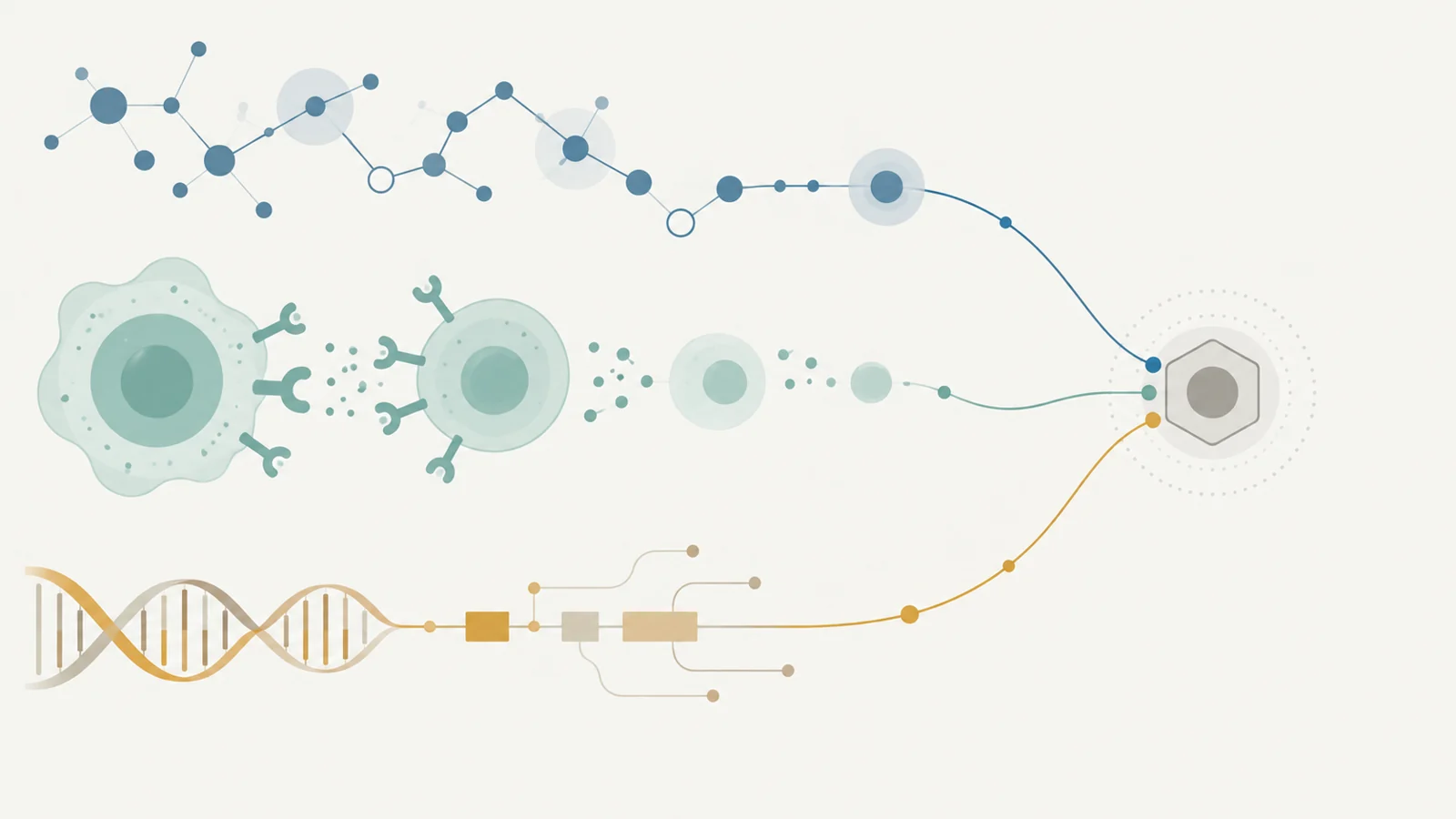
Cancer treatment can target different parts of the biology that shapes a tumor. A therapy may act on a molecular pathway linked to cancer progression, help the immune system recognize cancer cells, or alter gene expression. A review of these approaches can show how researchers are thinking about treatment choices, while leaving open whether a proposed match improves outcomes for a particular patient.
Targeting a pathway begins with finding a relevant match
The review describes therapies directed at molecular pathways implicated in cancer progression. The idea of tailoring treatment depends on connecting a treatment target to features of an individual patient’s cancer. Biomarkers—measurable biological features used to help characterize a disease—can inform that selection. The review links biomarker identification with precision medicines designed around individual patient profiles.
That connection matters because naming a pathway and identifying a biomarker are not, by themselves, proof that a specific patient will benefit from a therapy aimed at it. The review’s abstract outlines this approach but gives no study-level comparisons or validation details to establish how well any particular biomarker guides treatment.
Immune approaches work through recognition
Immunotherapy takes a different route from directly targeting a cancer-related molecular pathway. Rather than focusing only on a pathway implicated in tumor progression, it uses the immune system to identify and remove cancer cells. The review includes immune checkpoint inhibitors and CAR-T cell therapy among the approaches it discusses.
These categories share an interest in matching treatment to cancer biology, but the abstract does not provide enough detail to compare their clinical value or to say which patient profiles are best suited to each. Their inclusion shows the range of strategies covered, not a ranking of their effects.
Changing gene expression adds another route
The review also covers interventions that affect how genes are expressed. It names histone deacetylase (HDAC) inhibitors and DNA methyltransferase (DNMT) inhibitors as epigenetic modulators, alongside RNA-based approaches such as RNA interference and mRNA-based vaccines and therapies.
These approaches broaden the set of intervention points beyond a direct focus on a cancer-related molecular pathway or immune recognition. The abstract groups them within a wider discussion of emerging cancer therapies; it does not establish a specific clinical result for any one of them or for a combination of approaches.
A field overview is not a patient-level comparison
The breadth of the review is useful for understanding how targeted therapies, immunotherapy, epigenetic approaches and RNA-based interventions fit within a larger search for new cancer treatments. It connects these categories to precision medicine and describes them as promising areas of research.
The review’s abstract gives no study-level comparisons, effect estimates or validation details. It therefore cannot resolve whether one approach outperforms another for a defined patient group, which biomarker-guided choice improves outcomes, or whether a particular combination is worthwhile. Those questions require clinical evidence about the treatments and patient groups in question; the broad overview alone does not answer them.
What a better treatment match could change
If future clinical evidence shows that proposed biomarkers and interventions improve outcomes, matching treatment more closely to an individual’s cancer profile could help patients receive therapies better suited to their disease. The review points toward that possibility across several biological routes, while the benefit for patients remains conditional on those matches proving useful in practice.
Key Sources
- Primary source: A Comprehensive Review on Novel Pathways in Cancer Treatment: Clinical Applications and Future Prospects.
DOI or Journal Page · Review or Meta-Analysis · 2025-01-01
Keep exploring