
Research Signal – Source date 2021-03-24
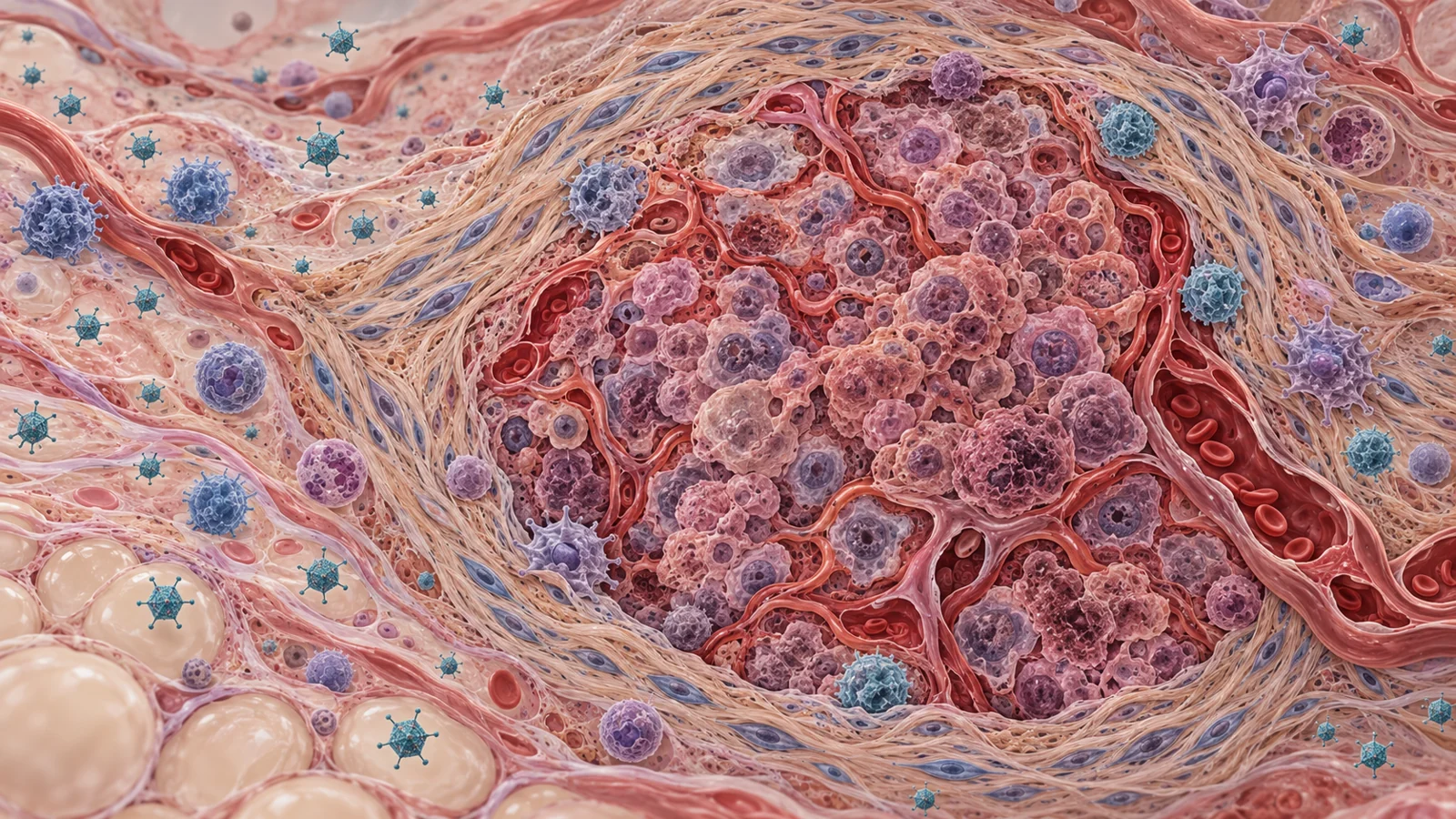
A virus can be engineered to infect and kill cancer cells, yet reaching those cells and prompting a useful immune response are separate challenges. In a solid tumor, the surrounding tissue helps determine whether the virus can spread. Blood vessels, support cells, immune cells and chemical signals all shape that environment, called the tumor microenvironment.
A 2021 review of oncolytic adenoviruses describes efforts to change this setting as part of cancer treatment. These are adenoviruses designed to multiply in tumor cells and kill them. The review brings together proposed engineering strategies, laboratory and animal findings, and early clinical studies. It does not report a new patient trial, and the approaches it discusses are not interchangeable demonstrations of benefit.
A tumor is more than its cancer cells
The tumor microenvironment includes cancer cells and the tissue around them: blood-vessel cells, fibroblasts that support tissue structure, immune cells, the extracellular matrix (a mesh of material between cells), and signaling molecules. The mix can change how a tumor grows and how immune cells behave.
Tumor blood vessels often have an irregular structure. In the conditions described by the review, local oxygen shortages can prompt new vessel branches, while uneven vessels contribute to high pressure within tumor tissue. Low oxygen also pushes tumor cells toward a form of metabolism that produces lactic acid, making the environment more acidic. These features are part of a setting that supports tumor survival and complicates efforts to deliver an active virus through the tissue.
Fibroblasts can add a more direct obstacle. Cancer-associated fibroblasts release growth signals and help form a barrier within tumors. That barrier may limit how well an oncolytic virus penetrates and spreads. A virus that kills an infected cancer cell still has to reach additional cells for replication to extend its effect.
The virus can carry more than instructions to replicate
After entering a tumor cell, an oncolytic adenovirus activates viral genes and makes new virus particles. The infected cell is eventually broken open, releasing those particles to infect other tumor cells. The review describes adenovirus designs that can also carry genes for immune-stimulating molecules, giving researchers a way to try to influence the surrounding tissue as the virus replicates.
One approach targets fibroblasts. The review describes an engineered adenovirus carrying a protein designed to recognize fibroblast activation protein, which is common on cancer-associated fibroblasts, and engage T cells. T cells are immune cells that can attack targets they recognize. The proposed design aims both to weaken the fibroblast barrier and to direct T-cell activity toward those support cells. It is an engineering strategy discussed in the review, not evidence that this effect has become a reliable clinical benefit.
Recruiting immune cells takes more than cell killing
Killing a tumor cell can release material that the immune system may recognize, but immune cells in the tumor do not automatically mount an effective response. Dendritic cells, for example, help present tumor material to other immune cells and activate them. In some tumors, their ability to do this can be impaired.
The review describes adenoviruses engineered to deliver CD40 ligand, a molecule that can help dendritic cells mature and trigger an immune response. It also discusses HP-NAP, a bacterial protein that can attract certain immune cells and stimulate immune signaling. These examples illustrate attempts to strengthen immune activity in the tumor after viral infection.
Macrophages have a different role. Some tumor-associated macrophages can suppress T-cell activity and support tumor growth. One strategy discussed in the review puts a soluble version of a protein that blocks the CD47–SIRPα interaction into an oncolytic adenovirus. In ordinary terms, this interaction can act like a “do not engulf” message to macrophages. Blocking it is intended to make tumor cells easier for macrophages to take up. The strategy addresses a different part of the immune response than activating dendritic cells.
Releasing the brakes is another design goal
Even when immune cells reach a tumor, inhibitory signals can restrain them. Checkpoint molecules are part of the immune system’s control system: they help prevent excessive immune activity, but tumors can exploit them to dampen attacks by T cells.
Some adenovirus designs discussed in the review deliver checkpoint-related molecules or antibodies within tumor tissue. In one cited mouse study, an adenovirus designed to alter immune signaling increased T-cell numbers in tumors and improved survival. That is an animal result, not a patient outcome. It illustrates the aim of combining local viral activity with changes to immune signaling, rather than showing that the same design will work across cancers in people.
Early glioma findings offer a human example
The review cites early results from a phase I study of Delta-24-RGD, an engineered adenovirus being studied against glioma. It reports that 20% of patients had durable responses and that many CD8-positive T cells—immune cells that can kill target cells—had entered the tumors. These findings give a human example of viral treatment alongside an immune response in the tumor.
The review also describes other adenovirus constructs in early clinical studies, including trials that were recruiting at the time. Their designs, cancer types and study stages differ. The glioma findings therefore cannot establish that the fibroblast-targeting, dendritic-cell or macrophage strategies will have the same effects, or that the broader field has demonstrated clinical benefit.
Why models leave important questions open
Researchers can study engineered viruses in cell cultures and in animals, but neither setting fully reproduces a human tumor’s environment. Adding signaling molecules to cultured cells or growing tumor cells in three-dimensional scaffolds can capture some features of tumor tissue while leaving others out. Human tumor grafts in immunodeficient mice also miss parts of the immune environment that would be present in a person.
The immune response to the virus is both part of the intended treatment and a safety concern. A strong response when the virus first enters the body could trigger a dangerous cytokine storm, a surge of immune signaling. Later, the host immune system may clear the virus, limiting its activity. How well a design balances these responses may depend on the tumor and the patient’s immune environment.
What reshaping a tumor could add to cancer treatment
If an adenovirus can reach enough tumor cells, spread through the tissue and help immune cells sustain an attack without provoking an unsafe response, it could become a way to pair direct cancer-cell killing with a more active antitumor environment. That could expand what a virus-based treatment can do for some solid tumors. The review’s early findings and proposed designs describe steps toward that capability; they do not yet show that it can be delivered consistently across cancers or patients.
Key Sources
- Primary source: Oncolytic adenovirus: A tool for reversing the tumor microenvironment and promoting cancer treatment (Review).
DOI or Journal Page · Review or Meta-Analysis · 2021-03-24
Keep exploring