
Research Signal – Source date 2022-01-01
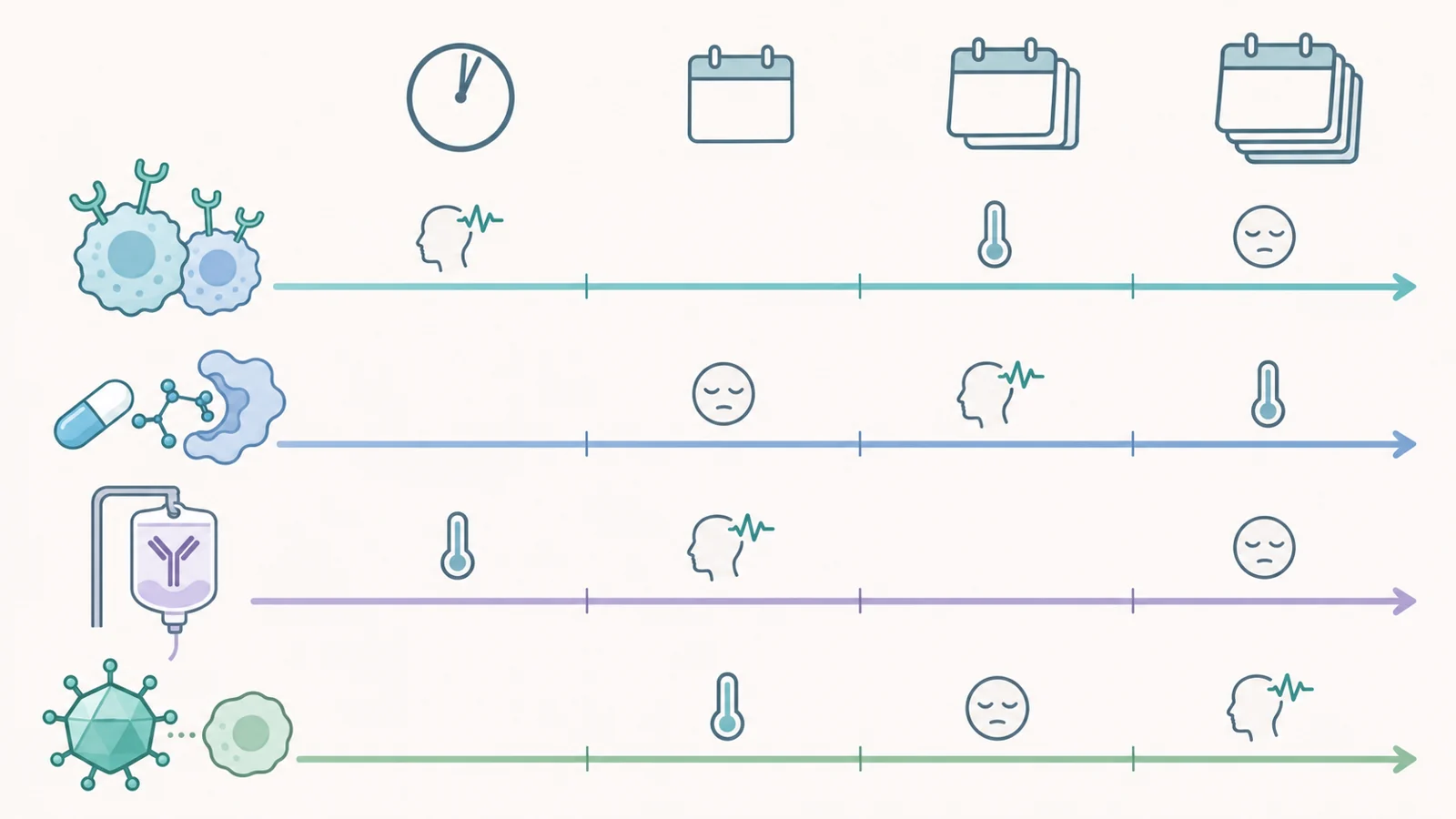
A fever or a new neurologic symptom can mean different things depending on which cancer treatment a person received and when it began. In a review of several immunotherapy classes, reported toxicities range from reactions during an antibody infusion to confusion days after engineered immune cells, or vascular problems that may take months to emerge with a kinase inhibitor.
These treatments all involve the immune system or proteins used by cancer cells, but they act in different ways. Their side effects therefore have different patterns and possible causes. The review brings together reported trials, clinical series, and cases to explain those patterns. Its examples can help readers understand why a symptom’s timing and treatment context matter; they do not provide a fair ranking of which treatment group is riskiest.
Engineered T cells can trigger a body-wide response
CAR T-cell treatment begins with a patient’s T cells, a type of immune cell. The cells are collected and genetically changed so they can recognize cancer cells. They are then multiplied over the following two to three weeks. Before infusion, the patient receives chemotherapy that reduces immune cells, and after the engineered cells enter the bloodstream, monitoring may continue for days or weeks depending on complications.
The infused cells can set off a strong inflammatory response called cytokine release syndrome, or CRS. It often includes fever and may affect several organ systems. The review describes CRS in 25–75% of patients across the CAR T studies it cites. That range reflects those particular studies, not a rate that applies to every CAR T treatment or patient.
Symptoms were reported from minutes to weeks after treatment began, with most cases occurring within two weeks. A larger cancer burden and the dose of cells may be related to the likelihood of CRS, though the review describes these as possible associations. The body-wide response can be severe, and the review notes that deaths occurred in a CAR T trial after a massive inflammatory reaction.
Similar symptoms can have competing causes
Fever and organ problems after CAR T treatment do not identify CRS on their own. Tumor lysis syndrome can also follow the destruction of cancer cells and can bring changes in blood chemicals, including high potassium, phosphate, or uric acid. Infection and sepsis can resemble CRS as well. The overlap makes recent treatment history important, and the review notes that clinicians may pursue evaluation and treatment for infection and CRS in parallel when the cause is uncertain.
A different complication, immune effector cell-associated neurotoxicity syndrome (ICANS), affects the nervous system. It may involve tremor, confusion or delirium, difficulty finding words, seizures, or, in severe cases, brain swelling, coma, and death. The review reports that ICANS occurs in up to 40% of patients in the evidence it discusses. The review gives a median onset of about four to five days after infusion, although symptoms can appear immediately or weeks later.
The review describes clinical evaluation that can include an examination and brain imaging, with other tests considered to investigate alternative causes. This is not a self-diagnosis problem: both CRS and neurologic toxicity can be serious, and their assessment belongs with the treating clinical team. For moderate to severe CRS, the review discusses the IL-6-blocking drug tocilizumab and corticosteroids, with treatment decisions involving the oncologist because suppressing inflammation may also affect the desired immune response.
A drug’s target can explain one effect, but not every effect
Kinase inhibitors block proteins that help regulate cell activity. Some side effects follow from the intended target: drugs that inhibit VEGF, a protein involved in blood vessel growth, can affect blood vessels and the cardiovascular system. Other effects may occur away from the intended target, in part because different proteins share features the drug can bind to. The review describes these as “on-target” and “off-target” effects.
Their timing varies too. Skin reactions are common with EGFR inhibitors, a subset of kinase inhibitors. The review reports that mild rashes often begin one to two weeks after treatment starts. They can include acne-like eruptions, sensitivity to sunlight, skin fissures, or mouth sores. More severe rashes were less common in the specific drugs and reports discussed.
Vascular problems can emerge much later. One series described a median of 42 months from starting nilotinib to an atherosclerotic vascular event. That figure belongs to that particular series; it is not a typical waiting time for all kinase inhibitors. The review describes withholding the drug as a main response to moderate or severe toxicity, while decisions about restarting treatment are made with the oncologist. The contrast between early skin effects and delayed vascular events shows why a symptom’s timing can matter even within one drug class.
Antibody reactions may follow an uneventful first infusion
Monoclonal antibodies can cause infusion reactions during administration or within hours. Symptoms can include chills, shaking, and a drop in blood pressure. These reactions can be difficult to distinguish from anaphylaxis, which the review describes as tending to appear within minutes, while infusion reactions may take hours.
An uneventful first dose does not rule out a reaction later. The review reports that 10–30% of infusion reactions may occur after the first infusion. Reactions are especially common with rituximab in the reviewed evidence, and also occur with trastuzumab and cetuximab. The review describes monitored infusions and supportive treatment, with different responses when a reaction is judged to be an immediate allergic emergency.
Trastuzumab also illustrates a separate safety concern. It can interfere with signals used by heart muscle cells, and the review describes heart failure in approximately 1–4% of patients treated with this antibody. The problem can appear as early as two weeks after treatment starts. The review discusses regular checks of cardiovascular function because continuing treatment after heart toxicity begins may leave lasting impairment. This is distinct from an infusion reaction: one is an acute response around administration; the other is a cardiac effect that calls for ongoing attention.
Tumor-targeting viruses raise a different detection question
Oncolytic viruses are designed to infect and destroy tumor cells while also stimulating immune activity. The review describes several ways selectivity may arise: tumor cells can have more of the receptors a virus uses to enter, support more viral replication, or be less able to block it. When tumor cells break apart, viral and tumor material can activate immune cells, potentially helping the immune system recognize cancer.
Injection-site reactions were common but generally mild in the evidence reviewed, with cellulitis reported in about 1–2% of patients. Fever and chills resembling influenza have also been reported after local or systemic treatment and were generally mild in the clinical experience summarized. These figures and descriptions are specific to the reports reviewed.
The review also separates detecting viral DNA from showing that a virus can infect someone. In reports of lesions suspected to be herpetic after treatment with talimogene laherparepvec, some samples contained viral DNA, but tested strains did not demonstrate infectivity. The review says person-to-person transmission had not been described in the evidence it considered. Viral detection alone, then, is not proof of infectious spread.
Where this research could lead
If experience across these treatments continues to clarify when particular toxicities tend to appear and what else can cause similar symptoms, care teams could have a better basis for recognizing complications and choosing what to investigate. That could support more timely, coordinated evaluation for patients receiving complex cancer therapies, especially when a symptom could reflect treatment toxicity, infection, or another urgent problem. The review offers a guide to patterns known from the evidence available to it; it does not test whether using that guide improves outcomes.
The evidence is a narrative synthesis of different agents, patient groups, trials, series, and cases. Its percentages describe particular reports, not a standardized comparison across CAR T cells, kinase inhibitors, antibodies, and oncolytic viruses. The useful thread is how treatment mechanism and elapsed time change the clinical question—not a league table of risk.
Key Sources
- Primary source: A Review of Cancer Immunotherapy Toxicity II: Adoptive Cellular Therapies, Kinase Inhibitors, Monoclonal Antibodies, and Oncolytic Viruses.
DOI or Journal Page · Review or Meta-Analysis · 2022-01-01
Keep exploring