
Research Signal – Source date 2021-01-20
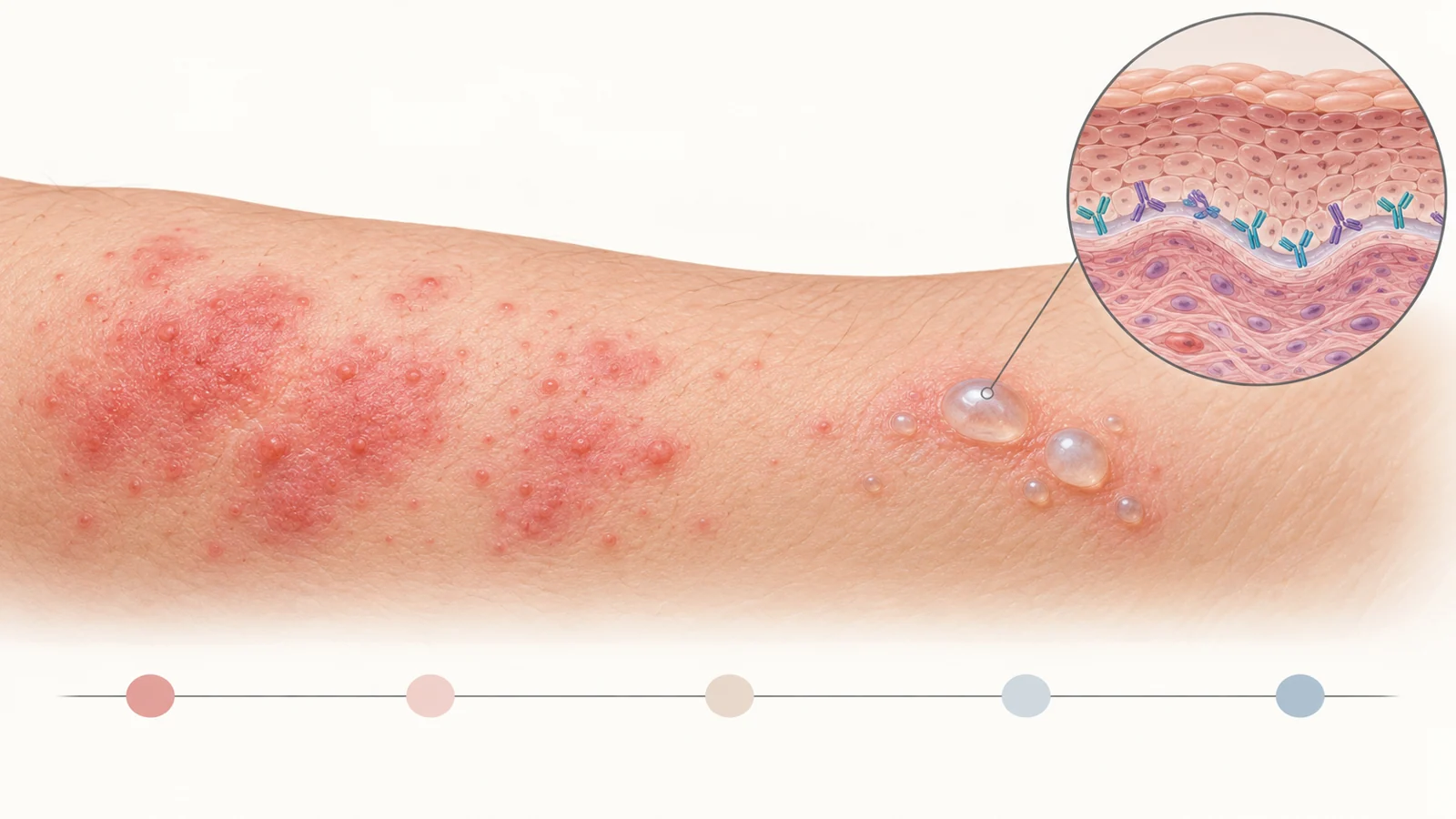
An itchy rash that lingers during cancer immunotherapy can be difficult to interpret. In a review of 58 reported cases of bullous pemphigoid, a blistering autoimmune skin disease, 20 people had a nonspecific eruption before blisters appeared. The early eruption was often itchy and could resemble eczema, with papules or plaques. That sequence gives clinicians a reason to consider the possibility, but an itch by itself cannot identify bullous pemphigoid or predict who will develop it.
The review, published January 20, 2021, gathered English-language reports through April 2020. It offers a close look at how this uncommon side effect appeared and affected cancer treatment, while the case-based evidence leaves important questions open.
The first skin changes and the blisters often came weeks apart
Across the 58 cases, the median time from starting a PD-1 or PD-L1 inhibitor to the first skin lesions was 21 weeks. The reported range was wide, from 1 to 88 weeks. Itching was recorded in 39 people, or 67.2%, and its median onset was 26 weeks after treatment began. In 20 people, a nonspecific eruption came before blistering.
Blisters appeared in 51 of the 58 cases. Their median onset was 27.5 weeks after immunotherapy began, with a range of 3 to 104 weeks. In five cases, blisters appeared after the drug had been stopped. These are separate summaries across reported patients, not stages on a timetable that every person follows. Some cases had early skin changes; others appeared much later.
That delayed and varied timing can make it hard to connect a skin problem with treatment. It also means the symptom pattern is a prompt for assessment, not a forecasting tool. The review cannot tell how often this condition occurs among everyone receiving these drugs, because it collected published cases rather than following a defined group of patients over time.
Tests can distinguish blistering disease from other rashes
A persistent rash has several possible explanations. In the reviewed cases, diagnosing bullous pemphigoid drew on skin samples and immune tests, much as it does in classic bullous pemphigoid.
A biopsy lets a pathologist examine the affected skin. Among the reviewed cases, a split beneath the outer skin layer was described in 41 of 58, and eosinophils—immune cells—were found in 47. A test called direct immunofluorescence looks for immune proteins deposited in the skin. In 46 of 53 cases with reported results, it showed a line of IgG antibodies and/or complement C3 along the boundary between the outer skin and the layer beneath it.
Blood tests can add another piece of evidence by looking for antibodies that target skin structures. Among 42 patients tested, 31 had antibodies to BP180, a protein involved in anchoring the outer skin, while three had antibodies to BP230. Some had antibodies to other targets, and seven had none detected by the tests used. These results are not a stand-alone checklist for interpreting an individual rash; they show how several kinds of evidence helped support a diagnosis across the cases.
Why immune treatment might also affect the skin
PD-1 and PD-L1 inhibitors are cancer treatments that alter immune activity. The same broad change in immune regulation that helps the body respond to a tumour may also be involved when immune defenses target healthy tissue. In bullous pemphigoid, the targets include proteins that help attach skin layers to each other.
The antibody findings offer clues, but they do not settle how the condition begins. The authors discuss immune-cell dysregulation as one possible explanation: altered activity of both B cells, which make antibodies, and T cells could contribute to antibodies attacking the skin’s basement membrane. They also consider whether immune activity directed at BP180 in a tumour might cross-react with the same protein in skin. These are proposed mechanisms, not demonstrated explanations for every case.
Blister control sometimes meant pausing cancer treatment
All 58 patients received topical corticosteroids. Most also received systemic treatment, usually corticosteroids taken by mouth or given intravenously. Other reported approaches included tetracycline antibiotics, sometimes with niacinamide, and treatments such as rituximab or omalizumab. The reports describe what clinicians used; they do not establish which option best controls the skin disease while preserving the cancer treatment’s effect.
For patients whose bullous pemphigoid began during immunotherapy, the review assessed treatment interruption in a group of 53. In 39 of them, the skin disease required an interruption or discontinuation. This is a substantial treatment tradeoff in the reported cases: clinicians had to manage blistering while weighing whether immunotherapy could continue. The case reports do not show that recognizing a rash earlier would prevent blisters or reduce the likelihood of interruption.
A few patients restarted an inhibitor after their skin disease stabilized. Bullous pemphigoid returned in one of four patients who restarted the same PD-1 inhibitor and in two of four who received another checkpoint inhibitor. These small numbers cannot establish how likely recurrence is or which patients can safely resume treatment.
The skin reaction did not establish a better cancer outcome
It can be tempting to read an immune-related skin reaction as evidence that cancer treatment is working especially well. The review’s cases did not support that conclusion for bullous pemphigoid.
Tumour outcomes were documented for 39 patients. Twenty-one had a complete or partial response, three had stable disease, and 15 had progressive disease. The authors found no basis to treat bullous pemphigoid as a marker of improved tumour outcome. These published observations also cannot establish a survival advantage or show that the skin disease caused any difference in cancer response. The records were retrospective and uneven, making it difficult to account for other factors that could shape outcomes, including changes to immunotherapy and the use of immune-suppressing medicines.
What earlier recognition could mean for cancer treatment
If future research clarifies which persistent or unusual eruptions are early signs of bullous pemphigoid, clinicians could investigate the condition sooner and coordinate skin and cancer care before blistering becomes extensive. That could give patients and care teams a better chance to control the skin disease while considering whether immunotherapy can continue. The review raises this possibility, but it does not show that earlier recognition prevents blisters or avoids treatment interruption.
The evidence came from 41 articles describing 58 cases found in an English-language search through April 2020. Most were case reports or small retrospective studies, and details such as severity, treatment duration and tumour outcomes were not consistently recorded. As more complete evidence becomes available, it may help distinguish a treatable early warning pattern from the many rashes that can arise during cancer treatment—and clarify which approaches manage blistering without compromising antitumour therapy.
Key Sources
- Primary source: Bullous Pemphigoid Associated with Anti-programmed Cell Death Protein 1 and Anti-programmed Cell Death Ligand 1 Therapy: A Review of the Literature.
DOI or Journal Page · Review or Meta-Analysis · 2021-01-20
Keep exploring