
Research Signal – Source date 2022-10-11
In a phase III clinical trial of people whose melanoma could not be removed surgically or had spread, five-year survival was 52% for patients given nivolumab with ipilimumab, compared with 44% for nivolumab alone and 26% for ipilimumab alone. Those figures, reported in a 2022 review of cancer immunotherapy, show why combining immune treatments can draw attention. They also belong to a particular cancer and trial; they are not a forecast for other tumors or treatment combinations.
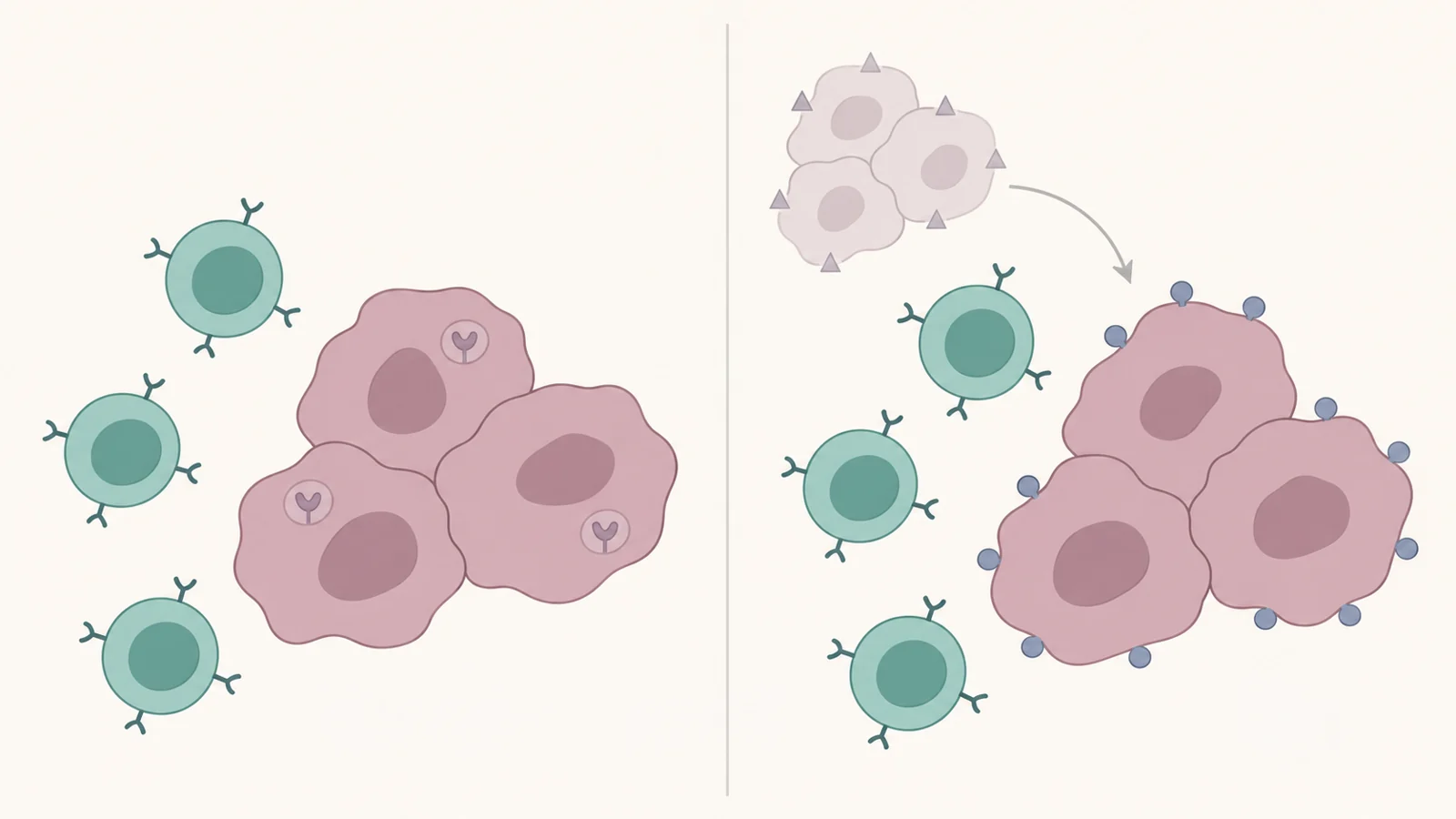
The results sit alongside a harder question: why might an immune treatment help one patient’s cancer while another tumor barely responds—or why might a tumor that first shrank later grow again? The review points to two different time courses. Some tumors resist treatment from the outset because immune cells have little to recognize or cannot reach and act on the cancer effectively. In other cases, an initial response is followed by changes that let the tumor evade immune attack.
Releasing a brake on immune cells
Some cancer treatments enlist T cells, immune cells that can recognize and attack abnormal cells. Tumors and the surrounding immune environment can restrain that activity. Checkpoint proteins are part of this restraint system: they act as brakes on immune responses. Antibodies that block a checkpoint can release some of that restraint, giving T cells more opportunity to attack when the tumor is recognizable and other conditions allow an immune response.
Two checkpoints discussed in the review are CTLA-4 and PD-1. PD-1 is found on T cells, while its partner PD-L1 can be present on tumor cells. Antibodies against PD-1 or PD-L1 interrupt that pathway and can restore T-cell activity. The review describes clinical benefits from these drugs in defined settings, including melanoma and non-small-cell lung cancer. Their ability to release a brake, however, does not guarantee that a tumor will be recognized or that the immune response will overcome its defenses.
Two routes to resistance
A tumor can be resistant before treatment has produced a meaningful response. One reason is a shortage of recognizable targets. T cells rely on signals from tumor antigens—features that help the immune system identify cancer cells. Tumors may have too few such targets, lose them, or reduce the display of the molecules that let T cells see them. The review links low immunogenicity, or a weaker capacity to prompt an immune response, with poor response to PD-1 or PD-L1 blockade in some settings.
The review also discusses tumor mutation burden as one possible clue to how many new targets a cancer might present. In the studies it describes, melanoma, kidney cancer and non-small-cell lung cancer with higher mutation burden were associated with better response to anti-PD-1 treatment, while pancreatic and prostate cancers with lower mutation burden were less responsive. This is a pattern across cancer settings, not a rule that predicts an individual patient’s outcome. A proposed resistance mechanism likewise cannot, by itself, identify why a particular person’s cancer did not respond.
Later escape is a different problem. Some patients initially respond to immune checkpoint blockade and then relapse. The review describes several possible routes: changes in the tumor features that T cells recognize, changes in how cancer cells display those features, and increased activity of other checkpoints that restrain T cells. These are mechanisms to investigate, not a validated way to identify why a particular patient’s cancer has started growing again.
A combination needs evidence of its own
Combining treatments can make biological sense when each one addresses a different barrier. The melanoma comparison offers a human clinical example: in the phase III trial cited by the review, nivolumab plus ipilimumab had a higher five-year survival figure than either drug alone. That result supports the combination in that trial setting. It does not establish that adding another drug will help in every cancer or with every regimen.
Chemotherapy can also affect the immune environment. Although it may suppress immune cells, the review describes research suggesting that some chemotherapy can increase tumor immunogenicity or support an anti-tumor immune response. It cites clinical use of pembrolizumab with chemotherapy for advanced non-small-cell lung cancer, as well as mouse studies in which oxaliplatin combined with PD-L1 blockade increased immune-cell infiltration or prolonged survival. Those animal results help explain why a combination might be studied; they do not demonstrate a survival benefit for people.
A plausible mechanism can still fail to translate into clinical benefit. The review notes that the ECHO-301 trial of the IDO1 inhibitor epacadostat with pembrolizumab failed. It discusses possible explanations, including a mismatch between the treatment strategy and the way its effects were measured, or compensation through another pathway. The account does not settle which explanation was responsible. The example shows why a rationale for combining drugs needs to be tested in the specific patients, cancer and regimen involved.
Engineered cells face a different barrier
Some immunotherapies give patients immune cells that have been selected or engineered to recognize cancer. CAR-T therapy, for example, equips T cells with a receptor intended to help them target a cancer marker. The review describes major progress with CAR-T treatments for blood cancers, particularly lymphomas, and notes that five such products had been approved by the FDA through March 2022.
Solid tumors pose a different challenge. The infused cells need to enter the tumor and remain functional in an environment that can suppress immune activity. The review describes this difficult tumor environment as a barrier for CAR-T and T-cell receptor therapies. A treatment’s success in blood cancers therefore cannot simply be carried over to solid tumors.
Tumor-infiltrating lymphocyte therapy takes another route. It uses immune cells collected from tumor tissue, expanded outside the body and returned to the patient. For one therapy in advanced melanoma, the review reports a 38% overall response rate and an 80% disease control rate; the broader disease-control measure also includes patients whose cancer remained stable, so neither number should be read as a survival rate. It also describes ongoing trials in several solid cancers. These figures concern that therapy and patient setting; they are not a direct comparison with CAR-T or checkpoint drugs. The approaches differ, and the review does not establish one as a general winner.
The cost of activating immunity
Effectiveness is only part of the clinical picture. Checkpoint drugs can cause immune-related adverse events when increased immune activity injures healthy organs. The review describes skin and endocrine problems among the more common events, with lung, kidney, liver and gastrointestinal injuries among less common but serious examples. It says most reported events were mild or moderate and that many were reversible, but severe harm can occur. These risks arise from immune activation and differ from the familiar toxicities of chemotherapy.
Other immune treatments have their own safety concerns. Therapeutic antibodies can, in some cases, trigger a cytokine storm—a dangerous release of inflammatory signals. Engineered T-cell approaches can cause serious adverse effects, and the review highlights off-target recognition as a concern: modified cells might react with healthy tissue. These are distinct risks attached to different treatments, so a promising response rate alone is not enough to characterize a therapy’s value.
Where this research could lead
If markers of tumor recognition and later escape become dependable, a clinician facing renewed tumor growth after an initial response could use a validated marker to choose a treatment shown to address that particular resistance route. Such a choice might help more patients achieve longer-lasting control. Patient selection already has a role in checkpoint therapy; the further capability would be to guide treatment after resistance emerges, using markers proven to identify a route and options shown to counter it safely and effectively.
The review’s discussion of antigen loss, alternative checkpoints, biomarkers and combinations suggests the biological pieces that such a strategy would need to connect. It does not establish that this resistance-guided approach is ready. A meaningful milestone would be a prospective trial in one defined cancer showing that marker-guided treatment improves durable response or survival over a comparator, while also reporting adverse events. That would test whether understanding how a tumor escapes can change the next treatment decision for patients.
Key Sources
- Primary source: Clinical cancer immunotherapy: Current progress and prospects.
DOI or Journal Page · Review or Meta-Analysis · 2022-10-11
Keep exploring