
Research Signal – Source date 2025-01-01
In one computer simulation, a controller brought modeled tumor cells to zero in about 50 days, compared with roughly 150 days for a previously published controller. The faster curve is striking, but the more consequential question is what the controller had to do along the way—and whether its inputs could later be reduced.
The 2025 study develops a mathematical feedback controller for a tumor–immune system. Its results come from equations and MATLAB simulations, not from patients. The work is useful as a design exercise: it asks whether a controller can steer tumor and immune variables toward chosen targets while managing the intervention signals it applies.
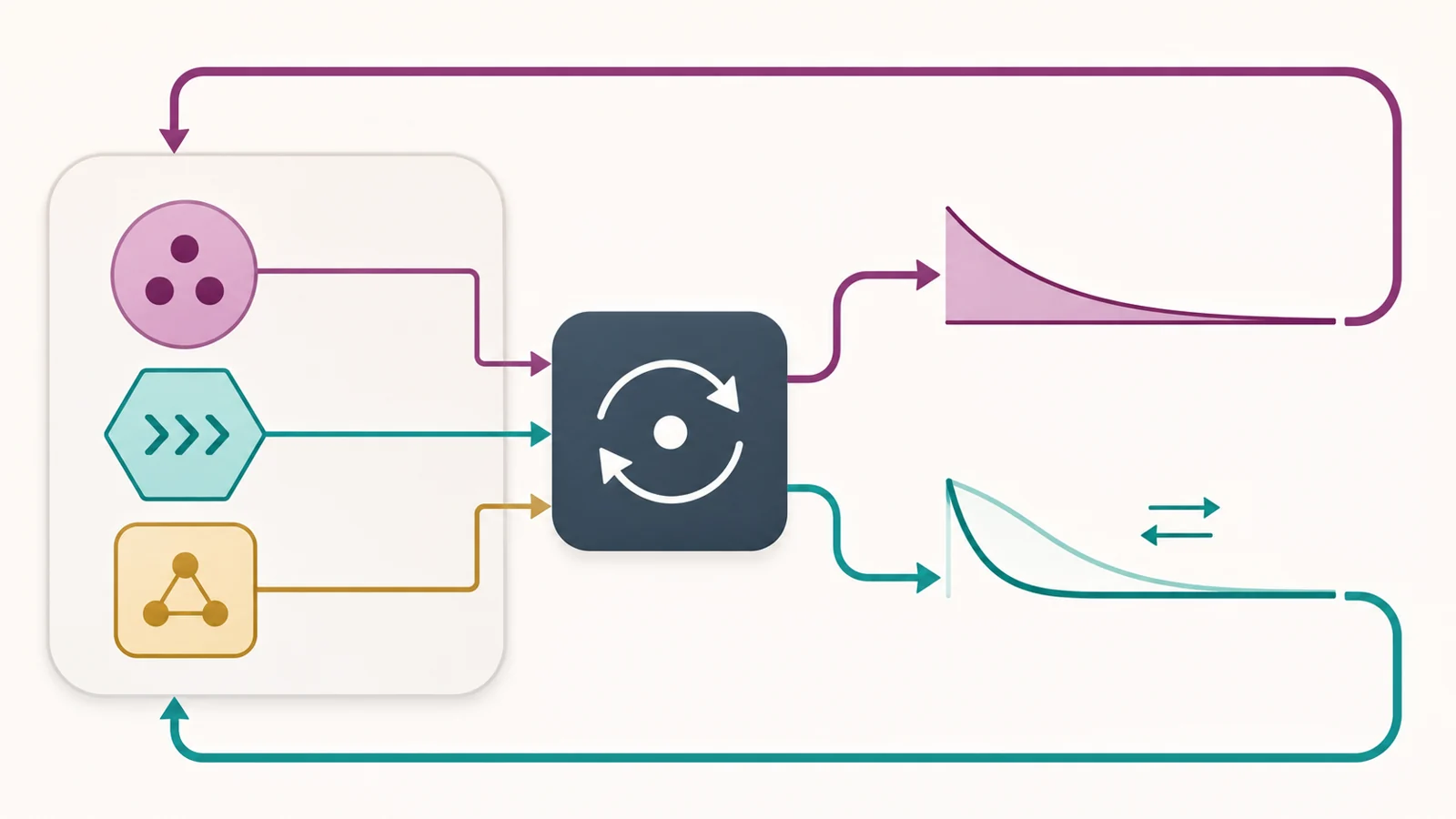
Three interacting quantities shape the model
The equations track tumor cells, activated immune effector cells, and interleukin-2, or IL-2, a signaling molecule represented as a separate state in the model. Effector cells are immune cells modeled as acting against the tumor. Their levels, the tumor-cell concentration, and IL-2 change in relation to one another over time.
The controller has two mathematical inputs. One represents an external source of effector cells; the other represents the influence of tumor-infiltrating lymphocytes. They are control terms in the equations, not a specified clinical drug regimen or dosing schedule. The model therefore lets researchers test how adjustments to these inputs affect the three modeled quantities without establishing how a real treatment would be delivered.
A controller uses the current state of a system to calculate adjustments intended to move it toward a target. Here, the design uses a method called backstepping to construct those adjustments. The aim is to reduce tumor cells while retaining high modeled effector-cell levels and bringing intervention inputs toward acceptable levels.
The initial 50-day comparison concerns one simulation against a controller reported in an earlier paper. A different comparison uses a fractional-order version of the tumor–immune equations. In that separate set of simulations, the authors report tumor cells reaching zero at about 80 days, while the compared model takes nearly four times longer. The two comparisons use different model comparisons and should not be blended into a single timing claim.
Stability describes the equations, not a treatment outcome
The authors use a mathematical result called Lyapunov stability analysis to show how the designed controller behaves under the specified equations. In the nominal, or baseline, system, they derive exponential convergence for particular modeled states: the tumor state, IL-2, and a tracking error move toward zero at a rate affected by a controller setting. In plain language, the equations predict a progressively shrinking gap from the target, with a mathematically bounded pace under the stated model.
The paper also applies a fractional-order model. Fractional derivatives can represent memory effects in a system’s mathematical dynamics, so the model’s rate of change depends on more than its immediate state. For this version, the authors establish asymptotic convergence: the modeled states approach their targets over time, without the same exponential-rate claim made for the nominal system.
These are claims about the behavior of the chosen equations and controller. They do not show that a biological tumor or immune system follows those equations closely enough for the predicted timing to occur in a person. Even the paper’s comparisons with other controllers are comparisons between modeled systems, not evidence that this approach outperforms cancer care.
Lowering one input can change the pace
The input trajectories add a second dimension to the simulated result. In the model, the input representing tumor-infiltrating lymphocytes tends toward zero as the tumor, IL-2, and tracking error approach their targets. This does not mean every intervention stops: the other input, representing an external source of effector cells, can remain at a steady level.
The authors describe a tradeoff for that effector-cell input. Adjusting a design parameter can reduce its steady-state magnitude, but the same adjustment can slow the tumor’s convergence. Their simulations also show smoother transient behavior for this input than in one comparator, which had more oscillation. The point is not simply to make every input small. The model makes the speed of reaching a target and the sustained level of one input competing design goals.
A soft actor-critic algorithm, a form of reinforcement learning, is used to tune three controller gain coefficients. These gains determine how the designed control law responds. The algorithm optimizes the controller within the modeled system; the study does not show it selecting treatments for individual patients or learning from clinical outcomes.
Uncertainty raises the modeled input demand
To examine sensitivity to imperfect parameter values, the authors simulate uncertainty ranging from 10% to 100% in system parameters. Their analysis describes the controller as robust across these tested uncertainty levels, while also showing a cost: larger parameter uncertainty requires a higher injection rate in the model. Thus, a controller that continues to guide the system despite uncertain parameters may need to apply a stronger input to do so.
The feedback calculation also depends on repeated observations of the state variables. The paper examines discrete measurements in simulation, but that mathematical test does not provide a clinical workflow for measuring tumor cells, effector cells, and IL-2 at the needed times or with the accuracy the controller would require. The measurement problem is part of the control problem, not a detail that the equations automatically solve.
How this could shape the future
A future oncology visit might include a validated decision aid that uses serial tumor and immune measurements to suggest adjustments to an existing treatment plan as a person’s response changes. Clinicians already monitor patients and adjust treatment; the possible addition would be a tested quantitative feedback rule that weighs tumor, immune, and intervention-input trajectories together.
This paper offers an early model-level version of that rule. For such guidance to become dependable, the biological model would need to match real responses, measurements would need to be practical and informative, and the approach would need clinical validation. A nearer milestone would be independent longitudinal biological data showing whether predicted trajectories and the inputs the controller requires match measured responses under realistic sampling and uncertainty. Until that bridge is built, the 50-day result remains a simulation finding rather than a forecast for treatment.
Key Sources
- Primary source: Designing a Resilient Controller for Cancer Immunotherapy: Application to a Fractional-Order Tumour-Immune Model.
DOI or Journal Page · Peer-Reviewed Paper · 2025-01-01
Keep exploring