
Research Signal – Source date 2022-01-04
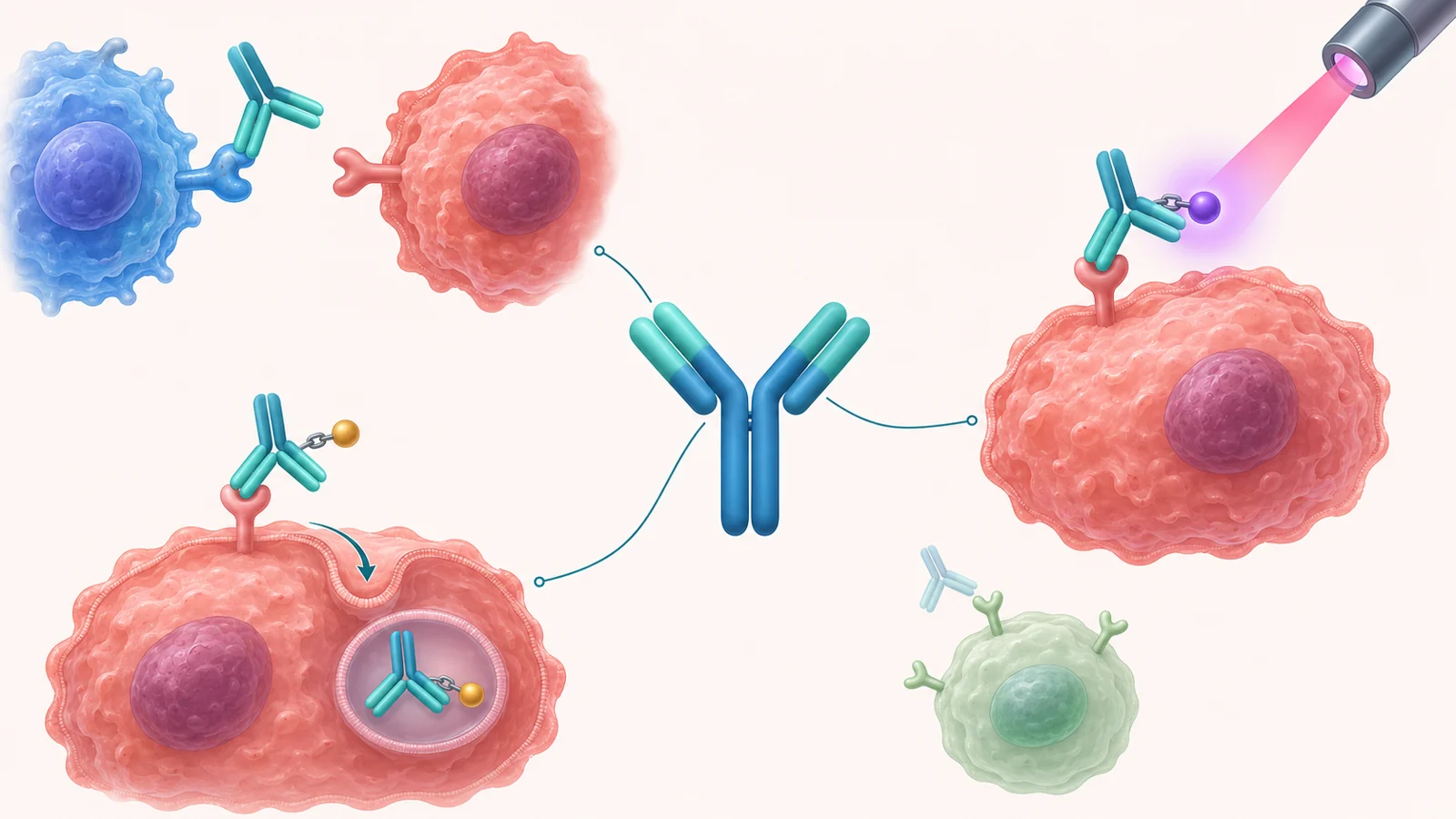
A cancer antibody can do very different jobs after it recognizes a target. It might block a signal that restrains immune cells, carry a drug into a tumor cell, or bring a light-sensitive attachment to a site where illumination activates it. The shared first step—binding—does not determine the treatment by itself. What matters is what the antibody is designed to change or deliver.
A 2022 review in the International Journal of Oncology follows that idea through the preparation of monoclonal antibodies and their cancer applications. A monoclonal antibody is a lab-made, highly uniform antibody designed to recognize a particular target. The review draws on 242 articles published mainly from 2005 to 2021, bringing together production methods, mechanisms, and clinical examples. It is a synthesis of different approaches and settings, rather than a new trial comparing them.
One target, different jobs
Antibodies recognize particular features, or epitopes, on a target. That specificity can make them useful in treatment, but recognition is only the start of the chain. An antibody can interfere with a biological interaction, engage immune activity, or serve as a carrier for another therapeutic component. Each role calls for a different design and depends on what is present in and around a tumor.
The review describes monoclonal antibodies as having high specificity and low cross-reactivity, among other practical advantages. They have been used in several forms of cancer treatment, including immune checkpoint therapy, targeted treatment, radioimmunotherapy, and near-infrared photoimmunotherapy. These categories illustrate why “antibody treatment” is not one mechanism. In some cases, the antibody is the active blocker; in others, it guides an attached agent toward cells bearing the chosen target.
Making an antibody more compatible with people
Early hybridoma methods made it possible to produce consistent mouse antibodies in large quantities. A hybridoma is a cell made by joining an antibody-producing immune cell with a myeloma cell, enabling the resulting cell line to keep producing the antibody. This offered a more uniform product than collections of antibodies that can vary from batch to batch.
But a mouse-derived antibody is foreign to a human immune system. The body can make human anti-mouse antibodies that clear the treatment, reducing its effectiveness and potentially provoking harmful immune responses. That problem drove successive efforts to make therapeutic antibodies more compatible with humans.
Chimeric antibodies combine a mouse antibody’s variable region, which recognizes the target, with human constant regions. This reduces some foreign material while preserving the original target recognition, though the review notes that mouse-derived parts can still provoke an immune response. Humanized and fully human antibodies represent further steps toward human-compatible designs. The review describes fully human antibodies as having human variable and constant regions, and discusses several routes for producing them, including engineered animals.
Human-compatible design addresses one obstacle: the patient’s immune response against the therapeutic antibody. It does not, by itself, show that the target is present on a particular person’s cancer, that the treatment will reach it, or that the treatment will improve outcomes. Those questions depend on the target, the tumor, and the antibody’s job.
Different ways to find an antibody
Preparation methods differ in what they preserve or select. Hybridoma technology maintains cells that produce an antibody, creating a renewable source of a particular antibody once a productive cell line is established. Its historic importance lies in making uniform monoclonal antibodies practical to produce at scale.
Display methods take another route. In phage display, antibody-related protein fragments are shown on the surface of phage particles alongside the genetic information that encodes them. Researchers can expose a library of candidates to a target and select those that bind. Ribosome display also links a protein candidate to its genetic information, but does so in a laboratory-made protein-display system: the protein, ribosome, and its messenger RNA are held together during selection. Both approaches connect a candidate’s binding behavior to the sequence that can be recovered and studied.
Single B-cell methods begin with an individual antibody-producing B cell. The review highlights that this can preserve the natural pairing of the antibody’s heavy and light chains and can yield fully human antibodies from a small number of cells. Memory B cells can also retain records of immune responses over time, offering a route to recover antibodies associated with past exposures.
The review compares these and other preparation approaches, including transgenic mouse technology. They are different ways to obtain or select antibody candidates, not treatments whose patient outcomes were tested head to head in this review. A method’s value depends on the antibody it yields and the purpose for which that antibody is being developed.
Blocking an immune brake
The PD-1 pathway shows how an antibody can act by changing a signal rather than carrying a drug. PD-1 is a receptor found on activated immune cells, including T cells. When it binds its partner PD-L1, the interaction can dampen T-cell activation. This regulation helps limit immune attacks on the body’s own tissues, but some tumors can use the pathway to suppress immune activity against them.
An anti-PD-1 antibody is designed to interfere with that inhibitory interaction, helping immune cells resume an attack on cancer. The review discusses the clinical use of drugs such as nivolumab and pembrolizumab in several cancer settings. It also describes a key limit: responses to PD-1 blockade are not strong across many unselected solid tumors. A tumor’s reliance on the pathway and other features of its environment matter.
Releasing an immune brake can also disturb immune control elsewhere. The review describes immune-related adverse effects associated with checkpoint treatment, including fatigue, skin rash, colitis, pneumonitis, and other inflammatory complications. It discusses combinations of checkpoint antibodies with other treatments, including evidence from cited studies in advanced melanoma. Those study findings belong to their specific treatment and patient settings; the review is not itself a new clinical trial and does not establish a universal benefit from combining drugs.
Carrying a drug into a tumor cell
An antibody–drug conjugate, or ADC, joins an antibody to a therapeutic payload through a linker. Here the antibody’s binding is a delivery step: it recognizes a surface target, and the linked drug can act after the conjugate enters the target cell and releases its payload.
The route through the cell matters. The review describes ADCs entering tumor cells through internalization, followed by linker cleavage or antibody breakdown that releases the payload. Some payloads can also move into neighboring tumor cells after release, a possible bystander effect. The antibody and payload therefore have complementary jobs: the antibody guides the conjugate toward cells with the selected target, while the attached agent supplies much of the cell-killing action.
That division of labor creates design constraints. The target should be available on tumor cells and limited on normal cells; otherwise, the payload may reach healthy tissue and cause targeted toxicity. The antibody also needs to bind effectively and support internalization so the payload can be released where intended. A target on the cell surface is not enough on its own: whether the conjugate enters the cell and how it releases its cargo affect where the drug acts. The review notes that large antibody molecules can have difficulty penetrating solid tumors, another practical challenge for delivery.
Binding first, light second
Near-infrared photoimmunotherapy uses an antibody attached to a light-sensitive molecule. The antibody recognizes a chosen tumor-associated target, while near-infrared illumination activates the attached molecule. In the approach described by the review, the activated conjugate can damage the membrane of cells to which it has bound.
The two steps have separate roles: binding helps position the light-sensitive attachment, and illumination activates it. The review presents this as a way to address the limited selectivity of conventional photodynamic approaches, in which photosensitizers can accumulate in normal as well as diseased tissue. It traces photoimmunotherapy’s development and discusses a near-infrared approach using an antibody directed at EGFR. It also describes other possible targets explored in the field.
Changing the antibody could change which cells a light-sensitive conjugate recognizes, but that change alone does not establish an effective treatment for another cancer. The target must be suitable, the conjugate must reach it, and illumination must activate the treatment where intended. The examples in the review describe a developing approach, not evidence that light-activated antibodies work for every tumor.
What this review can tell us
The review brings preparation technologies together with examples of how antibodies can block signals, guide payloads, or carry light-sensitive attachments. That breadth helps explain why a shared antibody structure can support several therapeutic roles. It also means its examples come from different designs and settings, rather than a single experiment that compares all the methods or applications on equal terms.
Its clinical examples show that antibody-based treatments have been used in specific cancers, alongside limits such as immune-related adverse effects, variable response, and risks when a target is not selective. They cannot establish that one way of preparing antibodies is best for patients overall, or that a target useful in one cancer will work in another. The review is most useful as a dated guide to the design logic and tradeoffs behind these approaches.
What this could make possible
If researchers can identify targets that distinguish tumor cells from healthy tissue and pair them with antibodies suited to the intended job, treatment could become more selective in how it engages immunity or delivers a payload. That could give clinicians more ways to direct a therapy toward cancers whose biology matches the target, while reducing exposure of unrelated cells. Reaching that future depends on a chain of evidence: a suitable target, an antibody that binds and behaves as intended, and results in the relevant patients that confirm the proposed benefit and risks. The review shows the range of design routes behind that possibility; it does not show that the bottlenecks have been solved for cancer as a whole.
Key Sources
- Primary source: Retrospective analysis of the preparation and application of immunotherapy in cancer treatment (Review).
DOI or Journal Page · Review or Meta-Analysis · 2022-01-04
Keep exploring