
Research Signal – Source date 2022-08-09
An engineered immune cell can find and kill breast cancer cells in an experimental model and still fall far short of being a safe, effective treatment for a patient. The reason is that recognition is only the opening move. The cell must also reach the tumor, remain active in its surroundings, avoid healthy tissue, and produce a meaningful effect without causing unacceptable harm.
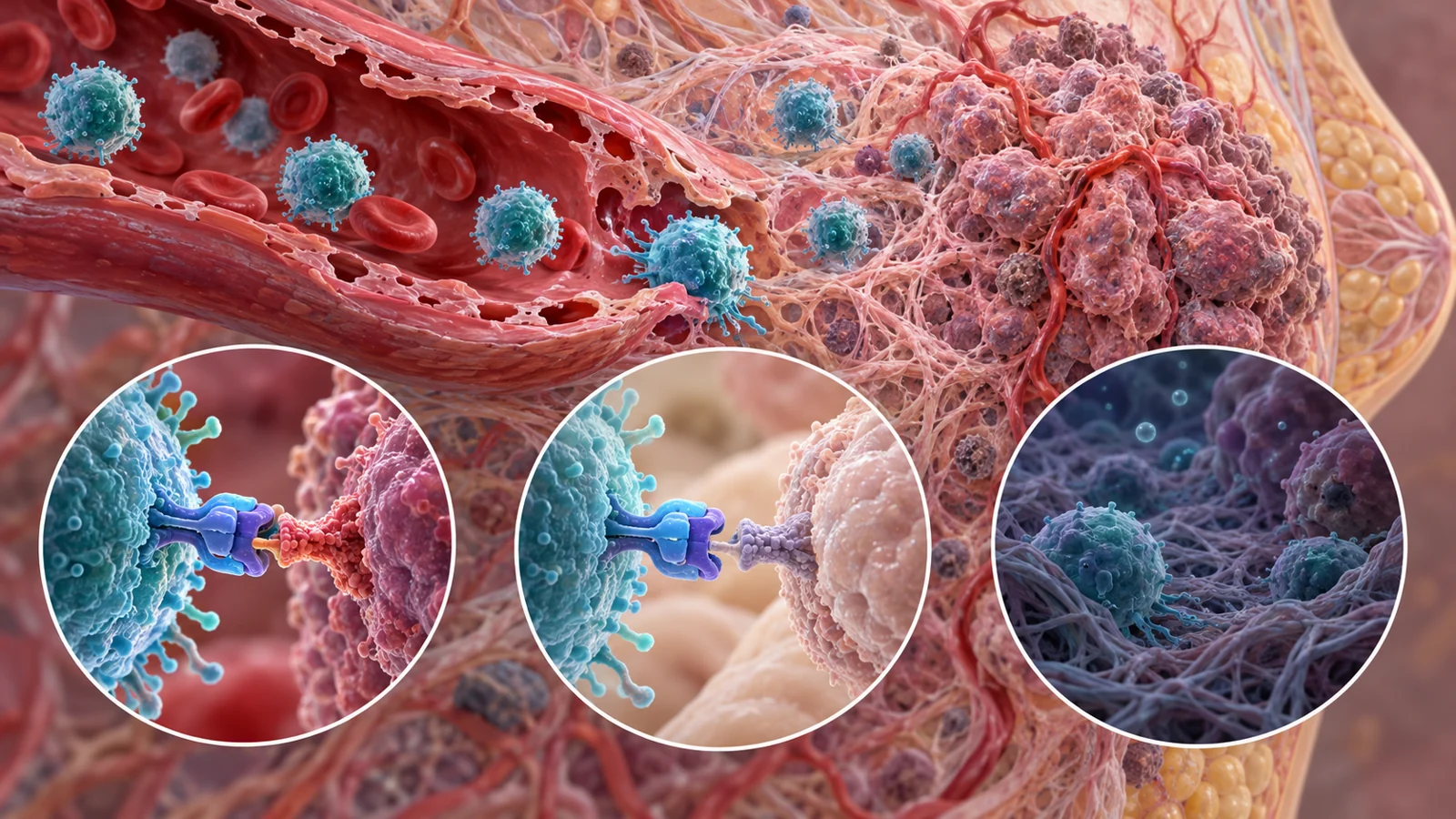
A review published August 9, 2022, examines how chimeric antigen receptor T cells, or CAR-T cells, were being adapted for breast cancer. These are T cells genetically equipped with a receptor that recognizes a selected marker on a cell surface. The review describes advances in receptor design, tumor-targeting experiments, and strategies for changing the tumor environment. It also shows why success in one part of that chain does not automatically solve the others.
A target is the beginning, not the whole treatment
CAR-T cells are built to recognize surface antigens without relying on the usual major histocompatibility complex pathway. Early designs used an antibody-derived binding fragment connected to cell-signaling machinery. Later generations added one or more costimulatory domains, and further designs incorporated features such as cytokine transgenes intended to strengthen activity. The engineering can make a T cell more responsive, but it cannot make every selected marker exclusive to cancer.
Many candidate antigens are present at lower levels in normal tissues. A receptor that attacks a tumor marker may therefore also recognize healthy cells carrying that marker. Target selection is a safety problem as well as a targeting problem. It also has a physical limit: CAR-T cells are designed to recognize accessible surface structures, not intracellular tumor proteins presented through a different route.
One proposed answer is conditional activation. The review describes synNotch-based designs in which recognition of a first marker, such as EpCAM or B7-H3, activates a CAR directed at ROR1. In the cited experimental setting, this logic-gated arrangement helped engineered cells distinguish primary breast tumors from nearby normal cells. The same example also shows why such selectivity cannot be treated as a universal property of the design. The cells did not discriminate secondary, metastasized tumors from adjacent non-cancer cells as effectively, and toxicity followed in those models.
The lesson is not that conditional receptors are ineffective. It is that a safety gate depends on where the tumor is, which markers coexist there, and whether the surrounding healthy tissue presents a confusingly similar pattern. A receptor can be precise in one spatial context and less precise in another.
The engineered cell still has to enter hostile tissue
After identifying a target, a CAR-T cell must travel from the bloodstream into the tumor. Solid tumors often contain abnormal, poorly organized blood vessels that hinder immune-cell entry. An engineered cell may therefore possess a useful receptor and still arrive in insufficient numbers at the place where it is needed. Strategies discussed in the review include combining CAR-T cells with approaches aimed at restoring more regular tumor vessels and improving infiltration.
Entry is only the physical part of the journey. The tumor microenvironment can also suppress the cell after it arrives. Breast tumors may contain low-oxygen regions in which T cells have difficulty sustaining the metabolic changes needed for activation. Hypoxia can also favor regulatory T cells, suppressive myeloid cells, and M2-like macrophages while increasing inhibitory signals.
Adenosine provides a more specific example of how the surroundings can interfere with an otherwise capable T cell. Under hypoxic conditions, tumor-resident cells can use CD39 and CD73 to convert extracellular ATP into adenosine. When adenosine binds the A2A receptor on T cells, the resulting signaling can interrupt proliferation, tumor killing, and the release of cytokines such as IL-2, TNF, and IFN-gamma. In this setting, the problem is not simply whether the engineered receptor can recognize its marker. The tissue can actively make the recognized target harder to act upon.
Early tumor control can leave cells behind
Experimental activity also has to be interpreted over time. The review discusses MUC1, a transmembrane glycoprotein that is present at much higher levels on many epithelial tumors than on normal epithelial cells and can expose tumor-associated features through different glycosylation patterns. Anti-MUC1 CAR-T cells produced strong killing of triple-negative breast cancer cells in experimental work, with increased release of immune-effector molecules and reduced tumor growth in an orthotopic model.
Those findings show useful activity, but they do not describe complete or durable elimination. MUC1-expressing tumor cells remained during longer follow-up, leading the authors to discuss the need for further CAR-T cell infusions. The remaining cells cannot simply be described as antigen-loss escape, because the evidence specifically identifies residual cells that still express MUC1. Initial killing and tumor-growth suppression are therefore different outcomes from sustained control of every tumor cell.
The way the receptor is delivered to T cells creates another tradeoff. The review describes minicircle DNA and other non-integrating approaches that may reduce concerns associated with insertion into the cell’s genome and avoid some bacterial backbone sequences. Their limitation is shorter maintenance of the CAR transgene and, consequently, a greater need for repeated infusions. A delivery method can improve one safety characteristic while making persistence more difficult.
Safety depends on what else the receptor can recognize
CAR-T toxicity has more than one pathway. A large immune response against tumor cells can release inflammatory signals from both the infused cells and the patient’s immune system. Cytokine release syndrome may involve fever, rapid heart rate, changes in blood pressure or oxygenation, and organ dysfunction. Extensive tumor destruction can also produce metabolic disturbances associated with tumor lysis syndrome.
A separate danger arises when the target marker is shared with healthy tissue. The review cites a fatal case involving ERBB2-targeting CAR-T cells in a patient with metastatic colon cancer, where severe respiratory distress developed rapidly after infusion. That case illustrates the seriousness of off-tumor recognition, but it is not a breast cancer response rate or an estimate of how often severe harm would occur in breast cancer patients. The disease context must remain attached to the example.
The evidence described in this review does not establish durable clinical benefit, improved survival, or an acceptable benefit–risk balance for CAR-T treatment of breast cancer patients. Nor do the experimental examples show that accurate targeting, tumor access, persistence, immune-environment control, and safety have been solved together in one breast cancer treatment. Those are the clinical questions that further preclinical and clinical assessment would need to answer.
What more selective cell therapy could mean for breast cancer
More selective CAR-T therapy could eventually give breast cancer patients engineered immune cells that do several difficult jobs at once: reach the tumor through abnormal tissue, keep functioning in low-oxygen and immunosuppressive surroundings, sustain an attack against residual disease, and limit recognition of healthy cells. That combination could turn a receptor that works in an experimental setting into a treatment option with a more credible path to patient benefit.
The possibility remains conditional. Each capability would need to work in the relevant tumor locations, persist long enough to matter, and demonstrate meaningful benefit with acceptable safety in patients. From the August 2022 perspective of this review, the important advance was the growing ability to engineer those features deliberately. The unresolved question was whether they could operate together in the complex biology of breast cancer without exchanging one failure mode for another.
Key Sources
- Primary source: Immunotherapy and immunoengineering for breast cancer; a comprehensive insight into CAR-T cell therapy advancements, challenges and prospects.
DOI or Journal Page · Review or Meta-Analysis · 2022-08-09
Keep exploring