
Research Signal – Source date 2022-05-16
A ClinicalTrials.gov description titled “The Effect of Transcranial Direct Current Stimulation Upon Sleep Spindles in Healthy Older Adults” asks a focused research question: can a non-invasive form of brain stimulation change a particular pattern of brain activity during overnight sleep? The intervention is transcranial direct current stimulation, or tDCS. The description presents the expected test, not a reported finding. It does not show that stimulation changed sleep spindles or improved memory.
A pattern researchers can measure during sleep
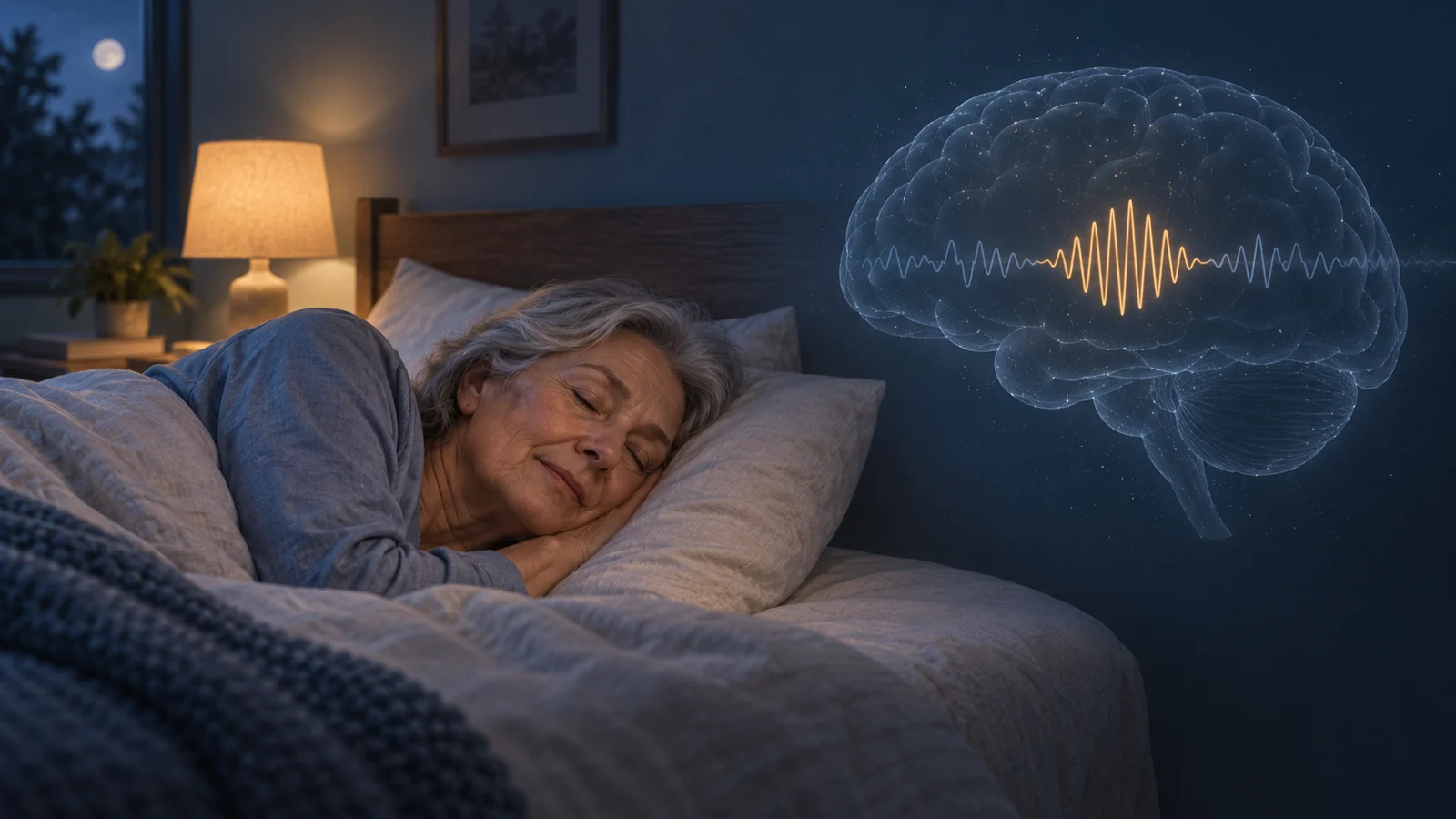
Sleep spindles are specific patterns of brain activity that occur during sleep. They are not the same thing as sleeping for more hours, feeling more rested, or reporting better sleep. The study description treats spindle activity as a physiological target that must be assessed through overnight measurement of brain activity.
That requirement shapes what the study could answer. A morning impression of sleep quality would not by itself reveal whether the targeted pattern changed. The relevant comparison is between active stimulation, which the description expects to affect the brain, and a placebo stimulation, with spindle activity measured during sleep.
Why this pattern became a research target
The registry description motivates the experiment through reported relationships between sleep spindles and attention and memory. It also points to reported links between reduced spindle activity, cognitive decline, and later dementia development. Those relationships give researchers a reason to test whether spindle activity can be influenced. They do not, on their own, show that changing the pattern will improve cognition.
The proposed study is therefore examining an early step in a longer chain. First comes the physiological question: can stimulation alter sleep spindle activity in healthy older adults? A separate question would be whether any measurable change affects attention, memory, or everyday functioning. Dementia prevention would be further downstream still, requiring evidence that any benefit is meaningful, durable, and relevant to disease risk.
Why testing at home matters
The description emphasizes a home environment rather than limiting the question to a sleep laboratory. It presents home testing as a way to reduce the need for older adults to travel to a laboratory and potentially make participation more inclusive. That practical aim matters if sleep-based interventions are ever to be studied with people who cannot easily attend repeated laboratory sessions.
It also raises a basic scientific requirement: a home-based approach would need to produce a reliable, interpretable measure of the sleep activity being targeted. The registry description supplies the rationale for investigating that possibility, but not evidence that the approach worked in practice.
A changed brain signal is only the beginning
Even a future result showing higher spindle activity after active stimulation would answer only the first part of the memory question. A useful clinical interpretation would require stimulation effects that are safe and reproducible, followed by demonstrated benefits in attention or memory. The supplied research description does not establish safety, durability, actual enrollment, study completion, or any cognitive outcome.
The most careful reading is therefore neither dismissal nor promise. Sleep spindles are a concrete physiological target, and tDCS offers a way to test whether that target can be influenced during overnight sleep. Whether the change has consequences that older adults would notice remains a separate question.
What this could change
A reliable way to influence sleep spindle activity at home could eventually support more accessible sleep-focused research and, if later studies demonstrate real cognitive benefit, help preserve attention or memory in older adults. That possibility depends on a chain of evidence: the stimulation must produce a safe, repeatable brain change, and that change must translate into meaningful function. Only much further evidence could show whether such a pathway has any role in slowing cognitive decline or dementia.
Key Sources
- Primary source: The Effect of Transcranial Direct Current Stimulation Upon Sleep Spindles in Healthy Older Adults
Government or Regulator · Clinical Trial · 2022-05-16
Keep exploring