
Research Signal – Source date 2021-04-27
Avoiding ingredients associated with bisphenol A (BPA) answers only part of the question about an orthodontic adhesive. A resin must also cure into a material with useful mechanical properties, and researchers need to consider what else might leave it. A 2021 review brings together experimental adhesive comparisons, separate composite extraction results, and ideas for materials that could respond to their surroundings.
These findings come from different kinds of work. The adhesive comparisons measured material properties in the lab; an oral-simulator experiment tested a coating; and several proposed functions remain design concepts. They do not amount to a single test of treatment in patients.
Two possible routes for BPA release
BPA is a chemical associated with some orthodontic plastics and resin ingredients. The review describes possible release from polycarbonate brackets as the plastic degrades. For resin materials, BPA may be associated with ingredients left after incomplete curing or with impurities remaining after resin synthesis. These are different materials and possible routes, so changing a resin ingredient would not address every source discussed in the review.
Curing, also called polymerization, joins small resin molecules into a solid material. How completely that process occurs matters when assessing a resin, alongside its composition and performance. This is one reason the search for alternatives has focused on more than whether a formulation avoids a BPA precursor.
The adhesive comparison measured both curing and stiffness
One study summarized in the review compared two experimental adhesives made for bonding fixed lingual retainers with a commercial adhesive containing bisphenol A-glycidyl methacrylate (bis-GMA). The formulas used different resin ingredients: one contained an aromatic ring, a ring-shaped molecular structure; the other did not.
The aromatic-free experimental adhesive had the highest degree of conversion among the three materials. This measure describes how much of the resin’s reactive material formed bonds during curing. The bis-GMA control had the lowest conversion in the comparison. The review relates this difference to the control’s molecular structure, which can restrict how readily its reactive groups move and join during curing.
The control, however, had the highest Martens hardness and modulus of elasticity. Hardness describes resistance to surface indentation; the modulus describes stiffness—how much a material resists bending under load. The two experimental adhesives ranked below the control on both measures. The review points to differences in filler amount and type among the formulas as relevant to interpreting those results.
So the conversion result alone cannot show whether either experimental adhesive would keep a fixed retainer attached during treatment. It is one material property alongside hardness and stiffness. These lab comparisons also do not establish patient exposure or improved clinical outcomes.
A separate composite test found another leachate
The review also describes urethane-modified composites, a different set of materials from the experimental retainer adhesives. Researchers modified bis-GMA and glycerol dimethacrylate monomers and compared the resulting composites with conventional bis-GMA composites. In the cited comparisons, the modified materials had lower water absorption and solubility; several mechanical measures and polymerization shrinkage and stress were comparable or improved. Their degree of conversion was lower on average than that of the conventional bis-GMA composites.
Extraction tests on these modified composites detected triethylene glycol dimethacrylate (TEGDMA) among the leachates—substances that came out of the material in the test. The review notes a potential biocompatibility concern: in a cited cell test, TEGDMA reduced the viability of human monocytes, a type of immune cell, by about half at the tested concentration of 4 mM. This result concerns a cell test and a separate composite comparison; it is not a measurement of patient exposure. It does show why removing BPA precursors does not settle what else a resin might release.
Placement can matter alongside the formula
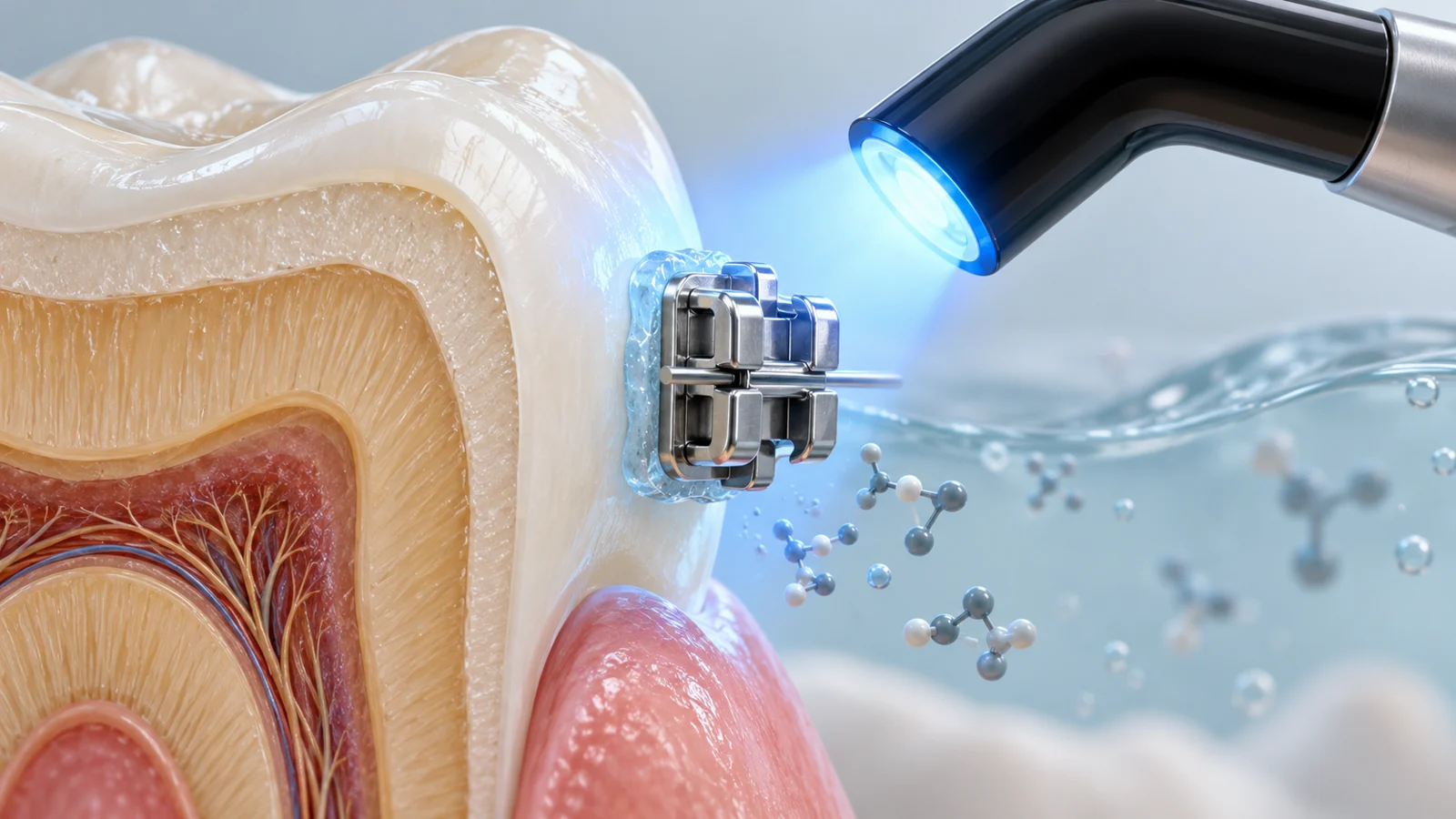
The review describes clinical steps recommended to limit potential BPA release during bracket bonding. These include holding the curing light close to the composite, curing indirectly around the bracket edges rather than through the bracket, polishing the bonded composite with a pumice stone, and having patients rinse with water or mouth rinse during the first hour after placement.
Those steps concern how a material is cured and finished, not a new adhesive formula. They add another part to the practical question: both the resin and its handling during placement may affect potential release.
Other designs address different material problems
The review also surveys “smart” materials, including shape-memory polymers that change from a temporary shape toward a fixed one when exposed to a stimulus such as heat or light. A proposed orthodontic wire could use that response to change its mechanical behavior. A separate self-healing composite uses liquid stored in tiny capsules; a crack releases the liquid, which reacts with powder in the material to form a substance intended to fill the fissure. One concept responds to a stimulus, the other to damage.
Surface behavior raises another distinct challenge. In an in-vitro oral simulator, a coating containing fluoroalkylated acrylic acid oligomer retained less Streptococcus mutans biofilm as the tested additive concentration increased. Hydrophilicity means how readily a surface interacts with water; the review describes increased surface hydrophilicity alongside the coating result. This experiment measured biofilm retained on a coated surface, not plaque in patients.
A surface that resists biofilm and an adhesive that bonds in a wet mouth need different evidence. The review discusses biomimetic adhesives inspired by gecko and mussel attachment: gecko-like structures create many contact points but are suited to dry conditions, while mussel-inspired chemistry is considered for wet adhesion. A combined approach is proposed as a possible design direction for bracket bonding, not a demonstrated clinical benefit.
What better orthodontic adhesives could change
An adhesive that combines suitable curing and mechanical performance with a well-understood release profile could give clinicians another option for securing orthodontic appliances while managing material concerns. That could matter to patients if a candidate also proves biocompatible and durable under the conditions of treatment. The 2021 review describes experimental comparisons and promising design ideas; the practical benefit depends on whether those properties hold up in clinical use.
Key Sources
- Primary source: A Review on Current Trends of Polymers in Orthodontics: BPA-Free and Smart Materials.
DOI or Journal Page · Review or Meta-Analysis · 2021-04-27
Keep exploring