
Research Signal – Source date 2025-09-18
A material that heats a tumor under near-infrared light has one clear job: help damage tumor tissue where the light reaches it. In a study published September 18, 2025, researchers paired such a light-responsive material with tiny parcels released by immune cells. The parcels were presented as active participants in changing the tumor’s immune surroundings, as well as carriers for the material.
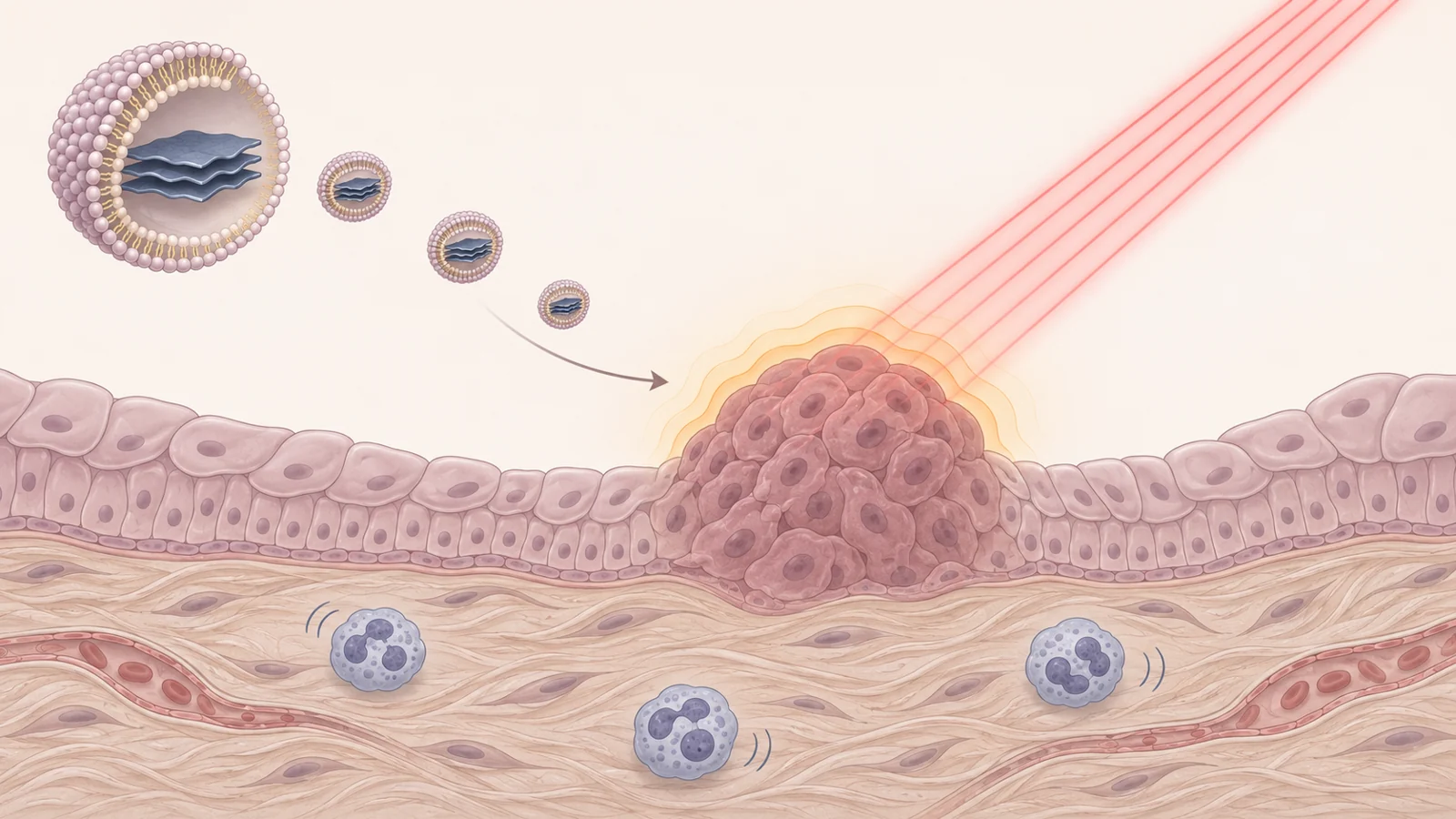
The team combined molybdenum disulfide, written MoS₂, with extracellular vesicles derived from M1 macrophages, a type of immune cell. The resulting hybrid, called M1 EVs@MoS₂, was studied as a way to bring photothermal treatment and immune modulation together in bladder cancer. The paper’s PubMed abstract reports bladder-tumor growth suppression and several immune changes. It does not provide enough detail to establish how much each part contributed or how the findings might translate to people.
A light-responsive material with an immune-cell partner
Molybdenum disulfide is the component described as responding to near-infrared, or NIR, light. Under illumination, the researchers report, it converts light into heat and increases the generation of reactive oxygen species, chemically reactive molecules that can contribute to cell stress. Those effects are intended to damage tumor tissue locally.
The vesicles add a different proposed role. These small packages released by cells can carry material, and the authors say the M1-derived vesicles helped deliver the hybrid toward tumor tissue. The authors also propose that the vesicles help shift macrophages toward an M1 state, a change they link to antitumor immune activity.
That makes the design more than a light-triggered heater in concept. It combines local physical and oxidative effects with a proposed immune contribution. The abstract reports that the hybrid suppressed bladder-tumor growth and changed cytokines, proteins that help immune cells communicate. The supplied evidence does not show how much heating, oxidative stress, vesicle activity, or delivery contributed to the result.
The reported immune changes are not all the same kind of evidence
The researchers used immunofluorescence, a staining method that helps locate cells and proteins in tissue. They reported more CD8-positive T cells inside tumors, signs of dendritic-cell activation, and lower PD-L1 expression. CD8-positive T cells can attack abnormal cells, dendritic cells help coordinate immune responses, and PD-L1 is a protein that can restrain T-cell activity.
Together, the findings are consistent with the researchers’ account of immune reprogramming alongside tumor growth suppression. They are not, by themselves, proof that the immune changes caused the suppression, that the response would persist, or that it would protect against recurrence. Nor do the supplied results establish benefit from combining this material with immune checkpoint inhibitors, which the authors identify as a possible direction for future study.
The abstract does not specify the experimental model, sample sizes, comparison design, numerical effect sizes, or durability in enough detail to characterize them here. Those details matter for judging the strength of the combined response and separating the effects of the material’s components. The reported findings are a research result, not evidence of a treatment benefit or safety profile for people with bladder cancer.
Delivery matters as much as the light response
A light-triggered effect is useful only if the material reaches the intended site and its activity can be directed there. The authors say the vesicles’ cell-like properties helped deliver the material to tumors and limit effects elsewhere. This is a distinct part of the proposal: local illumination may activate the material, while delivery is meant to make the material more available at tumor tissue in the first place.
The abstract does not provide enough detail to quantify how selective that delivery was or to assess off-target effects independently. A future assessment would need to examine tumor response, immune changes, and effects beyond the tumor together. Without that fuller picture, the reported delivery is promising as a design feature, but its practical precision and safety remain unresolved.
Where this research could lead
If the approach holds up, a future treatment might direct a light-responsive material toward a bladder tumor and use illumination to trigger local activity while also producing a dependable antitumor immune response. That could give clinicians a way to pair a localized intervention with broader immune engagement. The current study’s contribution is the reported pairing of photothermal activity with immune changes; controlled delivery, safe illumination, and demonstrated human benefit would all require further advances.
A nearer milestone is a well-characterized study in a living organism that measures tumor response, immune changes, and effects outside the tumor in the same design. Such evidence could clarify whether the combined material has advantages over its separate components and whether its delivery and immune effects can be controlled. Until those questions are answered, the prospect remains a research direction rather than a patient treatment.
Key Sources
- Primary source: Synergistic nanoplatform of M1 macrophage-derived extracellular vesicles and MoS 2 for tumor-targeted photoimmunotherapy in bladder cancer.
DOI or Journal Page · Peer-Reviewed Paper · 2025-09-18
Keep exploring