
Research Signal – Source date 2022-08-25
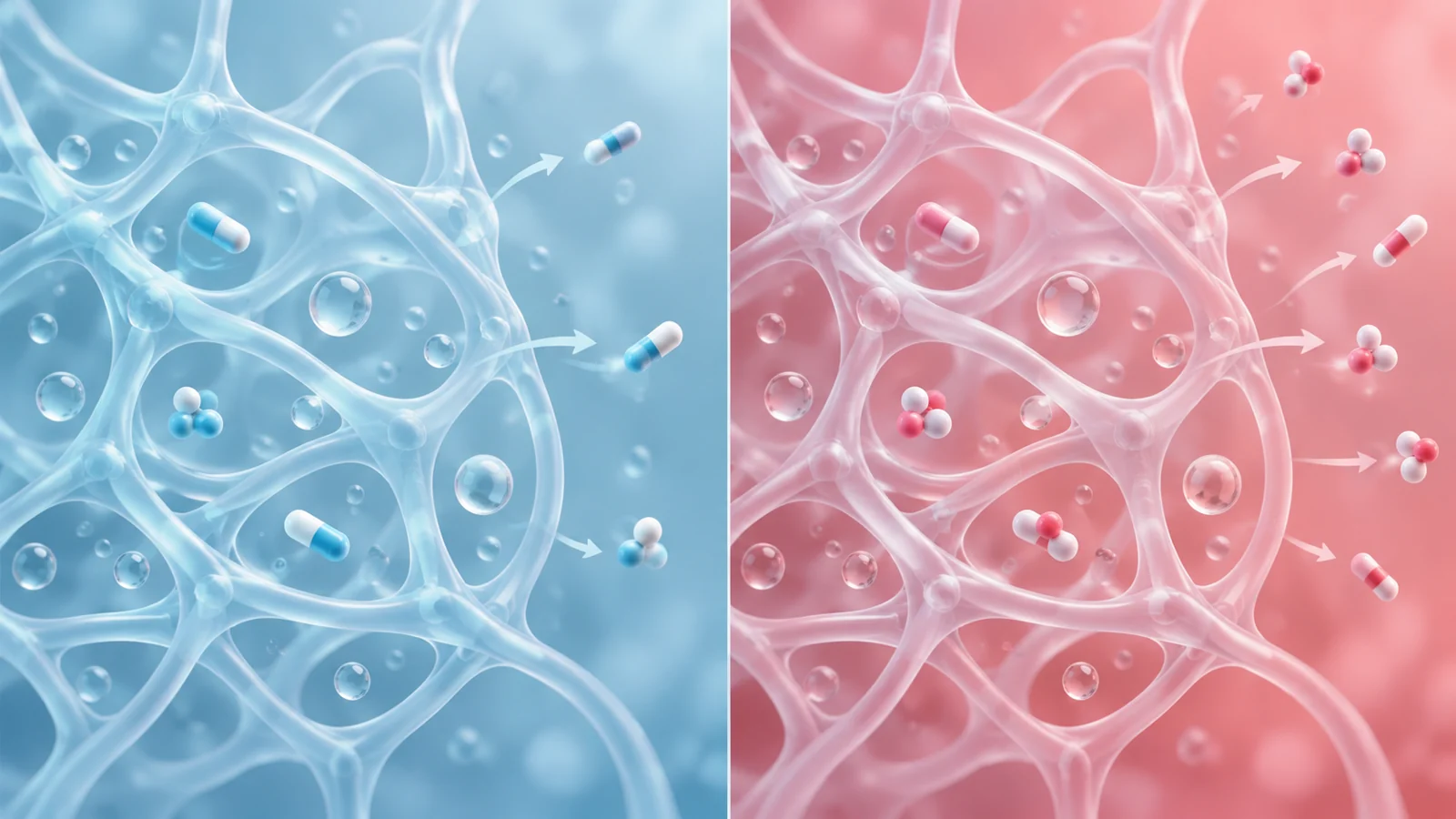
A gel carrying medicine can release its contents differently when the surrounding chemistry changes. In one example described in a review published on August 25, 2022, researchers combined a modified form of cellulose with a modified form of chitosan. They loaded the resulting gel with the anticancer drug 5-fluorouracil. Release was sustained under physiological conditions and accelerated in acidic or reducing surroundings.
That behavior gives a familiar material an unfamiliar role. Cellulose helps plant cell walls stay rigid; a chemically altered version can become part of a water-containing network whose drug-release behavior depends on its environment. The engineering lies in changing the material’s structure and then understanding what those changes do.
The review, A comprehensive review on recent advances in preparation, physicochemical characterization, and bioengineering applications of biopolymers, brings together existing research across medicine, agriculture, food packaging and other fields. Its biomedical examples reveal a particularly useful connection between how a polymer is prepared, what properties it acquires and which medical functions it might eventually perform.
From plant fiber to a water-containing network
Polymers are long molecules built from repeating chemical units. Their composition and the way their chains are arranged help determine whether a material forms a stiff structure, a film or a gel. Cellulose is one such polymer, best known as a structural component of plants and a source of dietary fiber.
The word “biopolymer” often refers to polymers made by living organisms. This review uses a broader scope, bringing biological materials together with chemically modified and synthetic polymers. Its examples therefore do not all share the same origin. A plant-derived starting material and a synthetically prepared polymer can both enter the discussion because researchers are investigating their properties for biological applications.
Origin answers only part of the engineering question. Chemical modification can change how a polymer interacts with water and with other materials. Carboxymethyl cellulose, usually shortened to CMC, is a cellulose derivative that the review discusses as a thickener, stabilizer, film-forming material and component of drug-delivery systems.
A hydrogel is a polymer network that holds water. Linking polymer chains together helps create that network, while the chemistry of the chains influences its behavior. The review highlights CMC’s ability to form gels and its swelling response to pH, a measure of acidity. These properties give researchers ways to build a carrier whose interaction with its surroundings contributes to medicine release.
When the surroundings change the release
The formulation carrying 5-fluorouracil combined CMC with quaternized chitosan, a chemically modified form of another polymer. The researchers cross-linked the materials to form a composite hydrogel. As described in the review, the formulation combined mechanical properties and water uptake with responsiveness to both pH and redox conditions.
Those are two different aspects of the surrounding chemistry. Acidity concerns pH. A reducing environment concerns chemical conditions that favor the transfer of electrons to other substances. A material can respond to either, so “responsive” needs to be understood in terms of the particular condition being changed.
For this drug-loaded gel, the review describes sustained release at pH 7.4, representing physiological conditions, and accelerated release in an acidic or reducing environment. The useful observation is the relationship between the surroundings and release behavior. The carrier’s performance cannot be described by its ingredients alone; the environment in which it operates also matters.
This gives the idea of controlled release a concrete meaning. Researchers incorporate a medicine into a material and use that material’s behavior to influence how the medicine leaves it. Here, the reported response concerns changes in release under different chemical conditions. It does not imply that the gel recognizes a tumor or decides where treatment is needed.
Preparation becomes part of the material
Designing a drug carrier also requires attention to what happens while it is being made. The review’s discussion of polylactic acid, or PLA, shows why preparation is inseparable from performance. PLA is a polymer that can be formed into structures investigated for tissue support and drug delivery.
Polymer production joins small starting molecules, called monomers, into longer chains. Some starting material can remain after the reaction. In its PLA synthesis discussion, the review identifies residual monomer as a substance that can act as a plasticizer, changing the finished polymer’s behavior and lowering its mechanical strength and thermal stability. It describes ethanol washing as a way of removing unreacted monomer in the preparation discussed.
That detail connects chemistry to a practical structural question. A scaffold is a material structure intended to support tissue growth or repair. Its ability to retain useful properties depends on the material that actually emerges from fabrication, including what remains within it. Naming the polymer does not fully describe that finished structure.
Adding a medicine introduces another interaction. The review notes that fabrication of drug-loaded PLA scaffolds can cause unexpected changes to the scaffold, the incorporated pharmaceutical or both. The manufacturing process is therefore part of designing a combined system. It must produce the intended structure while preserving the medicine’s useful properties.
PLA’s adjustable breakdown rate also offers a way to influence release over time. This creates an engineering connection between the lifetime of a supporting structure and the delivery of what it carries. Preparation, structural stability and release behavior become linked design choices.
Cartilage asks something different of a gel
Carrying a medicine and replacing cartilage place different demands on a material. A drug carrier is investigated partly for how it contains and releases its payload. Cartilage must function as a moving, load-bearing surface, making its behavior under force and friction central to its usefulness.
The review discusses poly(vinyl alcohol), or PVA, hydrogels as extensively studied candidates for articular cartilage replacement. Their appeal includes permeability, load-bearing properties, ease of preparation and biocompatibility. Yet the same discussion identifies inadequate surface lubrication and biomechanical strength relative to what natural cartilage requires.
A gel can therefore have several attractive properties and still fall short of a particular medical function. Allowing substances to pass through a material does not establish how smoothly its surface moves against another surface. Supporting a load under one set of conditions does not settle whether it can meet the mechanical demands of cartilage. The intended job determines which properties matter together.
These examples also resist a simple ranking. The responsive cellulose-derived carrier, PLA drug-delivery structures and PVA cartilage candidates involve different formulations, functions and experimental settings. They are not competitors tested together under a common protocol.
What the experiments establish
The biomedical findings in the review come from prior studies, and their experimental settings matter. Some PLA drug-delivery examples are explicitly described as work in cervical cancer mouse models and in vitro, meaning experiments outside a living organism. The review discusses sustained delivery of doxorubicin and effects on tumor-related measures in those settings.
Such results can support further investigation of a delivery approach. They do not establish patient benefit. Likewise, the cellulose-derived gel’s altered release behavior establishes a material response under the described conditions; it does not by itself establish improved cancer treatment. Connecting those observations to a therapeutic advantage requires evidence about the finished formulation in its intended medical use.
The terminology around safety and environmental performance needs similar care. The review frequently emphasizes biodegradability, biocompatibility and non-toxicity as attractions of biopolymers. These properties cannot be assumed for every formulation simply because one ingredient comes from a living organism. Chemical modifications, added components and the conditions of use belong to the assessment of the finished material.
Environmental benefit is a separate question from successful drug delivery. Renewable starting materials may reduce reliance on nonrenewable resources, but the medical examples discussed here do not establish a quantified environmental advantage. The review’s conclusion calls for continuing work on both performance and life-cycle evaluation. That broader evaluation matters when judging whether a material’s production, use and eventual disposal support the environmental promise attached to it.
What this could change
A concrete possibility is a medical scaffold that performs two jobs together: providing physical support while releasing an incorporated medicine over time. The review describes porous films based on PLA and polyethylene glycol carrying gentamicin sulfate or metronidazole for wound-dressing research. These examples connect the idea of a supporting material with the possibility of sustained local delivery.
If fabrication preserves drug activity and the structure’s useful properties, and the resulting formulation proves safe and effective in the intended setting, wound-care materials could combine support with medicine delivery in the same structure. Engineers could then design how long the material remains useful alongside how it releases its payload. The potential payoff is a dressing or scaffold whose physical role and delivery role work together throughout part of the healing process.
Key Sources
- Primary source: A comprehensive review on recent advances in preparation, physicochemical characterization, and bioengineering applications of biopolymers.
DOI or Journal Page · Peer-Reviewed Paper · 2022-08-25
Keep exploring