
Research Signal – Source date 2022-10-15
The chemical connections that make a plastic durable can also make it difficult to reuse. In a conventional thermoset, polymer chains are joined into a permanent network. Those crosslinks help the material withstand mechanical loads and heat, but they also obstruct the movement needed to reshape it. A useful adhesive or rigid component can therefore become difficult to recover once its original job ends.
Bio-based vitrimers offer a way to reconsider that tradeoff. These are crosslinked plastics made partly or wholly with renewable ingredients, with chemical bonds that can exchange partners. Under suitable conditions, the network can rearrange, opening possibilities for repair and reprocessing. The renewable ingredients and the exchangeable bonds make different contributions to the material.
A review published on October 15, 2022, Bio-Vitrimers for Sustainable Circular Bio-Economy, assembles earlier research on these materials. Its examples include an adhesive joint restored with heat and a sugar-derived plastic reprocessed several times. Together, they show what particular formulations could achieve, while exposing the design work needed to turn laboratory recovery into a practical way of keeping materials in use.
How a connected network can rearrange
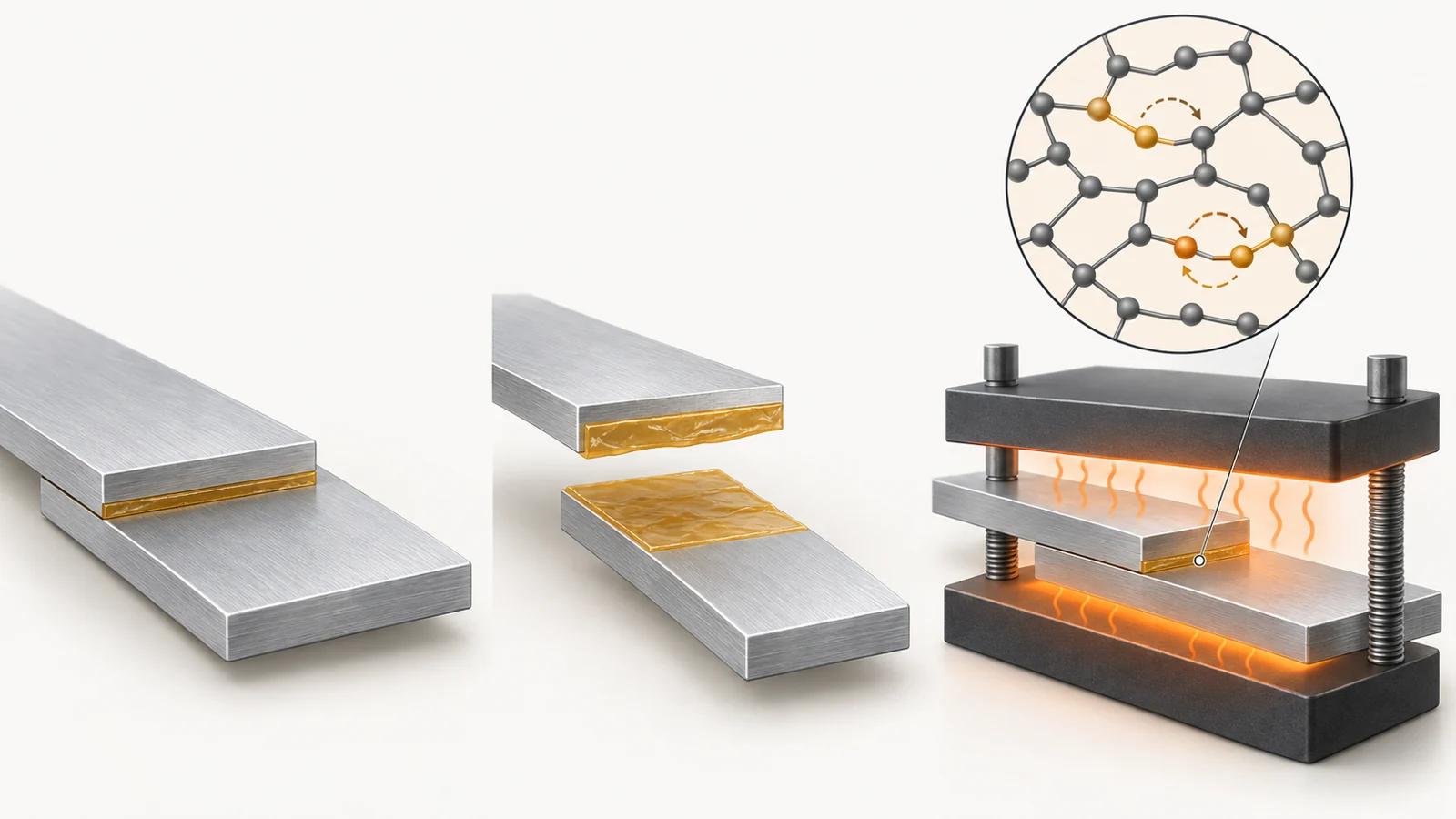
Imagine a network whose junctions can change which strands they connect. The network remains connected overall, but its arrangement can shift. That is the central idea behind the associative bond exchange described in the review. Chemical connections exchange partners without requiring the material to dismantle its entire crosslinked structure.
One frequently used reaction is transesterification, in which ester links exchange through reactions with alcohol groups. Other reviewed formulations use different exchange chemistry, including imine bonds. These choices affect how readily the network rearranges and what conditions it needs.
Rearrangement allows stress relaxation. When a material is deformed, its network initially resists the imposed shape; exchanges can gradually reduce that internal stress. Given enough movement and time, the material can be reshaped or joined again. This behavior gives vitrimers some of the processing flexibility associated with thermoplastics while retaining a crosslinked network.
Temperature matters because exchange has a rate. A reaction too slow to produce noticeable change during ordinary use may become useful for processing when heated. Molecular mobility matters as well. The practical question is whether the network can rearrange fast enough during a repair operation while remaining stable enough over the much longer period when a component must hold its shape.
What the renewable ingredients contribute
“Bio-based” describes where ingredients come from. The review distinguishes fully bio-based vitrimers, made using bio-derived chemicals, from partially bio-based formulations that combine biological and petroleum-derived ingredients. Plant origin alone does not create the bond-exchange mechanism; chemists must build suitable reactive groups and connections into the network.
Renewable molecules can also contribute useful structures. Some provide relatively flexible segments, while others supply rigid chemical groups or multiple sites for forming crosslinks. Their value therefore extends beyond replacing a fossil-derived starting material. They can help determine the properties of the finished plastic.
Still, renewable sourcing is only one part of sustainability. The review raises concerns about extracting natural resources and points to biological waste as a potentially useful feedstock. A bio-based label does not establish biodegradability, a low environmental footprint, or an effective collection and reuse system. Assessing those benefits requires attention to sourcing, chemical conversion, processing energy and what happens after use; the demonstrations discussed here do not establish a quantitative emissions saving.
A stronger plastic requires molecular design
A soybean-oil example shows why ingredient substitution is not enough. The review describes an epoxy vitrimer made from epoxidized soybean oil and fumaropimaric acid, a rosin-derived compound, using a zinc catalyst. Changing the proportion of the rosin-derived ingredient changed the resulting material’s properties.
The formulation with the highest reported glass transition temperature in that series reached 65 °C. This temperature marks a change in molecular mobility and stiffness; it should not be read as a certified maximum operating temperature. The same formulation had a reported tensile strength of 16.62 MPa, compared with 0.6 MPa for the citric-acid-cured soybean-oil network cited in the review. Tensile strength measures the stress a specimen can withstand when pulled before it fails.
The authors attributed the improvement to the rosin-derived molecule’s rigid ring structure and reactive groups, which could increase crosslink density. The example makes the design problem tangible. A plant-derived starting material may need additional molecular rigidity and carefully arranged connections to become useful in a demanding application.
These values describe a particular formulation and comparison. They do not rank bio-based vitrimers against all conventional plastics. Nor does a high initial strength settle whether the same material will retain its properties after repair or reprocessing. That requires a different experiment.
Repairing a joint, reshaping a plastic and breaking down a network
The review brings together several operations often grouped under “recycling” or “self-healing.” Their outcomes need to be read separately. Restoring an adhesive joint tests a bond between surfaces. Reprocessing tests whether material can be formed again. Chemical decomposition changes the network into smaller chemical species.
In one lignin-containing epoxy vitrimer example, researchers bonded overlapping aluminum sheets and measured the joint’s resistance to being pulled apart by sliding the sheets relative to one another. The original joint reached a lap-shear strength of 6.5 MPa. After the joint was broken, the separated sheets were rejoined at 190 °C, and the repaired joint reached 5 MPa.
That result demonstrates useful recovery of an adhesive joint under heated conditions, with less strength than the original joint. It is not a measurement of tensile strength in a free-standing plastic specimen. It also makes the word “healing” concrete: the operation involved bringing separated surfaces together and applying substantial heat.
A different example used fructose-derived building blocks in a network with exchangeable imine bonds. According to the review, the material was reprocessed three times at 120 °C for 10 minutes, without significant loss of mechanical properties. Here, the achievement was repeated processing of the material. Three successful cycles provide evidence over those tested cycles, rather than a promise of indefinite reuse.
Chemical recovery follows another route. For an eugenol-derived epoxy vitrimer discussed in the review, researchers demonstrated physical reprocessing in a hot press at 160 °C for one hour. They also decomposed the network in ethanol at 160 °C. The latter operation uses a chemical environment to break down the material, rather than simply rearranging it into a new shape. Decomposition alone does not establish that original monomers were recovered and reused in a closed production loop.
All of these numerical examples come through the review’s accounts of separate studies. The materials, test conditions and measured outcomes differ. A recovered joint strength, retained mechanical properties after reshaping and successful chemical decomposition answer different questions; they cannot be combined into one universal recovery efficiency.
The processing window has to fit the job
The temperatures in these examples expose an immediate practical constraint. A repair at 190 °C requires equipment and surrounding components that can tolerate that treatment. Lower-temperature exchange could make some repairs easier, but a material must also resist unwanted rearrangement during service. The challenge is to achieve a useful separation between conditions for everyday performance and conditions for deliberate processing.
Catalysts are another design choice. Several formulations in the review rely on catalysts to enable useful exchange rates. It also describes catalyst-free approaches, including vanillin-derived materials with disulfide chemistry. Those examples establish that an added catalyst is not necessary for every formulation. They do not mean every catalyst-free material can heal at room temperature or deliver the same strength and processing speed.
The review identifies lower-temperature healing, suitable mechanical and thermal properties, and scale-up as needs for further development. These requirements must be met together in a material intended for a particular use. A formulation that reshapes readily may not have the stiffness an adhesive assembly needs; a strong network may demand an inconvenient repair temperature.
As of the review’s publication, the evidence supported specific material demonstrations. Manufacturing cost, repeatable performance at larger scale and recovery through many service cycles remained questions that would determine practical usefulness. Favorable properties reported across different formulations should not be mistaken for a single material that already combines them all.
What this could change
For manufacturers and maintenance teams, the adhesive example suggests a concrete future option. If a suitable joint could be reheated and restored to the strength its application requires, some bonded assemblies could return to service after failure. That could reduce the need to discard joined components or replace an entire assembly because one connection has failed.
Repeated reprocessing could offer a complementary route for suitable crosslinked material after its first use. If recovered material retains adequate performance and can be processed with practical equipment, it could become feedstock for another useful part. Keeping that material in service would reduce replacement demand and delay disposal. Where responsibly sourced renewable ingredients also perform well, the same material system could change both what goes into production and how long its output remains useful.
Key Sources
- Primary source: Bio-Vitrimers for Sustainable Circular Bio-Economy.
DOI or Journal Page · Review or Meta-Analysis · 2022-10-15
Keep exploring