
Research Signal – Source date 2023-03-02
A food package can become waste while still containing something worth eating. It might hold more than a household can finish, leave food trapped inside, or provide too little protection during storage. Replacing its raw materials addresses one part of the environmental problem. The food that reaches the plate—or gets discarded with the package—also belongs in the calculation.
A review published March 2, 2023, in Foods connects these usually separate design questions. It examines bio-based packaging, meaning packaging made from biological raw materials, alongside protective films, preservation compounds, freshness indicators, adhesives, and dyes. Its contribution is to bring material performance into the same discussion as everyday use and the systems that handle packaging after disposal.
The research and design examples describe several ways to improve particular functions. They concern different materials, foods, and outcomes, so they cannot simply be placed on one performance ladder. Understanding the promise starts with understanding what each component is supposed to do.
A film controls what moves through it
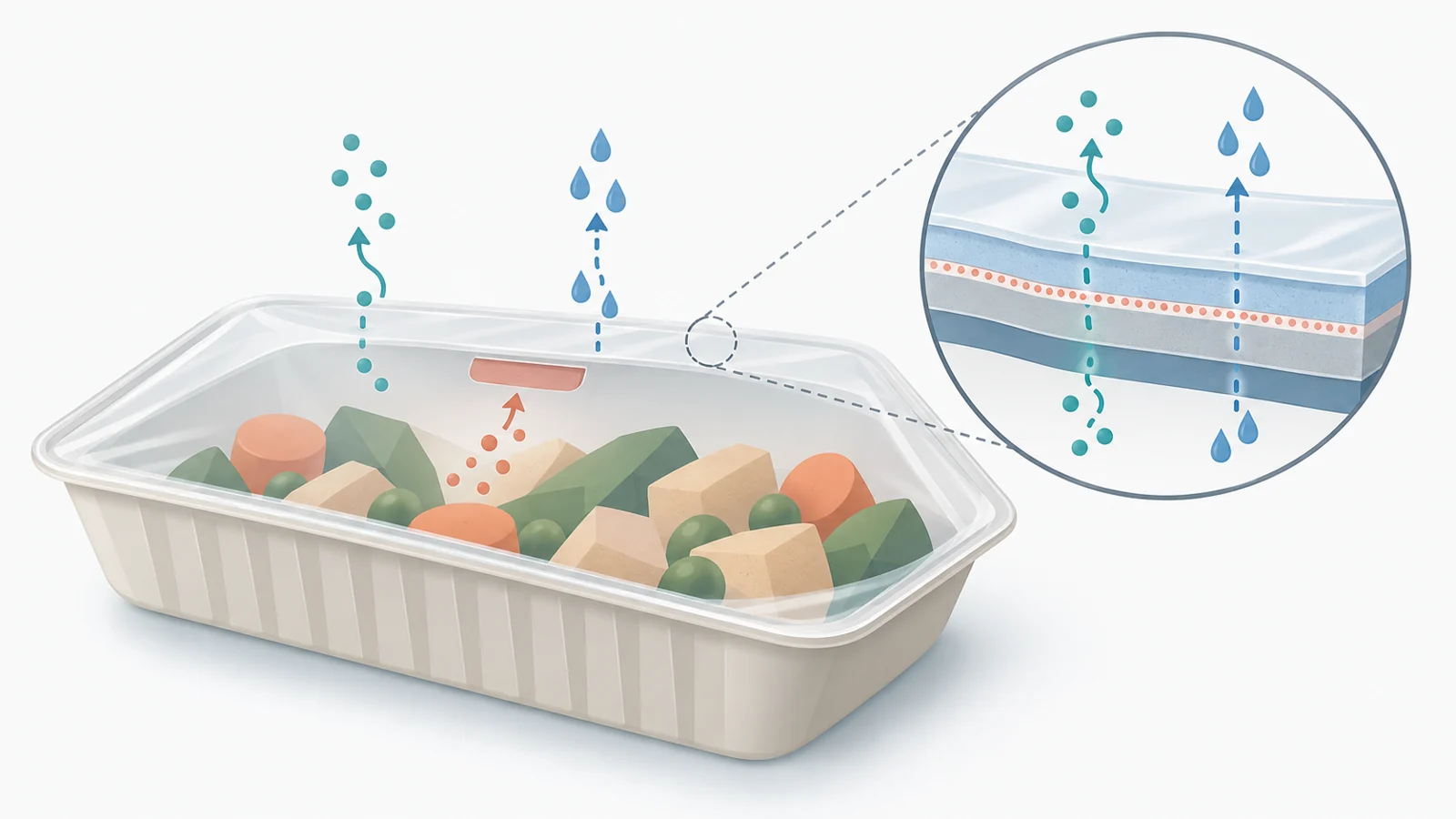
The thin film around food helps determine how quickly gases and moisture move between the contents and their surroundings. That movement matters because oxygen participates in fat oxidation, browning, and vitamin loss, while changes in moisture affect texture and the conditions for microbial growth. A useful barrier must suit the food it encloses.
Fresh produce adds another complication. Ethylene, a gas involved in fruit ripening, can accelerate deterioration when it accumulates. Controlling its passage or removing it from a package can therefore serve a different purpose from restricting oxygen. The review also describes carbon dioxide in modified-atmosphere packaging, where changing the surrounding gas mixture can help suppress microbial growth or slow produce respiration. There is no single instruction to block every gas as completely as possible.
To understand a film, imagine a molecule reaching its outer surface. It can be absorbed into the material and then move through it. The material’s chemistry affects how readily that happens; the arrangement of its polymer chains also shapes the journey. Blending polymers, arranging them in layers, and changing processing conditions can alter gas and water-vapor transport.
Starch offers a concrete example of the engineering involved. The review describes research in which starch was chemically modified using sunflower oil under alkaline conditions. The resulting films showed lower water solubility and lower water-vapor transmission, together with higher water contact angles.
Those measurements answer different questions. A higher contact angle means a droplet beads up more on the surface, indicating reduced wetting. Lower water-vapor transmission concerns moisture passing through the film. Lower solubility concerns the material dissolving in water. A beaded droplet is visually striking, but measuring passage through the film is essential to understanding how it could manage moisture around food.
Preserving food and reporting freshness are different jobs
Active packaging deliberately changes the food or its immediate environment. The review discusses substances that limit oxidation or microbial growth, absorb unwanted gases, or block light. Their intended contribution is an intervention in processes that affect preservation.
Getting an active ingredient into a film is only part of that task. Its release has to be controlled so that it can act over a useful period. It also has to survive package manufacture. The review describes encapsulation, in which small structures carry and protect active compounds, as one way to address both problems. This is especially relevant when a heat-sensitive ingredient must be incorporated into a material processed at high temperatures.
The production method creates its own demands. Spray drying, for example, can encapsulate compounds continuously and in substantial quantities, but operating conditions need careful control to limit losses of the active ingredient. A promising preservation compound and a workable manufacturing process are connected engineering questions.
Intelligent packaging performs an information function. An indicator responds to a change associated with storage conditions or food quality and communicates it, often through color. The review describes natural pigments such as anthocyanins that change color with pH, as well as indicators responding to gases associated with deterioration.
One example reported in the review is a color-changing label designed to indicate volatile amines produced by fish and shellfish during storage. The chemical response gives the label a specific target. It does not turn the patch into a detector for every pathogen or possible hazard. Reading such an indicator requires knowing which change it detects and how that change relates to the particular food.
The authors use “smart packaging” for systems combining active and intelligent functions, while acknowledging that terminology varies. Keeping the functions separate is useful when judging a claim. A component that senses a change and one that slows deterioration need different demonstrations of performance, even if a future package contains both.
The package still has to work in a kitchen
Size, opening, resealing, and emptying can influence whether protected food actually gets eaten. These features receive explicit attention in the review, alongside material chemistry.
Consider an everyday illustration: a person uses a few spoonfuls of sauce, closes the container, and returns it to storage. The portion size affects how much remains; the closure affects how easily the package can be resealed; the shape affects whether the last spoonfuls can be removed. This is an illustration of the design principles, not a measured result from a household trial.
Easy emptying also connects use with disposal. Less food left on the inside means less product thrown away and can make cleaning for recycling easier. A seemingly modest feature can therefore affect both the meal and the next handling step.
The glue and color deserve attention too
A package made entirely from biological materials involves more than replacing its main film. Adhesives hold components together, while inks and dyes carry information or provide a functional color response. Each has requirements that differ from those of the surrounding material.
The review describes food-packaging bioadhesives as an early area of development. Starch and proteins offer possible starting materials, but their attraction to water creates difficulties. Their many water-attracting chemical groups can make moisture sensitivity a major obstacle in adhesive formulations.
Researchers can modify these materials and create links between their molecular chains to improve performance. The review cites starch crosslinked with citric acid as an example associated with good mechanical properties. For the package designer, the practical question is whether the adhesive can maintain the required bond under the conditions the package will encounter.
Dyes bring a different set of problems. Natural pigments can come from biological sources, including waste biomass, and some have useful light-blocking or other functional properties. Yet the review identifies difficulties with production, cost, limited sources, and reproducible shades. A dependable printed color requires consistency across batches. A color used to communicate freshness additionally needs an interpretable response to its target condition.
Position does not remove a component from the safety assessment. An adhesive may sit between packaging layers without being intended to touch food directly, yet its constituents can still contribute to migration into the contents. The thin interface that a shopper never notices can matter to the finished package’s suitability.
Performance has to survive contact with real systems
The step from a useful material demonstration to a useful package involves several distinct checks. Food-contact assessment concerns which constituents could reach the food and in what amounts. For an indicator placed close to the contents, its sensing function and its potential to introduce substances are separate questions. Biological origin alone does not settle either one.
Recovery is equally specific. Added coatings, bonding layers, and sensing components enter the waste stream along with the package. The review calls attention to the possible effects of intelligent packaging on recycling and, for electronic tags, the need for suitable recycling programs. A material choice has to connect with the collection and processing systems available where it will be discarded. A biological feedstock does not by itself establish local recyclability or a particular composting outcome.
Life-cycle assessment brings these stages into one environmental comparison. The authors argue for assessing the combination of food and package, including production, preservation, use, and end-of-life handling. An added component has its own material and processing demands; any benefit from avoiding food loss must be evaluated alongside those demands. The balance can change with the food, the package design, and the disposal route.
This also sets the scale at which performance claims become meaningful. Extra shelf-life days, less discarded food, and lower climate impacts need evidence tied to a particular application. Results for a modified starch film, an active compound, and a freshness label cannot simply be combined into a quantified benefit for one finished product. Nor does progress on each component establish that all of them already work together in a fully bio-based package through manufacture, use, and recovery.
The review identifies a broader obstacle here: gaps between package design, material supply, manufacturing, commercialization, and the return of recovered materials. Closing those gaps requires the people handling successive stages to have compatible materials and processes.
What this could change
If preservation methods work under actual storage and handling conditions, and packaging remains convenient to open, portion, reseal, and empty, more fresh food could reach consumption. Households could get more usable food from what they buy. Retailers and food producers could benefit from fewer losses during distribution and storage. Reliable freshness information could also help supply chains coordinate stock before deterioration makes it unusable.
There is a second possible gain at the beginning of the material supply chain. Agricultural and food-processing byproducts could provide feedstocks for packaging materials or recovered active compounds, creating useful outlets for material that otherwise requires waste handling. Connecting those outlets with dependable package production and suitable recovery systems could make them part of a continuing resource flow.
From the review’s March 2023 perspective, the opportunity is to connect these capabilities: food that stays usable long enough to be eaten, packages that people can use effectively, and productive uses for byproducts. The public benefit depends on those connections delivering environmental gains across the complete life cycle.
Key Sources
- Primary source: Sustainable and Bio-Based Food Packaging: A Review on Past and Current Design Innovations.
DOI or Journal Page · Review or Meta-Analysis · 2023-03-02
Keep exploring