
Research Signal – Source date 2022-03-01
A few days after a person received a first infusion of pembrolizumab, doctors identified a rare and serious condition involving loss of bile ducts. Pembrolizumab is an immunotherapy drug used to treat cancer. The timing raised concern about a possible treatment-related immune reaction, but timing alone cannot prove that the drug was the sole cause.
The case report and literature review, published on March 1, 2022, describe how the team investigated the injury and what happened when they tried to control it. The diagnosis became clear through a liver tissue sample, while treatment with high-dose steroids and other immune-suppressing drugs had only scarce efficacy in this case.
The tissue sample revealed the missing ducts
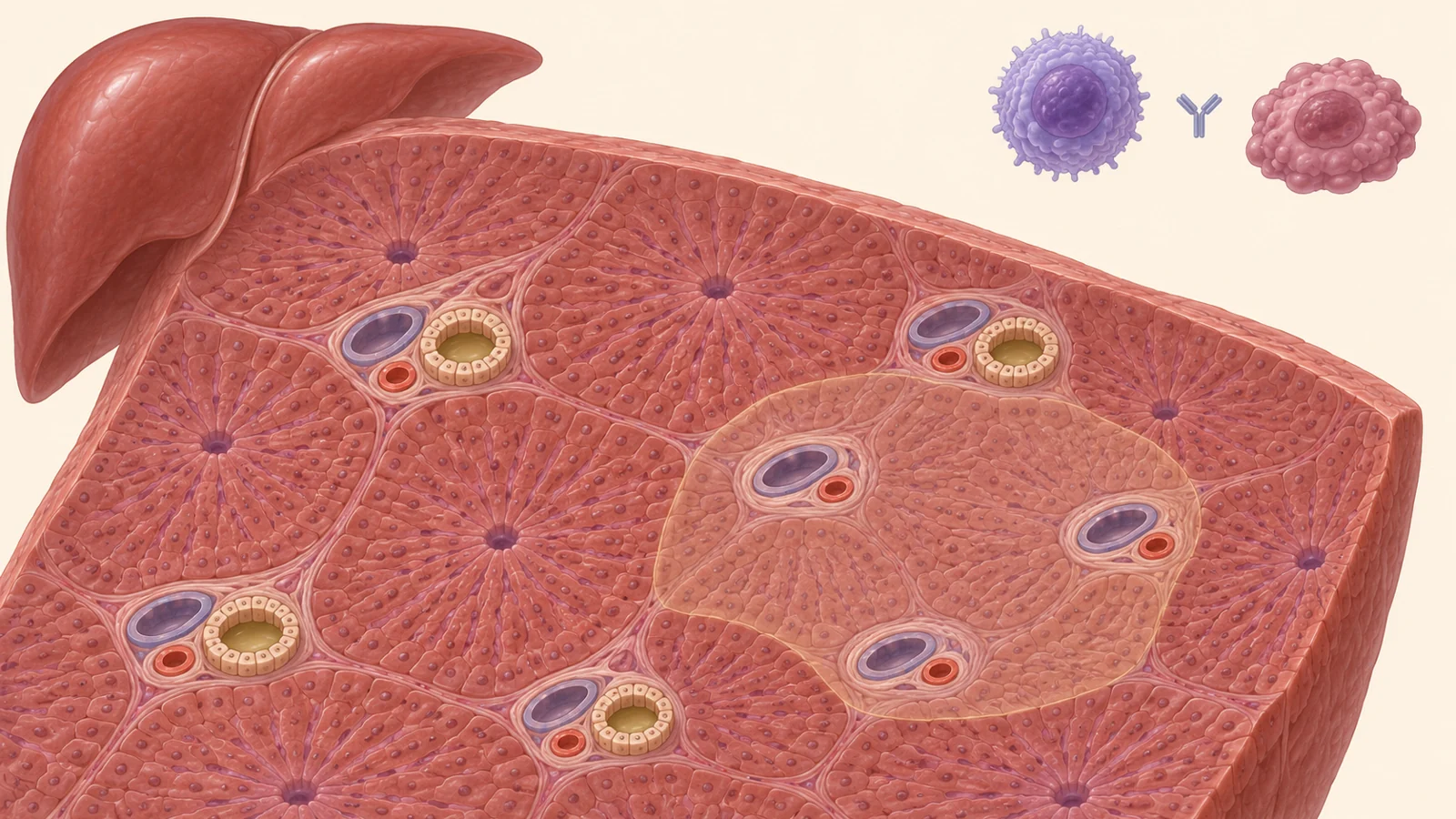
Bile ducts are small channels that carry bile, a fluid made by the liver. In vanishing bile duct syndrome, ducts are lost. The name describes the finding; it does not mean that every bile duct disappears.
The doctors used laboratory tests and radiological imaging to orient the diagnosis and monitor the disease. Those tests helped assess the situation, but the decisive evidence reported was in tissue: the sample showed ductal loss, which the authors describe as pathognomonic for the syndrome. In other words, that finding was characteristic of vanishing bile duct syndrome.
This distinction matters because the timing after the infusion alone could not establish what was happening in the bile ducts. The case report points to the observed loss in the sample as the finding that identified the condition.
Treatment made little difference in this case
The team administered high-dose steroids and immunosuppressors, medicines intended to reduce immune activity. Their reported effect was scarce. The account therefore describes a difficult treatment problem: doctors could identify the syndrome in the tissue, yet the treatments they tried helped little in this patient.
That result is specific to this case. It does not show that steroids generally fail for vanishing bile duct syndrome, nor does the supplied report establish that another treatment would have worked. The abstract does not give the patient’s eventual outcome, so it cannot support a conclusion about recovery or longer-term effects.
The broader risk figure is not this syndrome’s rate
The authors place the case against a wider safety backdrop, saying severe immune-related adverse events occur in about 5% of patients receiving PD-1/PD-L1 inhibitors. Pembrolizumab is one of these cancer immunotherapies. The figure refers to severe immune-related events overall. It is not an estimate of how often vanishing bile duct syndrome occurs among people treated with pembrolizumab.
A single reported case cannot establish how often the syndrome occurs among people receiving pembrolizumab. The broader percentage gives context for serious immune-related harms; it cannot measure the likelihood of this particular form of bile duct injury.
What this could change
If a treatment for steroid-refractory vanishing bile duct syndrome proves effective, doctors who recognize the condition early could have an option when steroids do little. In this case, a tissue sample showed ductal loss, but high-dose steroids and other immune-suppressing drugs had little effect. New drugs would need independent testing before such an option could be expected.
A nearer milestone would be documented outcomes from evaluated treatments in additional cases where steroid-refractory disease is clearly diagnosed. Those results could show whether another option helps when the treatments in this report had limited effect, while keeping the potential patient benefit conditional on evidence that has yet to be established here.
Key Sources
- Primary source: Vanishing bile duct syndrome following pembrolizumab infusion: case report and review of the literature.
DOI or Journal Page · Review or Meta-Analysis · 2022-03-01
Keep exploring