
Research Signal – Source date 2025-02-01
Multiple myeloma is a cancer of plasma cells, immune cells that normally make antibodies. It often returns after treatment, and relapses can become harder to treat. In a February 2025 review, researchers describe how engineered immune cells have created a new treatment option for some people with myeloma, while also showing why a strong response does not guarantee lasting control or easy access to treatment.
The therapy uses a patient’s own T cells, collected from the blood and modified to recognize a target on cancer cells. Two BCMA-targeting CAR T products have been approved in the United States for myeloma. Randomized trials summarized in the review found better response or disease-control measures for each product against its own standard-treatment comparison. Yet relapse, serious side effects and the time required to prepare an individual patient’s cells remain part of the story.
Why plasma cells make a useful target
BCMA, short for B cell maturation antigen, is a protein found on mature plasma cells. It is present on myeloma cells, but it is not exclusive to cancer: healthy plasma cells also carry it. The review describes BCMA as largely absent from other blood-forming cells and normal tissues, making it a useful target while leaving the possibility of effects on healthy BCMA-bearing cells.
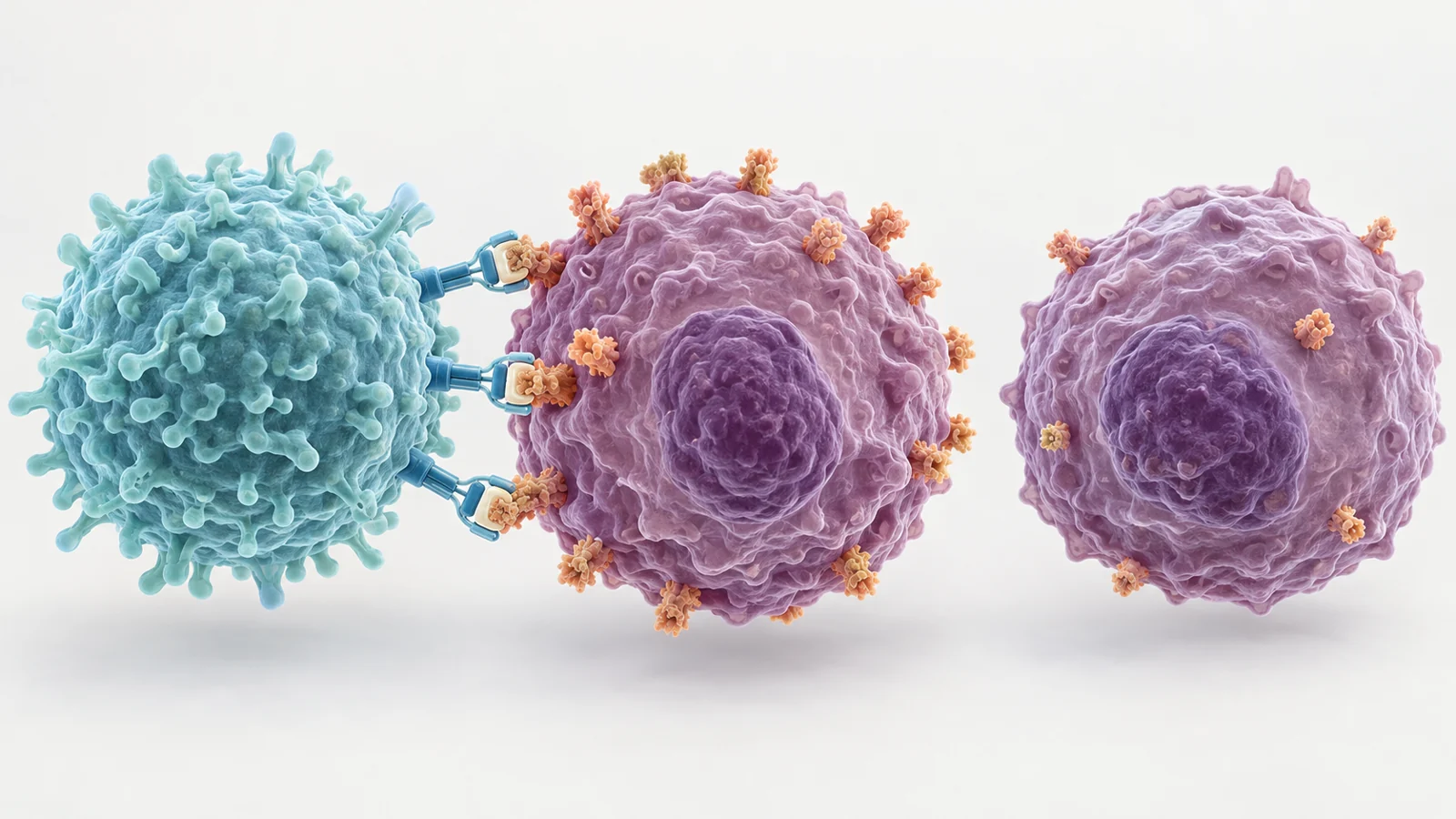
A CAR, or chimeric antigen receptor, is an engineered sensor placed on a T cell. Its outer portion binds a chosen target, while other parts anchor the receptor and transmit a signal into the cell. When the receptor recognizes BCMA, the engineered T cell can respond against the cell displaying it.
The target-binding portion can be built in different ways. Many CARs use a single-chain variable fragment, or scFv, made from two linked parts of an antibody. Other designs use compact camelid-derived VHH antibody fragments, natural receptors or ligands, or scaffold molecules. These choices affect how the CAR recognizes BCMA and how its components are assembled; they are engineering approaches, not a clinical ranking.
One representative VHH design, LCAR-B38M, uses two VHH sequences arranged in tandem to recognize two BCMA epitopes. The review also describes scFv-based designs, including the approved Abecma product, and other experimental recognition domains. Although a variety of designs have reached clinical study, the review says there has been no direct in vivo or clinical comparison of the different recognition-domain classes. Their number and variety alone cannot show which works best.
Two randomized trials show why the treatment matters
In KarMMa-3, a phase 3 trial summarized in the review, people with relapsed or refractory myeloma who had received two to four prior treatment lines were assigned to Abecma or standard regimens. At a median follow-up of 18.6 months, median progression-free survival was 13.3 months with Abecma and 4.4 months with standard treatment. Progression-free survival measures time before the disease worsens or the patient dies. Responses occurred in 71% of the Abecma group and 42% of the standard-treatment group; complete responses were reported in 39% and 5%, respectively.
Those gains came with substantial treatment burden. Among patients who received Abecma, 93% had grade 3 or 4 adverse events. Cytokine release syndrome occurred in 88%, with 5% experiencing grade 3 or higher cases. Investigator-identified neurological effects known as ICANS occurred in 15%, with 3% at grade 3 or higher.
CARTITUDE-4 compared CARVYKTI with standard regimens in adults with relapsed or refractory myeloma after one to three prior lines of therapy. At a median follow-up of 15.9 months, median progression-free survival had not been reached in the CARVYKTI group and was 11.8 months in the standard-care group. Overall response was 84.6% versus 67.3%, and complete response or better was 73.1% versus 21.8%.
In the as-treated CARVYKTI group, 76.1% experienced cytokine release syndrome; 1.1% had grade 3 or 4 cases. ICANS occurred in 4.5%, all grade 1 or 2. The review also reports other neurological effects, including cranial nerve palsy and peripheral neuropathy. These figures come from a different trial, with a different study population and comparator, so they should not be used to rank CARVYKTI against Abecma. Together, the trials show why BCMA CAR T therapy became clinically consequential, while making clear that treatment can bring serious adverse events alongside response.
Relapse can follow a change in the target
A cancer cell may evade a treatment aimed at a particular marker if it reduces or loses that marker. The review describes this form of antigen escape after BCMA CAR T therapy, including relapses in which myeloma cells showed diminished or absent BCMA. The reasons for relapse are multifactorial, but a changing target can leave some cells less visible to the engineered T cells.
One proposed response is to target BCMA alongside another myeloma-associated antigen. The review discusses dual-targeting CAR approaches as a way to broaden recognition, with targets under study including GPRC5D, TACI and other molecules. A broader target strategy could make it harder for a tumor cell to evade treatment by changing one marker. That is a rationale for ongoing development, not evidence that dual targeting reliably prevents relapse in patients.
Another approach aims to increase the amount of BCMA on myeloma cells. Gamma-secretase inhibitors can prevent BCMA from being cleaved off the cell surface. In laboratory studies described by the review, this raised surface BCMA and reduced soluble BCMA, a released fragment that may act as a decoy. The review also notes early clinical experience combining a gamma-secretase inhibitor with BCMA CAR T therapy. These findings make the combination a candidate strategy; they do not establish durable prevention of relapse.
The response has to be weighed against the experience of treatment
Cytokine release syndrome, or CRS, is an inflammatory reaction that can occur as immune cells become activated. Its severity varies. ICANS is a set of neurological effects associated with immune effector cell therapies. The review’s trial summaries include mostly lower-grade cases as well as serious events, and its pooled discussion of earlier BCMA CAR T studies found that CRS was common, while severe CRS and ICANS occurred less often.
The numbers are not interchangeable across studies. Trial populations, treatments and follow-up differ, and the review describes both variation in observed toxicity and strategies for managing it. For patients, a high response rate is only one part of the experience: serious adverse events can occur, and care teams need to monitor and manage them. The review also notes reports of secondary T-cell cancers after CAR T therapies and the need for continued monitoring after treatment.
Manufacturing begins with each patient’s cells
For an autologous CAR T treatment, the process starts by collecting a patient’s T cells through leukapheresis. The cells are modified to carry the CAR and expanded outside the body before they are returned to the patient. Making a separate product for each person creates a logistical challenge: treatment depends on collecting, processing and delivering that individual’s cells.
Some development efforts aim to shorten the time cells spend being expanded outside the body. The review describes PHE885, an autologous BCMA CAR T product made with a process that reduced ex vivo culture to about 24 hours. An early phase 1 study reported encouraging responses among the patients assessed, alongside grade 3 CRS and ICANS in some participants. These early results illustrate the potential of a shorter manufacturing process, but do not show that it has solved the wider delivery challenge or established long-term benefit.
Donor-derived, or allogeneic, CAR T cells offer another possible route. Rather than preparing cells from each recipient, the approach uses engineered cells from healthy donors with the aim of making treatment more readily available. The review describes early work on P-BCMA-ALLO1: seven patients received it, and four completed the dose-limiting toxicity evaluation and could be assessed for response. The review reports an overall response rate of 75% among those assessed, with no CRS or ICANS observed in this small early group. That finding is preliminary; donor-derived treatment remains under study, and these data cannot establish routine access, durable benefit or safety for larger populations.
What improved CAR T therapy could mean for myeloma care
For people whose myeloma returns, more durable responses could mean longer periods of disease control. Shorter preparation or donor-derived cells could also make a timely treatment option possible for people who cannot readily wait for their own cells to be manufactured. Both possibilities depend on newer approaches proving that they can deliver lasting benefit safely and reliably. The review describes active routes toward those goals, while the evidence it summarizes leaves their patient-facing impact to be established.
Key Sources
- Primary source: Targeting BCMA in multiple myeloma: designs, challenges, and future directions.
DOI or Journal Page · Review or Meta-Analysis · 2025-02-01
Keep exploring