
Research Signal – Source date 2025-08-13
Soft and hard tissues have limited ability to regenerate. That has driven interest in materials that can offer more than a place for cells to grow: a tissue scaffold is a supporting framework, and a multifunctional one might also contribute biological or physical functions relevant to repair.
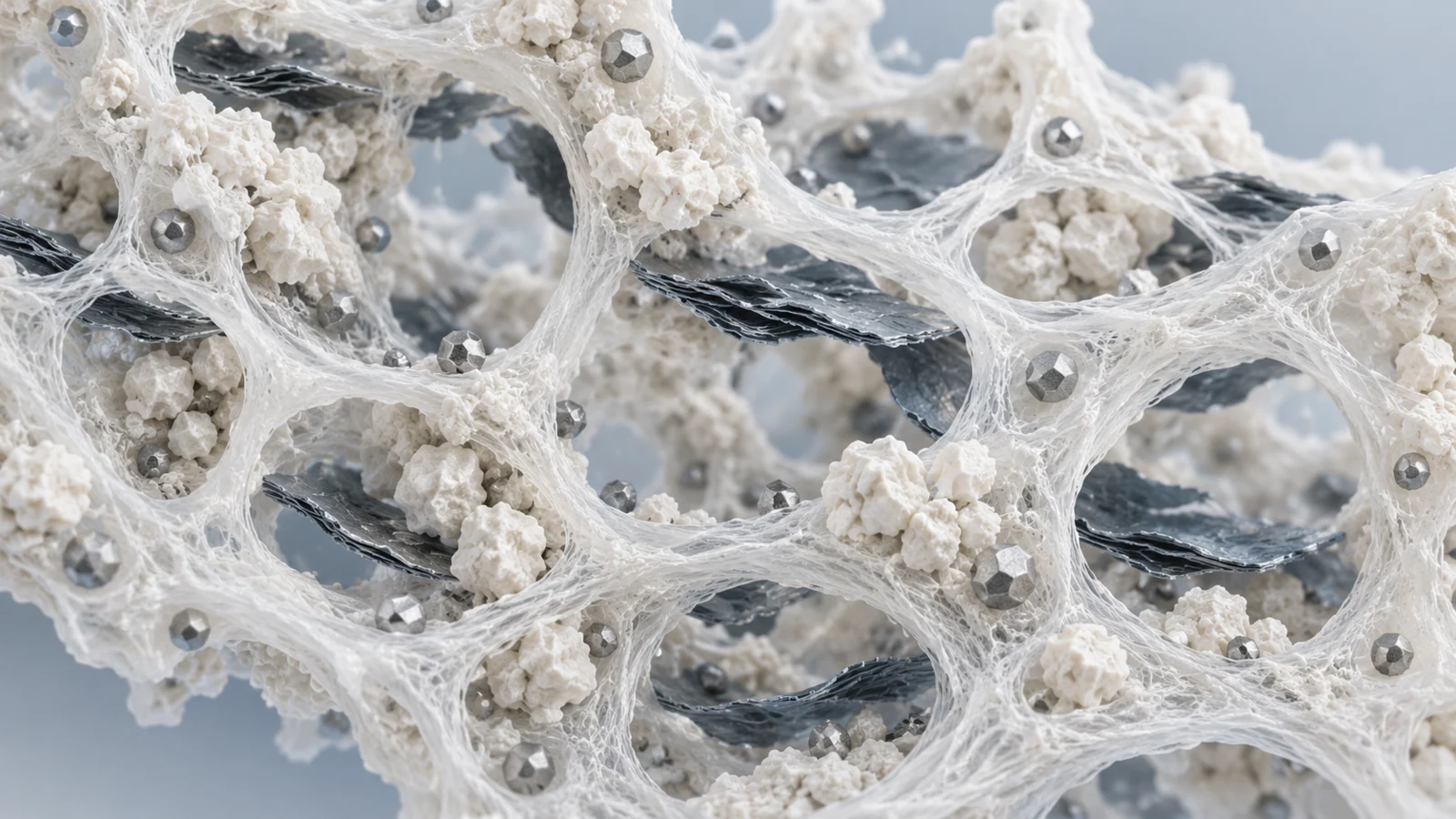
A review published on August 13, 2025, considers whether four materials could divide those jobs. It discusses bacterial cellulose, hydroxyapatite, MXenes and metal particles, then proposes combining them in one composite. The rationale draws on known properties of the ingredients and existing composite materials; the complete four-part combination is a proposed direction, not a demonstrated repair material.
The ingredients bring different strengths
Bacterial cellulose is described as biocompatible, but it lacks inherent bioactivity and other functions needed to promote regeneration. In other words, compatibility with tissue does not by itself make cellulose an active contributor to repair. The review also discusses genetic modifications to cellulose synthesis as one approach to addressing material limitations.
Hydroxyapatite offers osteoconductivity: support for bone growth. Its brittleness, however, is a structural limitation. Pairing it with a material such as cellulose is part of the broader rationale for composites, though the supplied evidence does not quantify how a particular pairing performs.
The other proposed ingredients add different possibilities. MXenes are electrically conductive, a property that could add a physical function to a scaffold, while their long-term biocompatibility remains uncertain. Metal nanoparticles may provide antioxidant, antimicrobial and drug-delivery functions, but their potential toxicity is a concern. The design problem is therefore not simply to collect useful properties; biological compatibility matters alongside them.
From known combinations to a four-part proposal
The review examines synthesis, structure and biomedical applications of individual materials and existing hybrids. Its argument for a four-component composite follows from the compatibility recognized across existing combinations: if these materials can be integrated successfully, one scaffold might bring together structural support, bone-growth support, conductivity and antibacterial activity.
That is a design expectation, not a reported result for a completed bacterial-cellulose/MXene/metal-particle/hydroxyapatite scaffold. The abstract supplies no comparative performance measures or validation of the full combination. It supports why the authors consider the idea worth exploring, while leaving open whether the ingredients can be assembled into a material that delivers those functions together.
The biological response remains a key question
A scaffold’s properties matter only in the context of how living tissue responds to it. The review highlights potential cytotoxicity from metal particles and limited study of MXenes’ broader effects on gene expression beyond specific markers. Those questions bear directly on whether the proposed combination could be biologically suitable, not just whether it can unite several material functions.
The evidence summarized here does not resolve long-term MXene safety or metal-particle toxicity. Nor does it establish a clinical treatment or patient benefit. At this stage, the four-part material is a research proposal grounded in the review’s discussion of ingredients and hybrids.
What one scaffold could bring to tissue repair
A successful and biologically safe combination could give researchers one material with structural and bone-supporting roles alongside electrical conductivity and antibacterial activity. That could broaden what a tissue-repair scaffold is able to contribute, if the four components work together as expected and their safety questions are answered.
Key Sources
- Primary source: Advanced biomaterials in tissue engineering: A critical review of nanocomposites based on bacterial cellulose, MXenes, hydroxyapatite, and metal particles for regenerative medicine.
DOI or Journal Page · Review or Meta-Analysis · 2025-08-13
Keep exploring