
Research Signal – Source date 2021-03-11
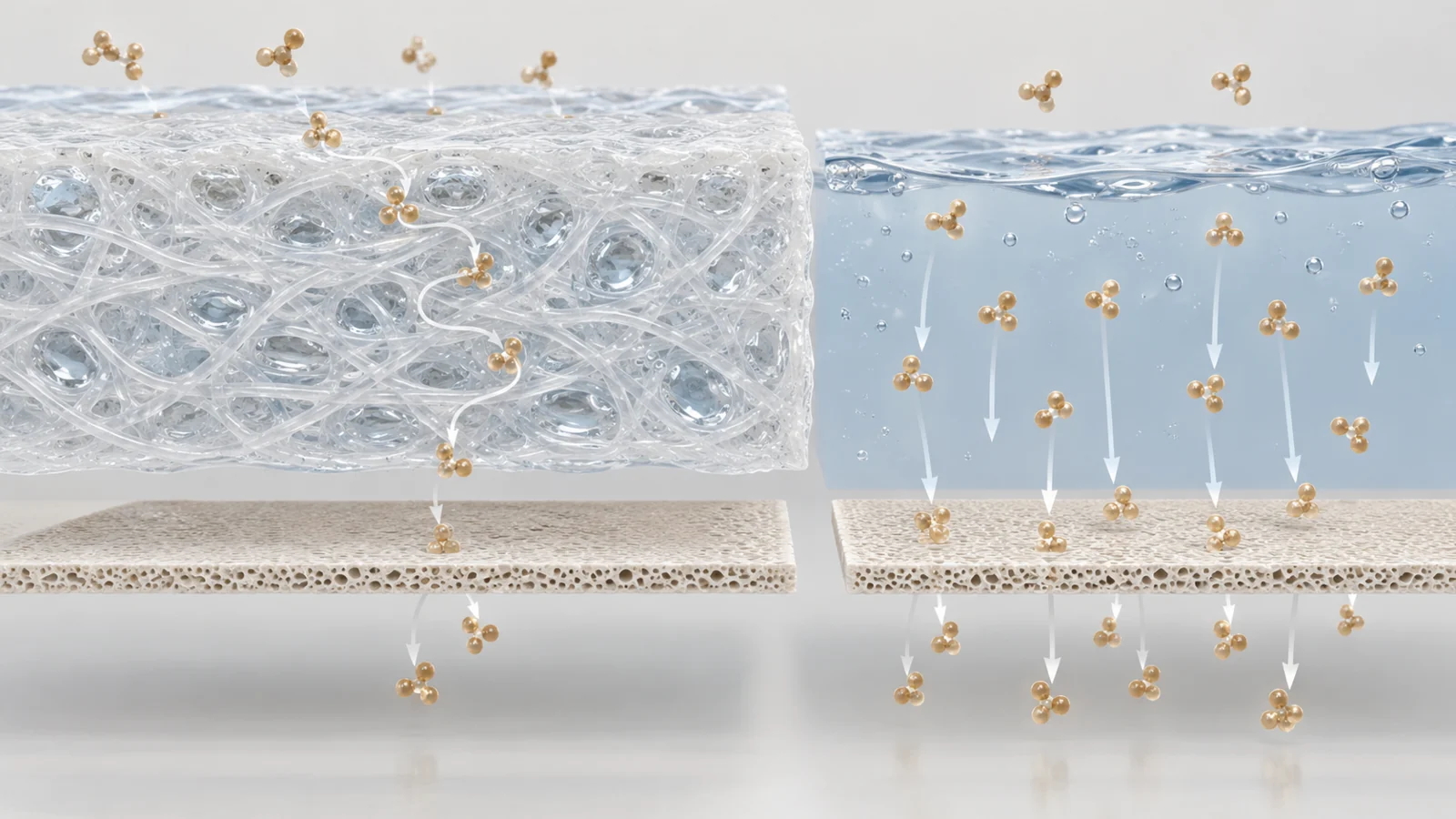
A close-fitting bacterial-cellulose face mask might seem like a direct route for an ingredient into skin. Yet in a laboratory comparison summarized in a 2021 review, less caffeine passed through an epidermal membrane from a bacterial-cellulose sheet than from a simple water-based solution. After 10 hours, the sheet delivered 0.39% of the applied caffeine dose through the membrane, compared with 0.97% from the solution.
The result is a useful reminder that holding an ingredient against skin and moving it through a skin barrier are different jobs. A material can carry a substance, release it gradually, or keep it from moving onward. Those behaviors depend on both the material and the ingredient. The review describes bacterial nanocellulose as a versatile option for cosmetics, while showing why each proposed use needs its own formulation and performance checks.
A close-fitting sheet can still slow movement
Bacterial nanocellulose, or BNC, is cellulose assembled by bacteria into exceptionally fine fibers. The fibers form an interlaced, porous network that holds a large amount of water. In the review, BNC membranes are described as having water content above 90%, with pores typically smaller than 10 micrometers. The resulting material can be made into a flexible, wet sheet that is sturdy enough to handle and can adhere closely to skin.
That structure helps explain why BNC has attracted interest as a carrier for skin-active ingredients. A sheet can hold a dose over an area and remain in contact with the skin. But close contact alone does not determine how quickly an ingredient crosses a membrane. The network also creates a route through the material that molecules must travel before they reach the skin barrier.
In the caffeine experiment discussed by the review, BNC membranes loaded with caffeine had a measured flux of 2.55 micrograms per square centimeter per hour. The aqueous solution’s flux was 7.53 micrograms per square centimeter per hour. The cumulative amounts that crossed the epidermal membranes after 10 hours were 0.39% and 0.97% of the applied dose, respectively. The review suggests that caffeine may follow a more winding diffusion path through BNC’s three-dimensional fiber network, slowing its release.
A slower release could matter in a product designed to keep delivering an ingredient over time. The experiment, however, measured passage through epidermal membranes in vitro. It does not show that a BNC mask works better on people, or that slower passage produces a cosmetic effect. It illustrates a material behavior that formulators can investigate, not a human outcome.
Sheet masks are an established use; delivery is ingredient-specific
By the review’s 2021 publication, BNC sheet masks were already sold as cosmetic products. The sheet’s strength when wet, elasticity, and ability to sit against the skin make it suitable for this familiar format. Some commercial masks were made of biocellulose, a product term used for this material.
The existence of masks does not settle how reliably they deliver every ingredient. A face mask is a format; its performance depends on what is loaded into it and how that substance moves through the sheet, formulation, and skin barrier. The caffeine comparison offers one example of slower passage. A different ingredient can behave differently.
Retinol, a poorly water-soluble ingredient, shows another challenge. In a system described in the review, retinol was loaded into polymer nanoparticles, which were then combined with BNC gel. The retinol left the nanoparticles gradually, but much of it precipitated and remained trapped in the cellulose gel. In other words, release from the first carrier did not ensure that the ingredient stayed dissolved and available in the surrounding material.
BNC’s water-loving structure is part of its appeal for water-rich sheets, but it can complicate the handling of ingredients that do not dissolve readily in water. Combining BNC with other materials may help create a more suitable environment, though the retinol example shows that the ingredient’s journey must be followed beyond the point where it leaves its original carrier.
There is also a preparation tradeoff when ingredients are added while the bacteria are making the cellulose. The finished sheet is washed and treated to purify it; water-soluble compounds added during growth may be lost during those steps. Researchers therefore need to check what remains in the purified material, rather than assume that adding a substance to the culture means it will be present in the final product.
Fine fibers can stabilize droplets instead of carrying a dose
BNC can also be processed into fine cellulose fibers for a different task: helping keep oil and water mixed. In a Pickering emulsion, solid particles gather at the boundary between droplets and the surrounding liquid, helping resist separation. This is distinct from using a sheet to carry an active ingredient toward skin.
The review describes early work in which bacterial-cellulose fibers were chemically modified to change their size and their interaction with water and oil. In a test emulsion made with liquid paraffin, one preparation was reported to resist separation by creaming and coalescence during storage at room temperature over eight months. That finding concerns a particular particle preparation and test mixture. The review identifies a next performance boundary: whether such fibers work in realistic cosmetic formulations, and how they affect the release and skin penetration of ingredients carried by those formulations.
This matters because an emulsion stabilizer is judged by how it behaves inside a complete product, alongside its other ingredients. A result in a model oil-and-water mixture is a starting point for that question, not evidence that cellulose fibers can broadly replace conventional cosmetic stabilizers.
A proposed plastic-bead substitute depends on particle control
Another possible use begins with BNC sheets dried and ground into powder. A patent discussed by the review proposed this powder for cosmetics such as scrubs and lotions, where small particles can serve roles associated with plastic microbeads. Conventional microbeads have been used for decorative or exfoliating purposes, and their persistence in the environment has raised concern. Cellulose offers a bio-based material to investigate for these applications.
A powder is not automatically a functional substitute for every bead. Particle size, shape, and hardness affect how it feels and performs in a product. The review points to the need for production methods that can make particles with consistent dimensions and properties at useful scale and cost. The patent is an early proposal, not proof of broad replacement or of a whole-product environmental advantage.
Manufacturing and product checks shape the prospect
BNC is grown through bacterial fermentation, and the culture medium contributes substantially to production cost. The review cites estimates ranging from about €60 to €9,000 per kilogram across different media. That wide spread reflects different production conditions; it is not a universal price for cosmetic-grade BNC. Researchers have explored lower-cost feedstocks, including agricultural and food-industry by-products, while improvements to fermentation systems and productive bacterial strains may also affect yield and cost.
Product consistency matters alongside the cost of making the material. For masks, the review discusses methods that can assess whether water and ingredients are distributed evenly within and across batches, and whether the mask formulation remains stable over time. Those checks help establish whether a product can be made consistently and how long it may remain suitable for use.
What more precise cellulose masks could change
If manufacturers can produce BNC consistently at competitive cost and tailor its structure to particular ingredients, the material could support cosmetic sheets and other formulations that rely less on some petroleum-derived polymers. The route to that possibility runs through dependable production, ingredient-specific delivery, and stable finished products; no single mask test or particle proposal establishes the environmental or performance advantage of a complete cosmetic. By 2021, BNC had moved beyond a laboratory material in sheet masks, while its wider role still depended on matching each form of cellulose to the job a product needs it to do.
Key Sources
- Primary source: Bacterial Nanocellulose toward Green Cosmetics: Recent Progresses and Challenges.
DOI or Journal Page · Review or Meta-Analysis · 2021-03-11
Keep exploring