
Research Signal – Source date 2026-03-01
The gut microbiome is already part of the conversation about cancer immunotherapy: microbes in the intestine can influence immune activity throughout the body. But bacteria may also live within tumor tissue, close to the immune cells that encounter cancer there. A systematic review published March 1, 2026, brings together research on this less familiar setting and describes ways those local communities may shape the immune response.
The review’s central insight is that bacteria inside a tumor are not simply another measure of the gut microbiome. Their possible effects unfold within a particular tumor environment, where location and cancer type can matter. The evidence points to several routes through which tumor-resident bacteria may relate to immune activity, but it does not yet turn those routes into a treatment rule.
Three routes through the tumor’s immune environment
Some reported microbial effects may help immune cells recognize and attack cancer. Antigen presentation is the process of displaying pieces of a target so immune cells can identify it. When that process supports a Th1 response—a type of immune activity associated with coordinating attacks on threats—it may help bring antitumor defenses into focus.
Other reported effects point in the opposite direction. Regulatory T cells normally help restrain immune responses; within a tumor, their recruitment may dampen activity that could otherwise target cancer. Stromal remodeling—the alteration of the supportive tissue around tumor cells—can also change the environment in which immune cells move and act.
A third route involves signals that influence immune checkpoints, the controls that regulate immune-cell activity. The review describes microbial signaling associated with checkpoint modulation and T-cell exhaustion, a state in which T cells become less effective after sustained activity. These pathways give researchers reasons to investigate local microbes alongside immune responses. They do not show that changing the microbes would improve a patient’s response to checkpoint treatment.
Location changes the meaning of a microbial finding
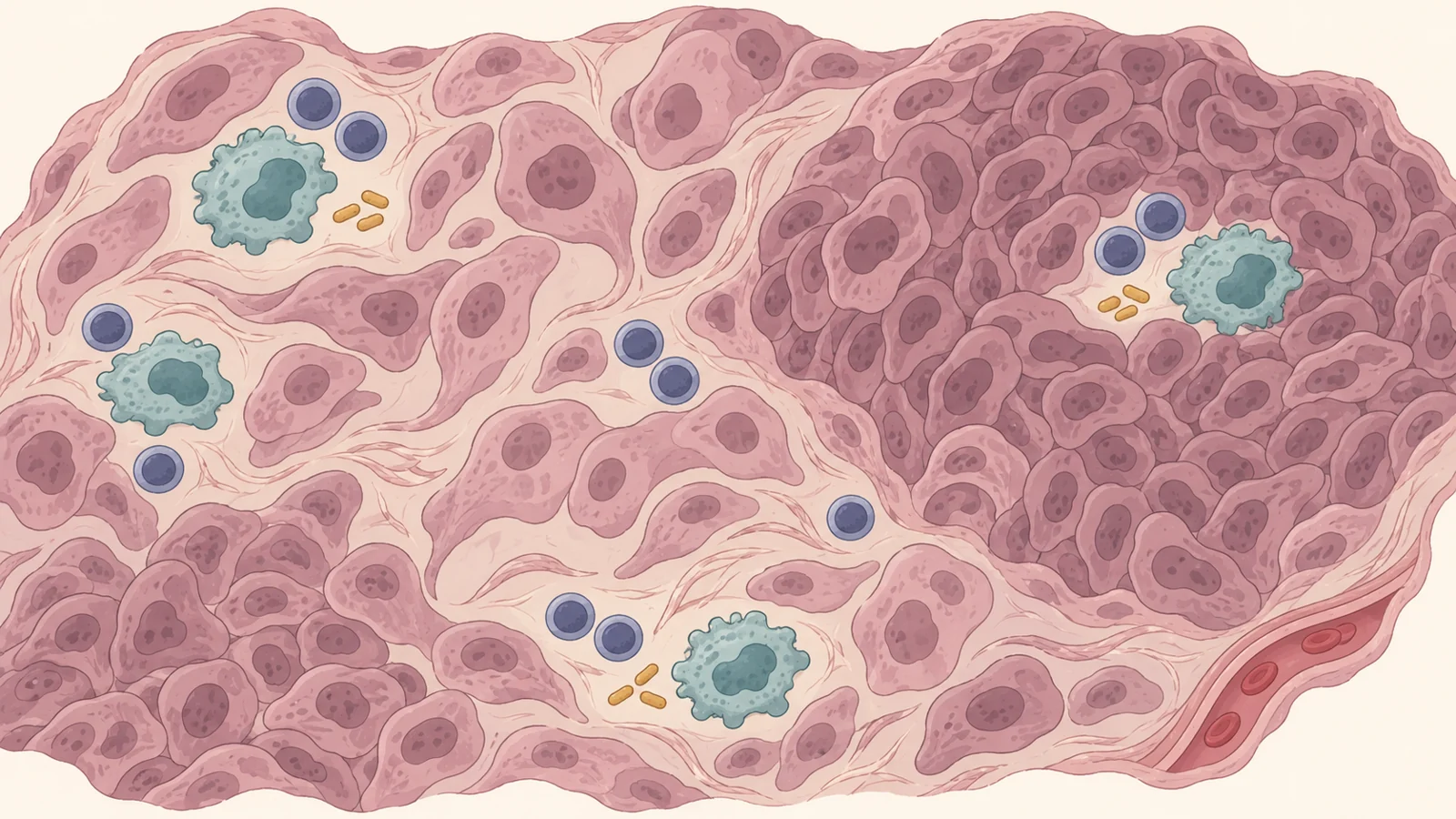
A tumor is not necessarily uniform from edge to center or from one region to another. The review describes microbial effects as spatially structured: where bacteria occur in tumor tissue may matter to the immune cells and other local conditions around them. A single label such as “bacteria present” could therefore conceal meaningful differences in arrangement and neighborhood.
Cancer context adds another layer. The studies covered melanoma, pancreatic, esophageal, gastric, breast, lung and colorectal cancers. Across these settings, the review found recurring categories of immune effects, yet the reported patterns depended on tumor context. The presence of bacteria cannot be treated as a universal sign of stronger or weaker immunity. A microbial pattern that matters in one cancer or tissue location may not carry the same meaning elsewhere.
That complexity is one reason the idea is interesting as a research direction rather than ready-made clinical guidance. A future test would need to identify patterns that can be measured consistently and shown to add useful information for a particular treatment decision.
Seventeen studies, with no single pooled estimate
Following PRISMA reporting guidelines, the authors searched PubMed, Scopus, Web of Science and EMBASE for studies published from January 2010 through April 2025. The 17 included studies examined microbes inside tumor tissue, rather than in the gut, and measured aspects of immunity or response to checkpoint treatment. Their measures included T-cell presence in tumors, immune signals and levels of PD-L1, a checkpoint-related marker.
Those endpoints describe different parts of the immune response and treatment experience. Because the studies did not measure the same outcomes in a sufficiently comparable way, the authors did not perform a meta-analysis. The review therefore offers a synthesis of reported mechanisms and patterns, not a pooled estimate of how large an effect is or whether it points in the same direction across cancers.
The findings also leave a gap between a plausible biological role and a dependable clinical test. They do not establish that altering tumor bacteria improves treatment outcomes, or validate a microbial profile for choosing therapy. Reproducible sampling and measurement, along with prospective clinical testing, would be needed before a local microbial pattern could guide decisions.
What this could make possible
If future studies identify a reproducible microbial pattern inside tumor tissue and show that it improves predictions of response to checkpoint treatment, clinicians could eventually use that information when assessing treatment options. This review supplies a reason to investigate that possibility: tumor-local microbes are associated with immune mechanisms that vary by location and cancer context. Dependable profiling and proof of added clinical value would be separate advances, not results established here.
A meaningful nearer milestone would be an independent prospective study testing whether a spatial microbial pattern predicts treatment response beyond existing markers. If that added value holds up, local microbial profiling could become one more evidence-based part of precision immunotherapy. The benefit would depend on validation; the current review identifies a frontier for testing, not a new treatment signal ready for patients.
Key Sources
- Primary source: The tumor microbiome and cancer immunotherapy: A systematic review of a new frontier beyond the gut.
DOI or Journal Page · Review or Meta-Analysis · 2026-03-01
Keep exploring