
Research Signal – Source date 2023-12-05
Bacteria can help concrete deteriorate. Could other bacteria help protect it? A study published on December 5, 2023, tested that possibility by cultivating a mineral-containing film on concrete surfaces before exposing them to seawater. The treated specimens lost less mass and strength than concrete left to develop its own naturally occurring microbial coating.
The useful finding goes beyond a surface that looks less damaged. The researchers combined measurements of concrete deterioration with observations of mineral deposits and the bacteria living around them. Together, those results offer a way to understand how a biological coating might work—and why judging marine concrete by appearance alone can be misleading.
Concrete cubes in a seawater tank
The team used concrete made with seawater and sea sand, together with Portland cement, pulverized fuel ash, aggregates, and a superplasticizer. This formulation matters because the study concerns a particular construction material, rather than every kind of concrete exposed to the ocean. The specimens were cubes measuring 10 centimeters on each side, cured for 28 days before testing.
To prepare the coating, the researchers enriched seawater bacteria that produce urease, an enzyme involved in breaking down urea. They applied bacterial suspensions together with a urea–calcium chloride solution. Three bacterial concentrations were tested, ranging from about one million to ten million colony-forming units per milliliter. After 24 hours, the specimens entered the exposure tank.
Untreated cubes were allowed to develop natural biofilms, the communities of microorganisms that attach to a surface. A separate chemical-corrosion comparison group had its surface microorganisms removed with ethanol every week. That treatment provided a practical comparator for examining the additional deterioration associated with microbial colonization.
The main experiment lasted 42 days at 18–22 °C, using seawater collected at Tsim Sha Tsui Pier in Hong Kong’s Victoria Harbour. Water circulated through the tank, and half was replaced weekly. Some specimens remained submerged. Others spent 16 hours in seawater and eight hours out of it each day, creating a simplified tidal exposure. This distinction let the team examine how the same treatments behaved under continuous immersion and repeated wetting and drying.
A mineral layer interrupts a corrosive cycle
Concrete corrosion does not require rust. Microbes can contribute to chemical reactions that attack the cementitious material itself. In the sulfur cycle described by the researchers, sulfate-reducing bacteria convert sulfate into sulfide. Sulfur-oxidizing bacteria can then convert sulfide into sulfuric acid. The acid attacks the concrete matrix, with the formation of minerals such as gypsum and ettringite contributing to expansion and fractures.
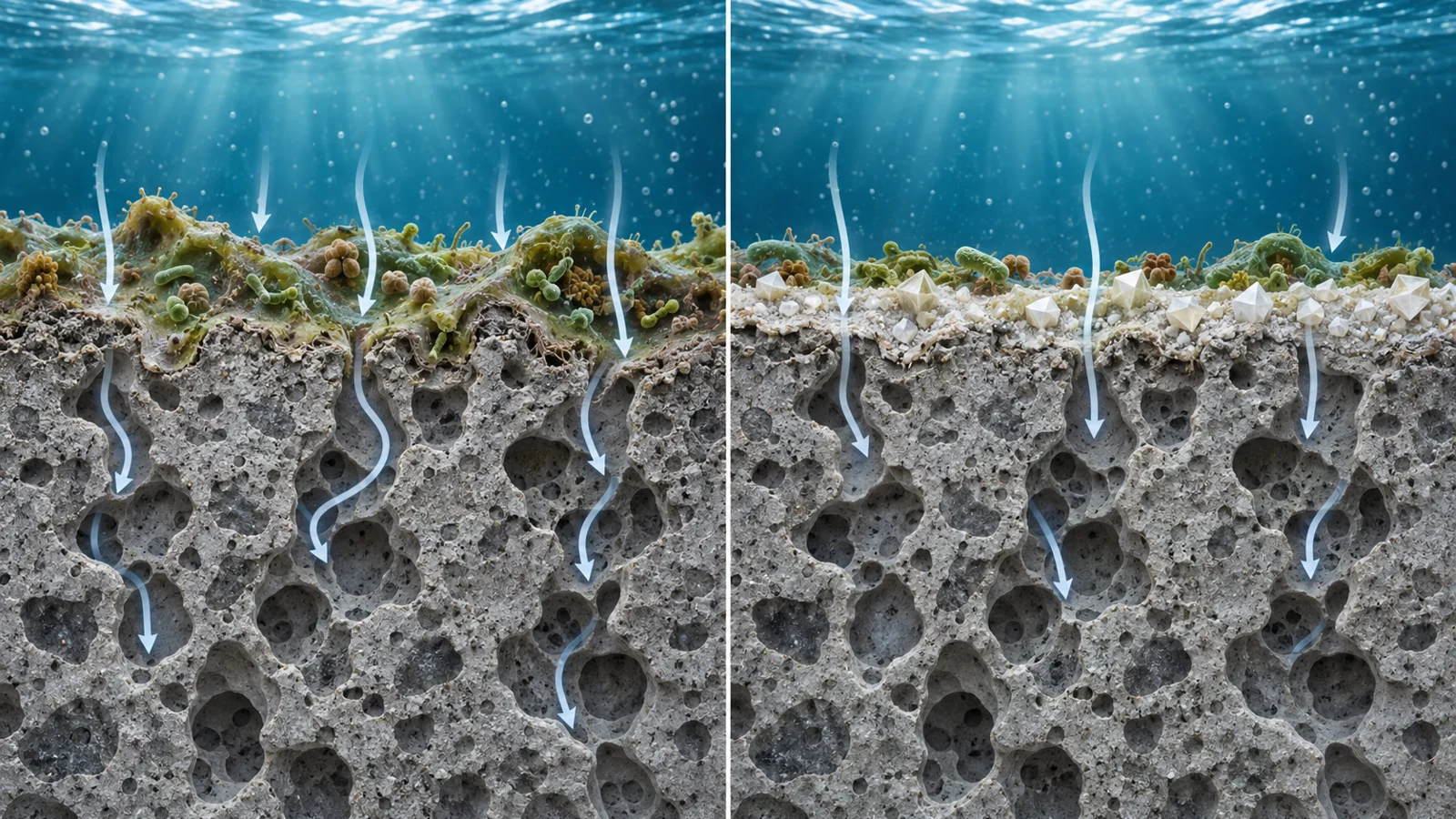
The proposed coating changes conditions at the boundary between seawater and concrete. Microscopy showed a compact, relatively uniform film containing abundant calcium carbonate crystals on treated surfaces. Their shape was consistent with calcite, a form of calcium carbonate. Untreated specimens exposed to microbial corrosion instead showed dense biofilms, pitting, and corrosion products.
One proposed defense is physical. A compact mineral-containing layer can restrict the movement of sulfate toward and into the concrete. The treated specimens contained less sulfate internally, and the researchers calculated smaller diffusion coefficients and shallower penetration, supporting that barrier interpretation. The film was not an impermeable seal; it reduced transport under the conditions tested.
A second proposed defense involves colonization. The bacteria cultivated for mineral formation could occupy attachment sites and compete for nutrients with sulfate-reducing bacteria. The researchers found lower total abundances of those potentially corrosive bacteria on treated samples. The mineral and microbial observations therefore point to complementary effects, although they do not independently establish how much of the benefit came from each mechanism.
Strength tests go beyond appearances
A convincing protective coating needs to preserve the material beneath it. The researchers weighed specimens before and after exposure, tested their compressive strength, and measured the apparent volume of permeable voids—an indicator of the pore space accessible to water. These measurements address different aspects of deterioration that a photograph cannot capture.
Untreated microbial-corrosion specimens performed worse than the chemical-corrosion comparators. The reported ratios of mass-loss rates were 2.71 under submerged conditions and 2.40 under tidal conditions. For strength-reduction rates, the corresponding ratios were 3.99 and 3.00. In this experimental comparison, allowing natural microbial colonization substantially increased the damage measured in the concrete.
The biomineralized specimens fell between those groups. They lost less mass and strength than the untreated microbial-corrosion specimens, but more than the chemical-corrosion comparators. They also had fewer permeable voids than the untreated microbial group. This is evidence of corrosion inhibition, with residual deterioration still present.
Higher bacterial concentrations generally produced better resistance within the tested range. That result does not establish that adding ever more bacteria would keep improving performance. It shows that the initial coating conditions affected the outcome and would need to be controlled in any practical application.
The detailed microbial investigation centered on the 42-day exposure. The paper also describes a six-month corrosion experiment in which treated specimens maintained a resistance advantage in mass loss and strength reduction. Those longer observations extend the mechanical evidence beyond the main experiment without turning it into a measurement of a structure’s service life.
Tides can move damage out of sight
The tidal specimens illustrate why surface appearance can give an incomplete account of concrete deterioration. Compared with continuous immersion, alternating wetting and drying produced higher internal sulfate concentrations, larger increases in permeable voids, and greater strength reduction. Yet some surface signs of corrosion were less pronounced.
The researchers explain this pattern through transport. During wetting and drying, changing pressure conditions in pores and cracks can help move sulfate-bearing water inward. Sulfate can therefore accumulate inside the material even when the surface carries fewer visible corrosion products. Cracks observed in the tidal groups were attributed mainly to the repeated wetting and drying.
This separates two questions that can otherwise become blurred. The amount of material visible on a concrete surface describes what has accumulated there. Measurements within the specimen and tests of its strength reveal what has happened beneath it. For a tidal structure, those answers may differ enough to change an assessment of damage.
A smaller bacterial population can have a larger share
The microbial results contain a similar distinction. Total abundance describes how much of a bacterial group is present. Relative abundance describes that group’s share of the community. A treatment can reduce the first while temporarily increasing the second if other organisms decline more strongly.
That happened early in the experiment. At day 14, sulfate-reducing bacteria made up a higher relative proportion in treated biofilms than in untreated microbial-corrosion biofilms, despite their lower total abundance. The authors proposed that oxygen consumption during film formation restricted aerobic bacteria, while many sulfate-reducing bacteria could persist in oxygen-poor conditions. Later community changes altered those proportions.
Measurements of the microbial gene marker dsrB supported a lower total abundance of sulfate-reducing bacteria in treated samples. Such gene measurements help track the organisms associated with a process; they do not directly measure the rate at which those organisms are carrying it out. Their value here comes from being interpreted alongside the sulfate measurements and concrete tests.
Over time, the treated and untreated biofilm communities also became more similar. The authors attributed this partly to subsequent colonization on top of the existing mineralized film. The observation suggests that a protective layer could remain beneath a surface community increasingly resembling a naturally formed biofilm. It is the specific basis for the authors’ interpretation of limited community disturbance, rather than evidence that the treatment removes marine microbial life.
The distance from a tank to a coastline
Turning this result into infrastructure protection requires a coating that keeps functioning under much longer and more varied exposure. The experiment used one concrete formulation, seawater from one location, and controlled immersion cycles. Different concrete surfaces can support different microbial communities, and the authors identify surface type as a factor that could change performance.
Durability also involves the coating itself. For coastal use, its attachment and mineral structure would need to withstand physical wear and changing seawater conditions while remaining practical to apply over large surfaces. The tested dose response is useful for developing that process, but it cannot yet specify a universal coating recipe or maintenance interval.
The six-month mechanical observations cannot tell an engineer how many additional years a pier or seawall would last. Translating specimen results into service life requires evidence connecting the treatment to deterioration under operating conditions. Likewise, possible filling of small pores or surface cracks is one explanation discussed for the material results, not a demonstrated ability to repair structural cracks.
Environmental interpretation needs a broader scale as well. Increasing similarity between the observed biofilm communities is encouraging, but community composition on concrete does not establish safety throughout a marine ecosystem. And calcium carbonate formation alone does not establish a net climate benefit. Evaluating that benefit would require accounting for coating production, application, upkeep, and any construction or repairs avoided through greater durability.
What this could change
If a bacteria-grown mineral film can retain its function on exposed marine structures, it could offer a way to slow deterioration at the concrete surface before extensive damage develops inside. Preserving strength for longer could allow longer intervals between major repairs, reduce replacement material, and limit disruption to coastal infrastructure.
That potential benefit follows a concrete chain of events: a durable surface treatment would restrict corrosive exposure, slower deterioration would preserve usable material, and longer use could reduce the need for reconstruction. The present study contributes laboratory evidence for the early steps in that chain. Establishing the later steps would make the approach valuable as a means of maintaining marine infrastructure with fewer repeated interventions.
Key Sources
- Primary source: Biomineralization To Prevent Microbially Induced Corrosion on Concrete for Sustainable Marine Infrastructure.
DOI or Journal Page · Peer-Reviewed Paper · 2023-12-05
Keep exploring