
Research Signal – Source date 2024-10-16
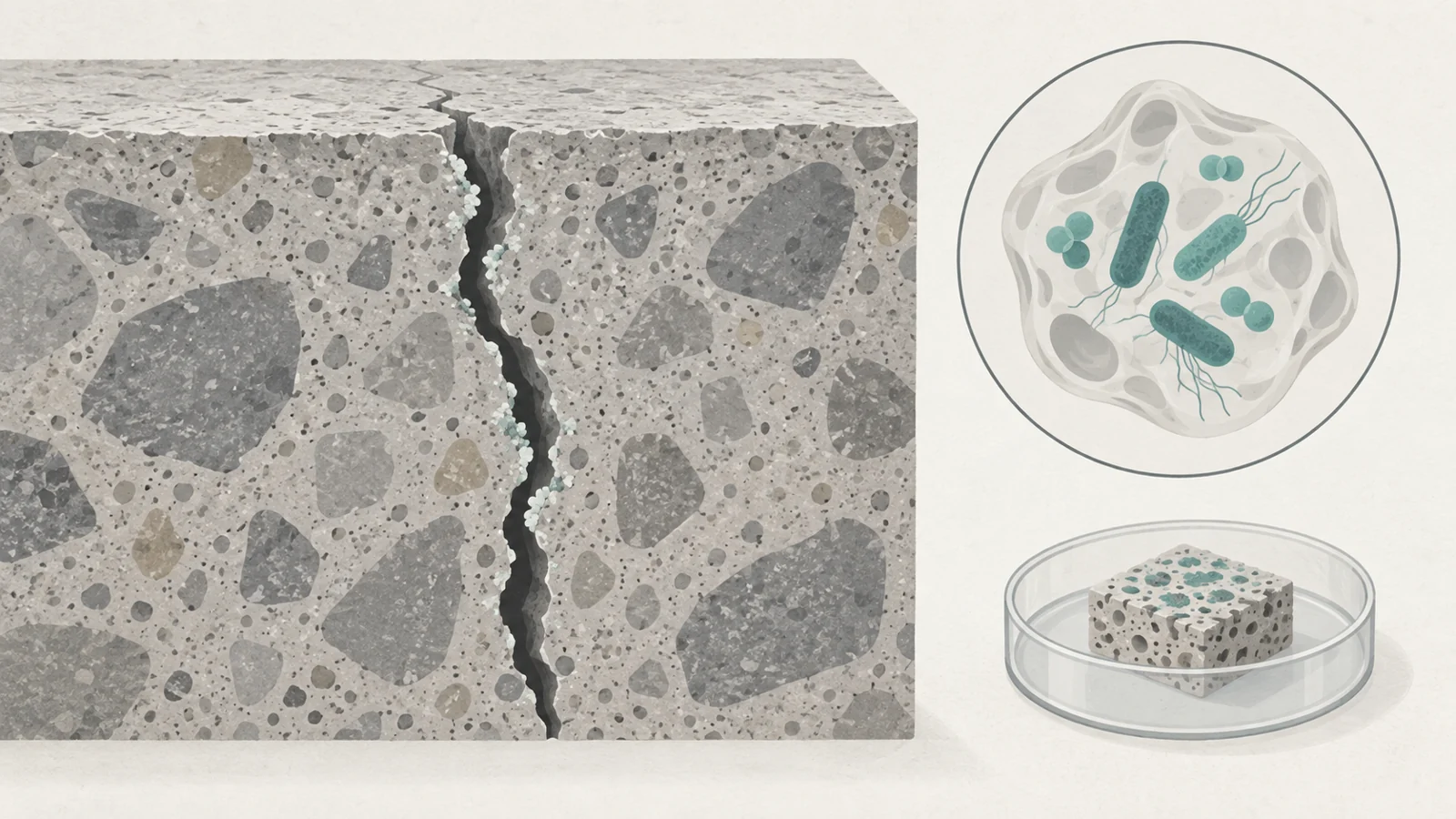
Concrete that repairs its own small cracks does not automatically replace cement. A review published on October 16, 2024, connects these two ambitions through bacterial mineral formation. One direction seeks to improve concrete’s ability to heal microcracks. The other explores living materials as potential alternatives to traditional construction materials, with reduced cement consumption as a goal.
The motivations are related but distinct. Concrete maintenance and repair can be costly, while Portland cement production contributes to carbon dioxide emissions. The review’s abstract brings both problems into view, helping explain why researchers are interested in bacteria for more than one construction role.
Why keeping bacteria active matters
The shared process is microbially induced calcium carbonate precipitation, or MICP. In plain language, bacteria drive the formation of a mineral called calcium carbonate. Research on self-healing concrete—concrete intended to repair small cracks—uses this mineral-forming activity as the basis for healing.
That makes the bacteria’s condition part of the material’s function. Their presence alone is not enough; they must remain viable and capable of the activity needed for mineral formation. The review identifies bacterial carriers as a way to help maintain that viability and activity, potentially improving microcrack healing. Their role is to support the biological component on which the healing process depends. The abstract supports this functional explanation without identifying a particular carrier design to recommend.
Repairing concrete and developing a substitute
In the repair approach, concrete remains the construction material. Bacterial activity adds a possible healing capability to it. Success at that task would address how the material is maintained, but would not by itself demonstrate that less cement is needed to make it.
Engineered living materials pursue a broader construction ambition. These materials bring together biology and material science; the review describes a direction combining synthetic biology with MICP-based material development. Here, bacterial mineral formation is part of developing potential alternatives to traditional construction materials. The intended change concerns what builders could use, extending beyond how existing concrete might repair itself.
This distinction matters when interpreting claims about “bacterial concrete.” Better microcrack healing and a workable alternative material answer different practical questions. Progress in one cannot simply be counted as success in the other, even when both draw on the same mineral-forming process.
Commercial use brings a wider test
The review explicitly highlights economic challenges and environmental concerns around commercial-scale MICP. Those concerns bear directly on its appeal. A method motivated by expensive repairs still needs a practical economic case. Likewise, an ambition to reduce cement consumption does not, on its own, establish a lower overall environmental impact.
The abstract provides an account of research directions, rather than enough detail to assess those tradeoffs. It cannot support estimates of healing performance, repair savings, material strength, or net lifecycle emissions. Nor does this abstract-level account establish performance in everyday construction or equivalence to conventional structural materials. Those are limits on what can be concluded here, not claims that the full paper omits such topics. From the October 2024 perspective, the commercial questions remain central to interpreting the proposed benefits.
What this could change
If maintaining bacterial activity enables useful microcrack healing under practical conditions, infrastructure owners could face a smaller repair burden. The causal step would be a material handling some small cracks through its own mineral-forming capability, reducing the need for interventions directed at those cracks.
If engineered living alternatives also become technically, economically, and environmentally workable, builders could gain additional material choices that reduce demand for conventional cement-based materials. That would affect the materials selected for construction, alongside any benefits from maintaining existing concrete. The two possibilities offer different routes to changing construction’s resource demands.
Key Sources
- Primary source: Advanced bacteria-based biomaterials for environmental applications.
DOI or Journal Page · Review or Meta-Analysis · 2024-10-16
Keep exploring