
Research Signal – Source date 2023-05-07
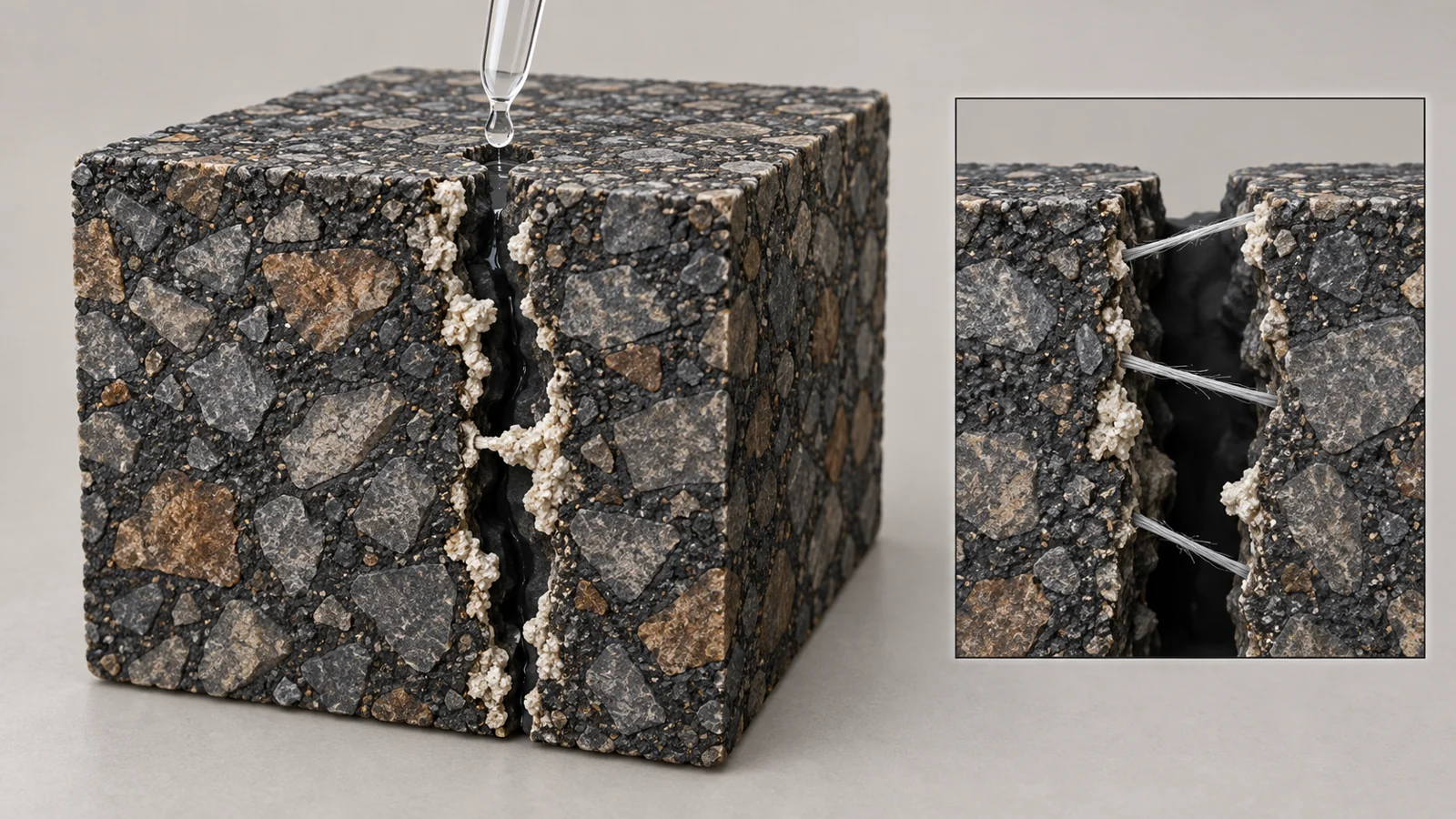
Pale mineral deposits gradually closed the openings in cracked asphalt specimens. After eight days of treatment, their surfaces looked almost completely sealed. But a closed opening leaves a practical question unanswered: how much force can the repaired material carry?
A laboratory study published on May 7, 2023, investigated that question using deliberately formed cracks. Researchers supplied bacteria and a mineral-forming solution, then measured sound transmission, strength and deformation under sustained pressure. For cracks between 0.5 and 1.5 millimeters wide, the treatment improved several measured properties, with the strongest repair performance in the smallest cracks. A separate experiment examined whether fibers could help the mineral treatment bridge a 3-millimeter gap.
The distinction between appearance and function is central. Mineral can cover a crack opening while the material beneath it remains mechanically compromised. These experiments offer evidence of partial strength recovery in prepared specimens, giving engineers more to assess than photographs of a sealed surface.
Growing mineral inside a prepared crack
The treatment uses microbially induced calcite precipitation, or MICP—bacteria-driven formation of calcium carbonate mineral. The researchers introduced bacterial culture and a cementing solution containing urea and calcium chloride into existing cracks. Bacterial activity promotes the chemistry that produces solid mineral deposits from the supplied ingredients.
This was an externally applied repair process. The specimens received cultured bacteria, chemical solution and treatment equipment; they did not initiate repair by themselves. For the smaller cracks, a peristaltic pump delivered the bacterial and cementing solutions by drip injection during an eight-day treatment period. The intervention depended on getting liquid into the gap and allowing mineral to accumulate there.
The asphalt specimens were cubes about 71 millimeters on each side. Their regular cracks were formed with removable plastic sheets. The 0.5-, 1.0- and 1.5-millimeter openings were each 30 millimeters deep and 40 millimeters long. That controlled geometry let the researchers examine width while keeping these other dimensions fixed. Across the study, they prepared 60 cracked specimens and 12 intact controls.
Surface observations showed progressive deposition over several days. Microscopy and elemental analysis supported the identification of calcium carbonate deposits; the authors described predominantly spherical calcite particles, mostly smaller than 10 micrometers. These tiny particles supplied the mineral material that accumulated along the crack faces.
What returned when the specimens were tested
The researchers first used ultrasonic pulses to examine the specimens without breaking them. After treatment, sound traveled faster through all three smaller-crack groups. In the 0.5-millimeter group, velocity rose from about 1,545 to 1,825 meters per second, an increase of roughly 18%.
Faster transmission is consistent with improved continuity through the damaged material. It is useful evidence that the interior has changed, but it does not directly measure the load a specimen can withstand. For that, the researchers compressed samples until failure and separately tested their resistance to splitting.
The detailed compression results make the comparison clear:
| Initial crack width | Unrepaired compressive strength | Repaired compressive strength | Repaired strength relative to intact control |
|---|---|---|---|
| 0.5 mm | 0.80 MPa | 1.05 MPa | About 79% |
| 1.0 mm | 0.70 MPa | 0.90 MPa | About 68% |
| 1.5 mm | 0.55 MPa | 0.64 MPa | About 48% |
MPa, or megapascals, expresses force per unit area. The final column uses the intact specimen as its reference. Reaching 79% of intact strength does not mean gaining 79% over the damaged specimen. For the 0.5-millimeter crack, the reported rounded values rose from 0.80 to 1.05 MPa—an improvement of about 31% over the unrepaired value, while remaining below intact strength.
The paper uses inconsistent wording for some compression percentages across its results and conclusions. Keeping the measured strengths and their reference points explicit avoids confusing an improvement after treatment with the fraction of original strength restored.
The splitting test addressed a different form of failure. Indirect tensile testing loads a specimen in a way that makes it split, probing resistance to being pulled apart within the material. Reported strengths increased from 0.091 to 0.122 MPa, from 0.070 to 0.092 MPa, and from 0.055 to 0.063 MPa across the three widths, respectively.
Together, these tests support the same width-dependent result while measuring different properties. Mineral accumulation can increase the area available to transfer load and reduce the concentration of stress around a crack tip. The gains in sound transmission, compression and splitting resistance are consistent with that explanation. They do not establish restoration of every property of intact asphalt.
Holding a load asks a different question
A specimen can survive a brief peak force and still deform while pressure remains applied. For pavement, this distinction matters because maintaining shape is part of useful performance.
The researchers examined that behavior with a static creep test, applying a constant compressive stress of 0.12 MPa. Creep is the gradual change in shape under sustained loading. The calculated creep stiffness modulus relates the applied stress to the resulting strain; a higher value means less deformation under the same stress.
After 3,600 seconds—one hour—the repaired groups had stabilized at approximately 124, 55 and 50 MPa for the 0.5-, 1.0- and 1.5-millimeter cracks. The first group therefore showed the greatest resistance to deformation under these test conditions. This adds a time-dependent measure to the strength results. It remains a sustained laboratory loading experiment, leaving performance under repeated traffic loads as a separate question.
Fibers help only if the solution can still reach them
The 3-millimeter cracks introduced another material-design problem. The researchers added basalt, polyester, glass or steel fibers while delivering the treatment solutions. Fibers could provide surfaces for mineral accumulation and connections across the gap, helping the deposits form a reinforced filling.
The glass-fiber results reveal why simply adding more reinforcement can fail. Increasing the fiber mass from 0.5 to 1.0 gram raised compressive strength by 0.27 MPa. Increasing it again to 1.5 grams reduced strength to a level comparable with the treatment without fibers. The authors attributed the decline to crowding within the crack, which made it harder for the bacterial and cementing solutions to make adequate contact. Reinforcement occupied space that the liquid also needed to reach.
Basalt and polyester fibers showed strength gains as their amounts increased over the tested range. That contrast makes fiber type and quantity part of the treatment design, rather than interchangeable additions.
These results require their own comparison. The wider cracks were 40 millimeters deep, received a different solution-delivery setup, and were tested in a different loading placement. Their absolute strengths cannot be placed alongside the smaller-crack results as one controlled ranking across all four widths. Nor do the tested fiber quantities establish a dose suitable for road maintenance or a universal maximum repairable crack width.
Real cracks complicate the route the liquid takes
The carefully shaped gaps are a major boundary between this experiment and pavement repair. The authors explicitly acknowledge that regular cracks are rare in practice. Irregular extensions make the path of the biological slurry difficult to control and can complicate where mineral attaches.
That delivery problem reaches beyond the visible opening. A liquid must enter the parts of a crack where deposits could contribute to useful load transfer. In a branching or uneven gap, the route available to the treatment may differ substantially from the straight slot in a laboratory cube. Successful application would depend on controlling access through that geometry, as well as on producing calcium carbonate.
The eight-day treatment also makes the practical requirements concrete. Translating the process into maintenance would require a workable way to supply and retain the treatment at damaged locations over the necessary period. The laboratory arrangement establishes that the intervention can be delivered to prepared samples; road-scale delivery and durability remain unresolved here.
The environmental promise needs the same care. Calling the process biological does not establish that it has lower overall impacts than conventional repair. Such a comparison would have to account for the culture, chemicals, equipment and application process alongside any pavement preservation achieved. The findings presented here do not establish comparative environmental benefits, maintenance savings or a quantified extension of service life.
What this could change
If the treatment can be delivered reliably through irregular cracks and its mechanical gains persist under road conditions, mineral formation could become a way to preserve usable asphalt around localized damage. Restoring enough load transfer and resistance to deformation could help a repaired area remain in service longer before more extensive work becomes necessary.
Fibers could broaden that possibility where a gap needs added internal support, provided they still allow treatment liquid to circulate. The potential public benefit is pavement retained in useful service through targeted repair. Reaching it depends on turning the laboratory gains into durable performance with an application process that maintenance crews can practically use.
Key Sources
- Primary source: Experimental Investigation on the Influence of Crack Width of Asphalt Concrete on the Repair Effect of Microbially Induced Calcite Precipitation.
DOI or Journal Page · Peer-Reviewed Paper · 2023-05-07
Keep exploring