
Research Signal – Source date 2022-05-31
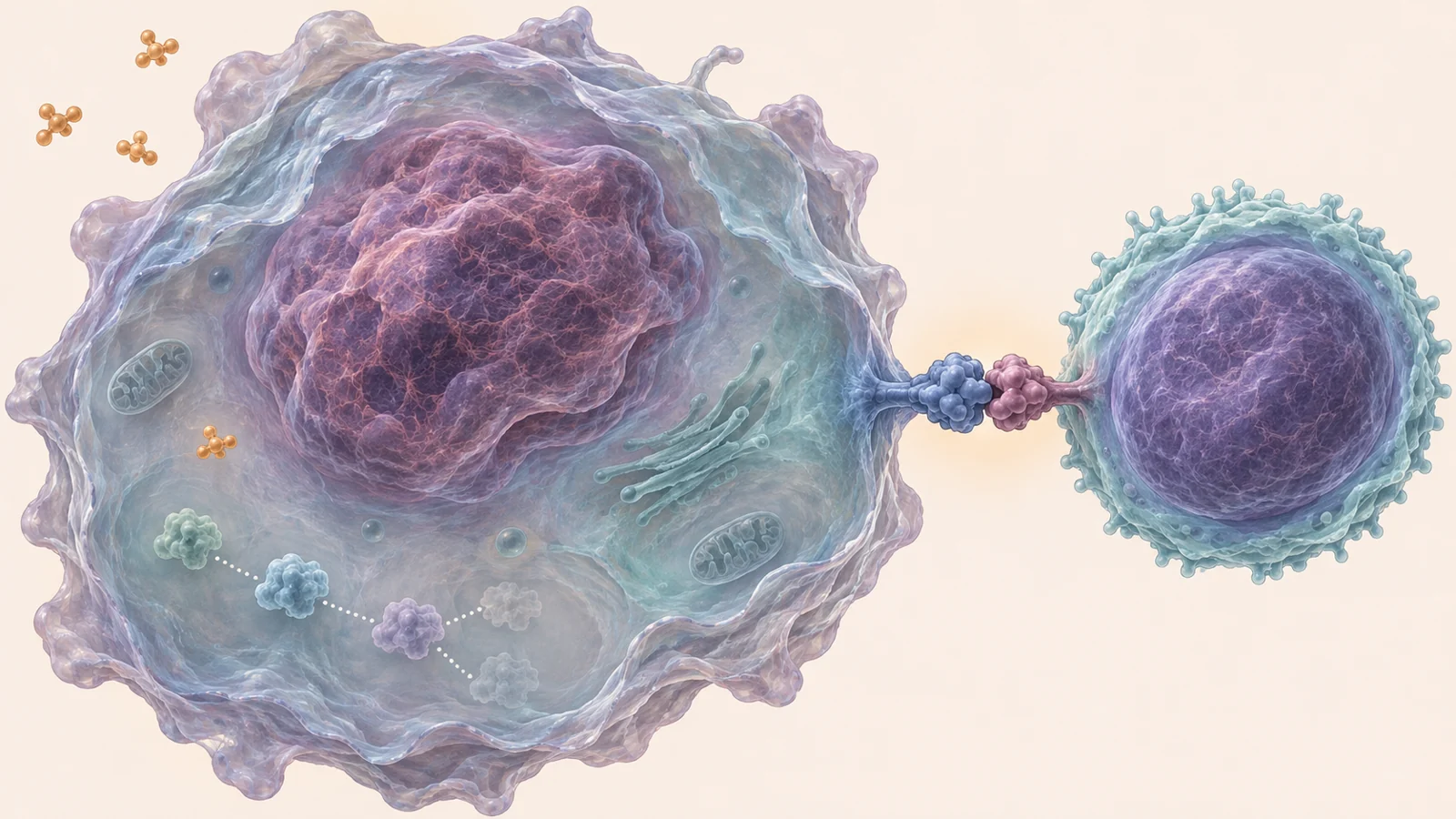
A signal known for quieting immune cells may also help some cancer cells survive chemotherapy. In breast cancer cells, reducing PD-L1 increased cell death after doxorubicin treatment. PD-L1, also called B7-H1, is best known for binding PD-1 and reducing T-cell activity. The cell experiment points to a second question: can a checkpoint molecule influence the tumor cell itself as well as the immune response around it?
A review published on May 31, 2022, brings together studies of B7 family checkpoint proteins and resistance to cancer treatments. Its examples span cell experiments, mouse models and patient tumor-expression associations. They suggest that certain B7 proteins can be involved in chemotherapy resistance, but the proposed effects vary by protein and cancer type. They do not show that targeting any B7 checkpoint will restore chemotherapy response across cancers.
A familiar immune brake may have another role
B7 family proteins help regulate immune responses. Depending on the protein and its receptor, they can stimulate or inhibit T-cell activity. PD-L1 (B7-H1) is an immune brake: when it binds PD-1, it can reduce T-cell activation and related immune signals. This interaction is part of why PD-1 and PD-L1 became targets for cancer immunotherapy.
The review also describes experiments in which PD-L1 appears connected to survival mechanisms inside cancer cells. In one breast cancer cell-line study, researchers reduced PD-L1 using a gene-silencing method and then treated the cells with doxorubicin. More of the altered cells underwent apoptosis, a form of controlled cell death. This supports a possible role for PD-L1 in how those cells responded to that drug. It does not show that patients with PD-L1-expressing tumors benefit from combining a PD-L1 treatment with doxorubicin.
Multiple myeloma cell experiments offer a possible explanation for that kind of link. In the cells described in the review, PD-L1 interacting with PD-1 was associated with activation of PI3K/AKT, a pathway that can support cell survival. The experiments connected this route with higher levels of the anti-apoptotic protein Bcl-2 and lower levels of proteins involved in cell death. When researchers reduced PD-L1 in myeloma cells and exposed them to melphalan, apoptosis increased compared with control cells. In plain terms, changing the checkpoint was associated with a weaker survival response to the drug in that model.
Triple-negative breast cancer cell experiments point to a related possibility through a different setup. Researchers removed PD-L1 from cells, exposed them to cisplatin and observed greater drug sensitivity; restoring PD-L1 reduced that sensitivity. The review also reports reduced tumor growth when an antibody against PD-L1 was combined with cisplatin in the tested model. These findings connect PD-L1 to chemotherapy response in the tested models, but do not establish a treatment benefit for people with triple-negative breast cancer.
The same family does not mean the same target
B7-H3 provides a contrast. In melanoma cell experiments, lowering B7-H3 increased sensitivity to dacarbazine and cisplatin. In mice injected with melanoma cells with reduced B7-H3, tumors grew less during dacarbazine treatment. The melanoma experiments implicated changes in a signaling route involved in drug response. In ovarian cancer cell experiments, B7-H3 was linked to resistance to cisplatin and paclitaxel, with another survival pathway implicated. These examples differ in model and proposed mechanism; the family name alone does not identify a single target.
Patient observations in ovarian cancer answer a different question. The review describes higher B7-H3 expression in patients with advanced-stage disease and an association between expression and tumor stage. That is an observation about tumor expression and disease features. It is not an intervention, nor does it establish that measuring B7-H3 can identify who would benefit from a B7-H3-targeted chemotherapy combination.
B7-H6 illustrates another distinct context. It can appear on tumor cells and engage NKp30, a receptor on natural killer cells, which can promote immune attack on tumor cells. The review also discusses soluble B7-H6 in high-risk neuroblastoma: when levels of the natural-killer-cell receptor NKp30 were reduced, soluble B7-H6 levels correlated with bone-marrow metastasis and chemotherapy resistance; in a laboratory experiment, soluble B7-H6 inhibited natural-killer-cell function. These findings concern an immune interaction and an association; they do not show that targeting B7-H6 reverses chemotherapy resistance in patients.
What the experiments can—and cannot—tell us
The evidence comes from designs that address different parts of the problem. Patient expression associations can show that a protein is found alongside a disease feature. They cannot, by themselves, show that the protein caused that feature or predict benefit from a particular treatment. Cell experiments can test whether changing a protein alters drug response in a defined setting. Mouse studies can test tumor responses in an animal model. Neither kind of model establishes that a combination improves outcomes in people.
Across the studies it summarizes, the review describes B7 family members in connection with several pathways involved in cell survival or treatment response. The examples make a biologically plausible case for investigating particular checkpoint proteins in particular cancers. But the findings do not establish that blocking B7-H1, B7-H3 or another family member reverses resistance broadly, or that a treatment tested in one cancer or model will work in another.
That leaves a practical clinical question. For a specific cancer, does a defined B7 measurement identify patients whose tumors are more likely to respond to a matched checkpoint treatment alongside chemotherapy than to chemotherapy alone? Answering it would require a reliable test and patient evidence comparing treatment outcomes. Tumor-expression associations and model experiments are a reason to ask the question, not a validated way to make that choice.
How this could shape the future
For an oncologist facing a tumor that survives an appropriate chemotherapy, a validated, cancer-specific B7 test could one day help identify a matched add-on treatment. Existing PD-L1 inhibitors provide a starting point for this idea, while the review’s tumor-cell experiments suggest one possible bridge: a checkpoint molecule may be connected to how cancer cells withstand a drug. The new capability would be a dependable link, demonstrated in patients, between a defined resistance signal and renewed response to treatment.
A nearer milestone would be a prospective patient study showing that a specified B7 measurement predicts greater benefit from a matched combination than from chemotherapy alone. That would help establish whether the test can guide treatment in that cancer. Developing the test and demonstrating patient benefit would require evidence beyond the cell and mouse experiments summarized in the 2022 review.
Key Sources
- Primary source: Targeted Therapy of B7 Family Checkpoints as an Innovative Approach to Overcome Cancer Therapy Resistance: A Review from Chemotherapy to Immunotherapy.
DOI or Journal Page · Review or Meta-Analysis · 2022-05-31
Keep exploring