
Research Signal – Source date 2021-04-01
B-cell acute lymphoblastic leukemia (B-ALL) is a blood cancer. Treatment may bring it into remission, meaning signs of the disease have subsided, but remission and long-term freedom from disease are different outcomes. A 2021 review reports similar remission rates for adults and children, yet lower long-term disease-free survival among adults. Its abstract does not explain why that gap occurs. It also describes relapse as difficult to treat: after the cancer returns, routine chemotherapy has a low remission rate and the prognosis is poor.
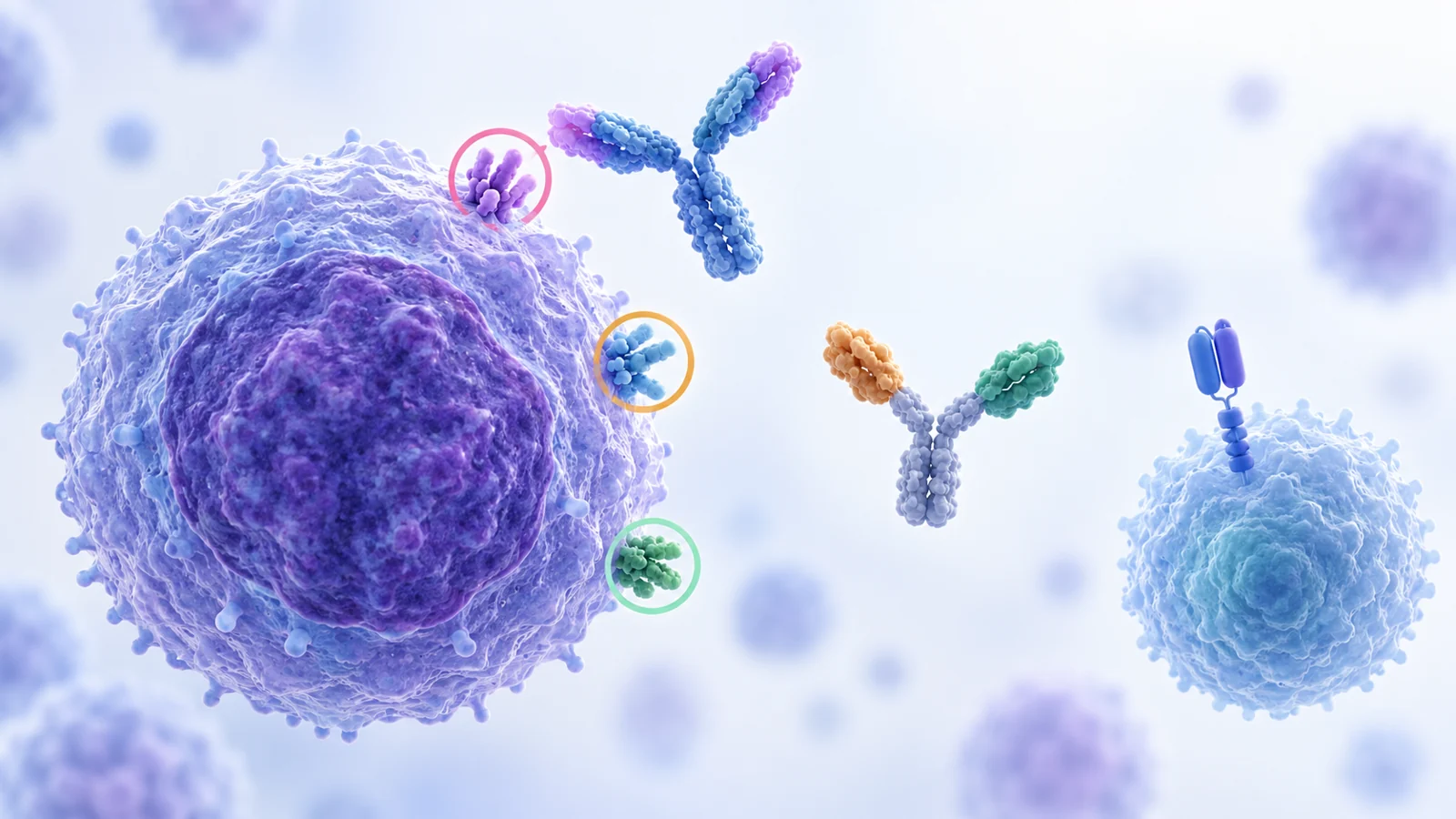
The review turns to markers on leukemia cells as potential targets for immune-based treatment. It names CD19, CD20 and CD22. The idea is to direct immune treatments toward features displayed on the cancer cell’s surface. The paper presents several approaches to doing so, especially for relapsed or refractory B-ALL, which has returned or has not responded adequately to treatment.
Surface markers give immune treatments something to recognize
A surface antigen is a feature on the outside of a cell. When leukemia cells display a particular antigen, a treatment designed to recognize it may be directed toward those cells. CD19, CD20 and CD22 are the examples highlighted in this review; they are not interchangeable labels for a patient’s disease, and the abstract does not say which markers any individual’s leukemia carries.
This target-based idea shifts attention from treating B-ALL only as a diagnosis to identifying features on the cancer cells that an immune therapy can recognize. The review summarizes progress using those features as targets. It does not establish that every patient has all three markers or could receive every treatment described.
Three ways to direct an immune response
The review names monoclonal antibodies, bispecific antibodies and chimeric antigen receptor T cells, usually shortened to CAR-T cells. Each is a distinct treatment family. A monoclonal antibody is designed to bind a particular target, such as a cell-surface antigen. A bispecific antibody is designed to recognize two targets; the supplied abstract does not specify the pair for any particular treatment. CAR-T uses immune T cells with a chimeric antigen receptor intended to recognize a target on leukemia cells.
These descriptions clarify why the three approaches belong in a discussion of surface antigens, but they do not show which works best. The review’s abstract says targeted immunotherapy can greatly improve treatment efficacy, particularly in relapsed or refractory disease. It provides no treatment-by-treatment effect estimates or safety comparison in the evidence available here, so the approaches cannot be ranked from that claim.
What this review can tell us
Published on April 1, 2021, the paper is a review of immunotherapy aimed at B-ALL cell-surface antigens, not a newly reported clinical trial. Its abstract supplies a clinical rationale: adult and childhood cases may enter remission at similar rates, long-term disease-free survival is lower in adults, and routine chemotherapy has limited success after recurrence. It then describes immune treatments directed at CD19, CD20 or CD22 as a promising area, particularly for disease that returns or resists treatment.
That overview helps explain why researchers focus on cell-surface markers. It does not provide figures that would tell a reader how often a given treatment works, how long benefit lasts, or how its risks compare with another approach. Nor does the adult–child outcome difference, on its own, identify its cause. Those questions require evidence beyond the qualitative account in the supplied abstract.
How cell-surface targets could expand treatment after relapse
If clinical evidence confirms meaningful, lasting benefit for the patients whose leukemia carries the relevant targets, marker-directed immune therapies could give people with relapsed or refractory B-ALL more effective options when routine chemotherapy has limited success. The potential lies in directing treatment at features on the leukemia cells; whether that translates into durable benefit depends on evidence for each approach and the patients it applies to.
Key Sources
- Primary source: [Research Advances in the Treatment of B-Cell Acute Lymphoblastic Leukemia Based on Surface Antigen Expression –Review].
DOI or Journal Page · Review or Meta-Analysis · 2021-04-01
Keep exploring