
Research Signal – Source date 2022-05-17
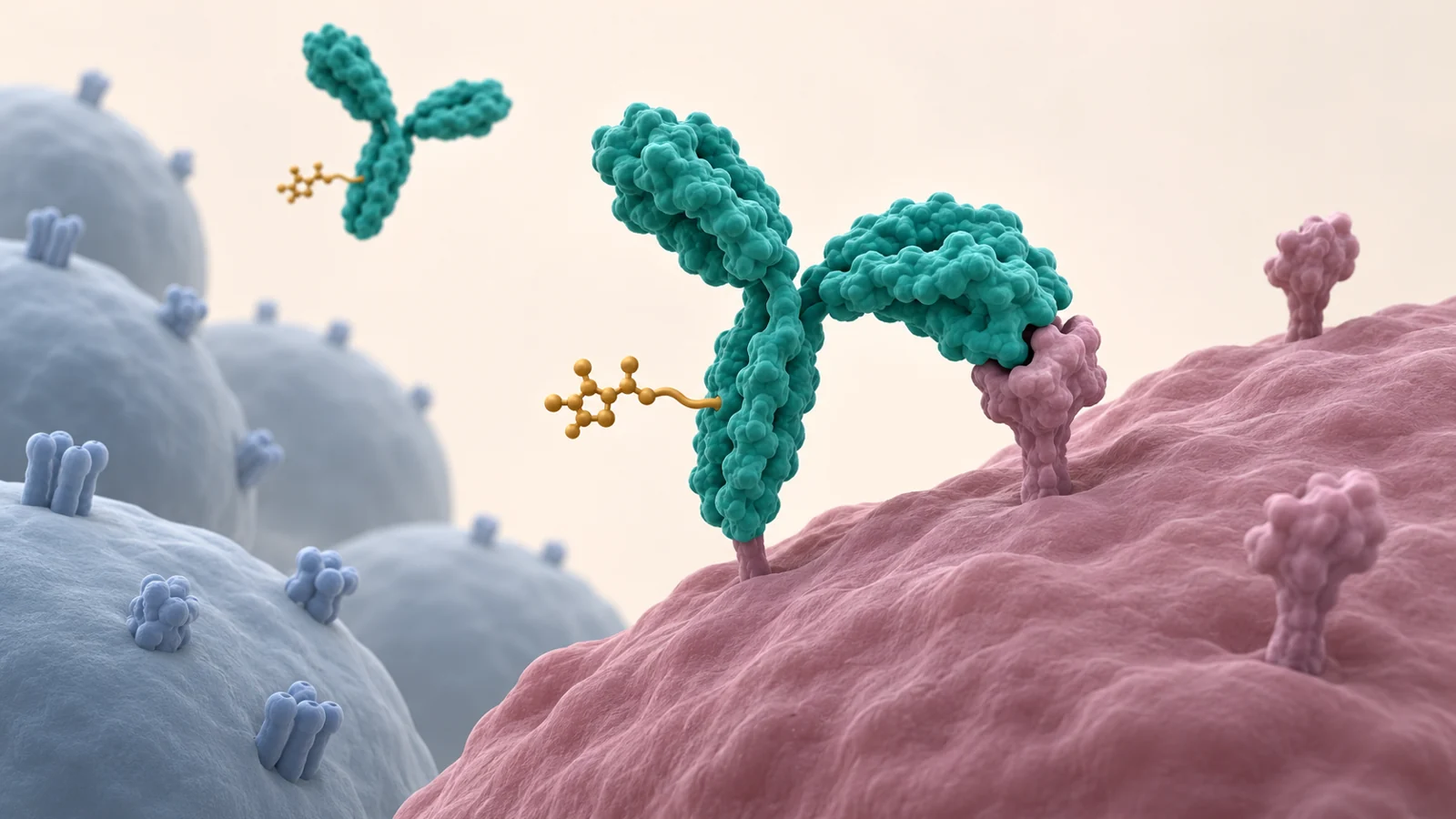
An antibody-drug conjugate is a cancer drug carried by an antibody that can recognize a matching feature, called an antigen, on a cancer cell. The idea is to guide a cell-killing drug toward cells displaying that target, with the possibility of reducing exposure to normal tissue. Whether that design improves treatment for patients depends on clinical evidence, not the delivery concept alone.
A 2022 review surveyed this approach across prostate, renal (kidney) and urothelial cancers, which affect the urinary tract. Its headline figures—12 targets and 18 antibody-drug conjugates—describe a broad development landscape. They do not mean that patients had 18 proven treatment options.
A targeting idea with a difficult test
The antibody supplies the targeting part of the conjugate; the attached drug supplies the cell-killing part. The approach depends on cancer cells displaying an antigen the antibody can recognize. In principle, that could help direct a potent drug toward a tumor while minimizing toxicity to normal tissue. The review presents this as an opportunity for a wider therapeutic window, not as proof that the surveyed treatments had already achieved that result.
The practical question is therefore more demanding than whether a conjugate can be designed to bind a target. Researchers need evidence about how a particular conjugate performs in people: whether it affects the cancer, what adverse effects occur, and how the balance of benefit and harm looks in the patients being treated. The abstract does not provide individual results for the 18 conjugates, so it cannot support comparisons among them.
Eighteen conjugates, twelve targets
The review counted 12 targets and 18 antibody-drug conjugates across three cancer areas: prostate, renal and urothelial. Those numbers describe different things. A target is the feature a treatment is designed to recognize; a conjugate is a particular antibody-and-drug pairing. Multiple candidates can therefore be directed at targets within the same research landscape. The abstract does not name the targets or assign each candidate to a cancer type, so the counts are best read as the scale of the field surveyed, not as a ranked list or a treatment menu.
The authors also reported that three antibody-drug conjugates had been approved by the US Food and Drug Administration at the time. Separately, they described many conjugates as under clinical development for urological malignancies. The approval count refers to antibody-drug conjugates overall; the abstract does not identify the indications for those approvals or establish that all three were approved for the cancers in this review. Development candidates are being investigated, but that status is not equivalent to an approved, proven option for a patient with prostate, kidney or urothelial cancer.
A combination question alongside the delivery question
The review also considers pairing antibody-drug conjugates with immune checkpoint inhibitors, a separate type of cancer treatment. The authors discuss these combinations as a possible way to enhance therapeutic activity. That is a research rationale, not a reported combination outcome in the abstract: it gives no patient-level results for these pairings. A combination would need evidence of its own about outcomes and adverse effects.
Where this research could lead
A dependable treatment directed toward an antigen on a person’s prostate, kidney or urothelial cancer could give clinicians another way to deliver a cell-killing drug to that tumor. The review’s survey of targets and conjugates shows that researchers were pursuing this possibility across all three cancer areas in 2022; the antibody-directed design explains how those efforts might work. For that future capability to matter in care, studies would need to show that specific treatments help patients and establish their tolerability. The mechanism alone cannot answer either question.
A useful nearer milestone would be a study of a clearly identified target and conjugate that reports both patient outcomes and adverse effects. Such evidence would let readers see whether the intended targeting translates into a dependable treatment option, and what trade-offs come with it.
Key Sources
- Primary source: Current status and future prospects of antibody-drug conjugates in urological malignancies.
DOI or Journal Page · Review or Meta-Analysis · 2022-05-17
Keep exploring