
Research Signal – Source date 2022-03-14
When cancer cells vary, the surroundings become a target
A solid tumor is not always a uniform collection of cancer cells. The 2022 review connects this heterogeneity with unpredictable results from antibodies aimed directly at tumor cells, including variation in remission and in how durable clinical benefit is. That problem motivates a different question: could an antibody act on something around the cancer cells and disrupt conditions that help the tumor?
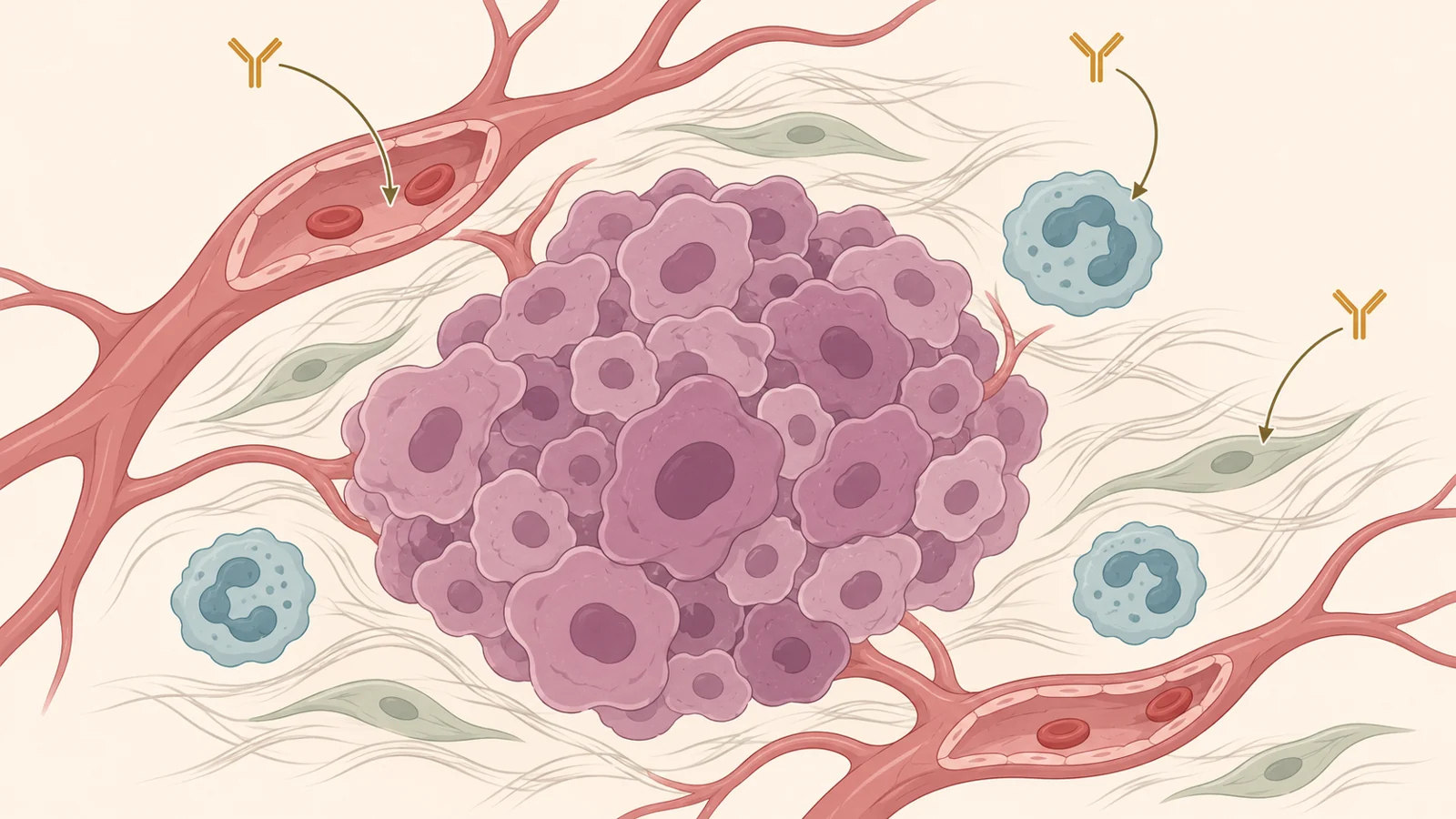
The tumor microenvironment is the tissue and cells around a tumor. The review describes ways antibodies might target parts of that environment, including blood vessels, immune activity and signals associated with supporting tissue. This shifts the intended target; it does not, by itself, show that the treatment works better.
Antibody form and target are separate choices
An antibody can be used as a whole molecule, joined to a toxin, drug or radioactive payload, or reduced to an antibody fragment. These are different forms of the treatment. A separate design choice is what the antibody recognizes: a cancer cell itself, or a feature of the tumor’s surroundings. The review notes that antibody approaches have mostly targeted tumor cells and organizes alternatives aimed at the surrounding environment.
This distinction helps make sense of the proposed shift. Changing the antibody’s form does not necessarily change its target, and choosing a surrounding-tissue target is not itself a particular antibody format. The review’s central interest is in how antibodies might affect tumor cells indirectly by acting elsewhere in the local environment.
Three routes through the tumor’s environment
One route is to interfere with the formation of blood vessels that serve a tumor. The review groups this under anti-angiogenesis. In plain terms, the antibody’s intended action is on the vessel system around the cancer rather than on the cancer cell alone.
A second route changes immune activity. Antibodies could stimulate immune responses, suppress them or deplete particular immune components. These are not one uniform effect: they describe different ways of altering how the immune system behaves in the tumor environment.
A third route targets growth signals associated with the supporting tissue, including signals linked to cancer-associated fibroblasts. These are cells in the surrounding tissue that the review identifies in connection with stromal growth signals. Blocking such signals is intended to interrupt support for tumor growth without making the cancer cell the only target.
The review also discusses targeting cancer stem cells. Across these approaches, its focus is on proposed targets, mechanisms and clinical uses, alongside resistance. The available account does not establish that one route is preferable or that these strategies solve the variable responses that motivated interest in the environment.
What the review can tell us
This is a review of strategies, not a new human trial or a treatment-defining clinical event. The evidence available here explains why researchers have considered indirect targets and how the main approaches differ. It does not provide a comparative effect estimate, a rule for choosing patients, or patient-level validation of a favored route.
That leaves an important question open. A tumor’s surroundings may offer targets distinct from cancer cells, but the rationale for choosing one does not establish that doing so improves remission or makes benefit more durable. Those claims require evidence from drug development and clinical testing. The review’s discussion gives readers a way to understand the proposed options, not a basis for ranking their outcomes.
What this could make possible
A future oncology consultation could include an additional, evidence-backed antibody option for a person with a heterogeneous solid tumor: a treatment chosen to act on a process in the tissue around the cancer cells. The review’s vessel, immune and stromal strategies point to how such an option might work indirectly. For that to become a dependable choice, drug development and clinical testing would need to show that selecting the surrounding-tissue target improves outcomes for appropriate patients.
A meaningful nearer milestone would be a study of a specified surrounding-tissue target in a defined solid tumor that reports patient responses, how long they last and how much they vary across patients. Such evidence could help show when this different target choice adds value. Antibodies for cancer already exist; the new capability would be knowing when aiming beyond the cancer cells makes treatment more effective and dependable.
Key Sources
- Primary source: A review on targeting tumor microenvironment: The main paradigm shift in the mAb-based immunotherapy of solid tumors.
DOI or Journal Page · Review or Meta-Analysis · 2022-03-14
Keep exploring