
Research Signal – Source date 2023-01-03
Sleep apnea means repeated pauses or reductions in breathing during sleep. It is commonly assessed through an overnight laboratory study, but spending a night connected to equipment may be difficult for some older adults. A ClinicalTrials.gov study record describes a different way to collect the relevant information: asking participants at risk for dementia to wear an investigational monitor at home.
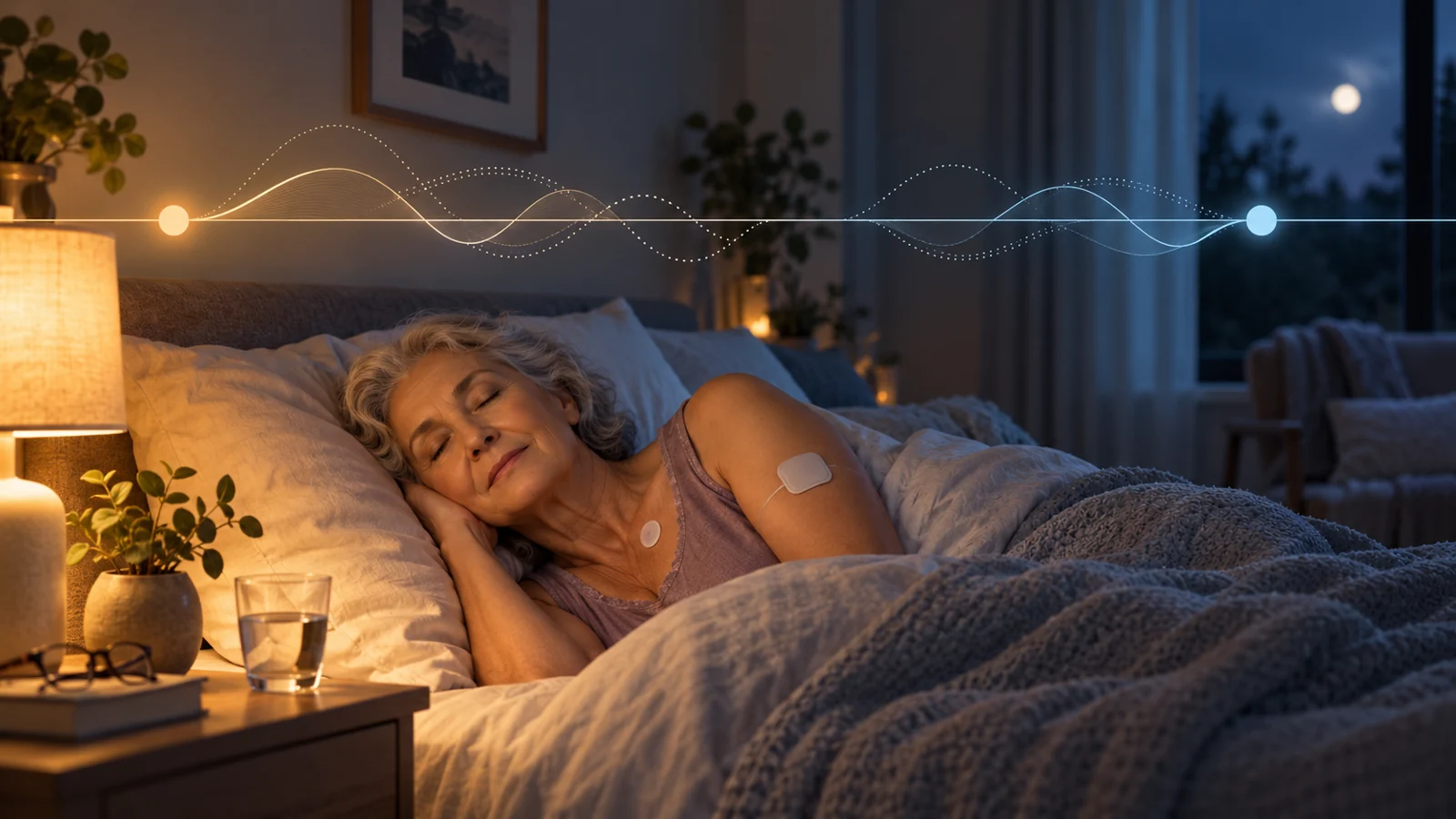
The device is the Advanced NeoNatal Epidermal, or ANNE, Vital Sign System. Despite its name, the registry describes it as a wireless system for collecting physiological measurements from two flexible, skin-mounted electronic devices. The planned research is not presented as a new diagnosis for the public. It is an attempt to make sleep-related measurements practical enough to study alongside changes in cognition.
A research plan built around a practical problem
The study is designed around participants enrolled in a broader Canadian research program involving older adults at risk for dementia. Study staff plan to obtain consent, ship the equipment and instructions, and guide participants through applying the sensors during a video call. Participants would wear the system for 24 hours, remove it themselves, and send it back to the research team.
The registry describes several synchronized measurements: electrocardiography, photoplethysmography with derived pulse oximetry, pulse arrival time with derived beat-to-beat blood pressure, movement from triaxial accelerometry, respiratory rate and temperature. Together, these signals are intended to help researchers characterize breathing interruptions and related cardiovascular changes during ordinary sleep.
That makes the home setting important to the research question, but the proposed setup remains an investigational approach. The record does not establish that ANNE can replace a standard clinical assessment or provide a numerical estimate of diagnostic accuracy.
What the 12-month comparison is designed to test
Researchers plan to collect sleep-apnea and cognitive measurements at two points: baseline and 12 months later. They can then ask whether participants with more evidence of sleep apnea also show a different pattern of cognitive change over the same interval.
This timing gives the study more structure than a one-time snapshot. A single sleep measurement could show how apnea and cognition appear together at one moment. Repeating both assessments creates a way to examine whether the relationship is associated with change over time. The planned analyses also include sex stratification where appropriate.
The wording matters. The stated objective is to test whether sleep apnea is associated with accelerated cognitive decline in older adults at risk for dementia. It is not a reported finding that the association exists, nor does the registry description provide its size. The 12-month design can support a more informative comparison than a single visit, but it still begins as a research plan rather than an established result.
A wearable must work for people as well as sensors
The investigators plan to use qualitative feedback forms to learn how participants experience the system and how easy it is to use. This addresses a separate obstacle from physiological measurement. A monitor may collect many signals, yet still be difficult to apply correctly, uncomfortable to wear or impractical to return after use. Participant experience affects whether a method can be used reliably in a larger study.
Ease of use and measurement accuracy are related only indirectly. Positive feedback could indicate that people are willing and able to complete the procedure; it would not show that the recorded signals identify sleep apnea correctly. Conversely, a technically capable monitor would have limited research value if participants could not use it consistently at home. The study therefore has both a measurement question and an implementation question, and the answers need not be the same.
What the design can and cannot tell us
Three questions should be kept apart. First, is sleep apnea associated with cognitive decline in this group? Second, can the investigational system capture the physiological information well enough for that relationship to be studied? Third, would treating sleep apnea change cognitive outcomes or reduce dementia risk?
The proposed assessments speak most directly to the first two questions. Comparing sleep and cognition at baseline and 12 months may reveal a relationship worth investigating. The device and participant-feedback components may show whether remote data collection is workable. Neither part, by itself, would demonstrate that sleep apnea causes cognitive decline.
Other explanations could still account for an observed relationship, and the study description does not turn an association into evidence that treating apnea prevents dementia. The selected registry date also identifies the publication provenance of this research plan; it does not establish that recruitment or completion had occurred on that date, or that results were available then.
What this could change
A workable home-based assessment could give researchers a practical way to study sleep apnea and cognitive change in older adults who may struggle with an overnight laboratory visit. If the measurements prove adequate and participants can use the system successfully, repeated sleep-and-cognition assessments could become easier to incorporate into dementia-risk research across more settings.
That would improve the ability to investigate whether breathing interruptions during sleep track with cognitive decline. It would not by itself create a treatment or prove a dementia-prevention benefit. The potential advance is more basic and more useful: a less burdensome route to collecting the evidence needed for those later questions.
Key Sources
- Primary source: ANNE Vital Sign System Remote Sleep Assessment
Government or Regulator · Clinical Trial · 2023-01-03
Keep exploring