
Research Signal – Source date 2023-03-17
A clinic visit captures a limited moment in a condition whose symptoms may change from one day to the next, or even within the same day. ANeED Joint Effort 21 is a registry-described research approach that asks whether measurements collected at home could add a fuller account of those changes between appointments.
The supplied publication date for the ClinicalTrials.gov record is March 17, 2023; the available evidence does not establish whether the description reviewed here appeared in that initial registry version. It describes the project as an additional study linked to the parent ANeED study, identified there as NCT04588285. Its stated goal includes developing predictive algorithms and digital biomarkers for prodromal or established dementia with Lewy bodies. Digital biomarkers here mean measurable signals gathered through digital tools and investigated as possible indicators of disease features.
Why the timing of symptoms matters
The registry’s rationale is straightforward: an inpatient clinic visit may not adequately represent symptoms that fluctuate between days or during the day. A person’s movement, sleep, cognition or other experiences at one appointment could therefore provide only part of the picture that researchers want to understand.
Home measurements are intended to extend observation into the time between visits. That does not make every home reading meaningful on its own. It creates a larger set of observations from which researchers can investigate whether particular patterns correspond to changes in DLB and whether those patterns could eventually help describe treatment response or disease progression.
The project is also linked in the registry description to efforts to improve treatment, diagnosis and prognosis in relation to Ambroxol, the study drug used in ANeED. That connection identifies the research context; it does not establish that Ambroxol is effective, safe or approved.
A record made from several kinds of input
The proposed collection system combines information entered by participants with measurements from devices. An application was developed for reporting study-medicine intake and side effects. Those reports depend on what a participant records and when they record it, so they answer a different question from a sensor reading.
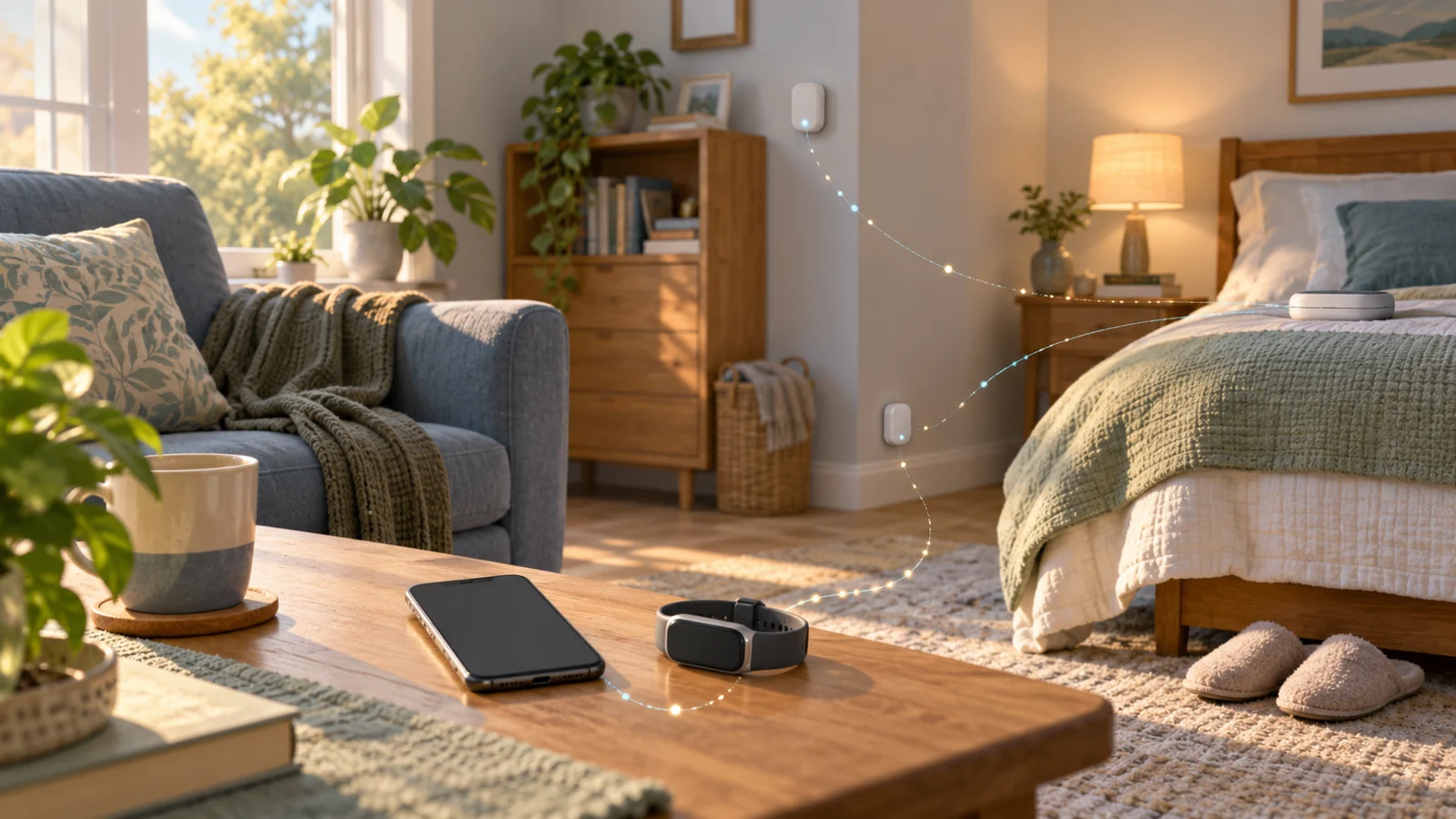
The description also names smartphone cognitive tests and health data from a smartwatch. Two wearable movement sensors are intended to measure activity and sleep, while a bedside sleep monitor is described as registering sleep disturbances. An EEG/EOG/mood sensor would be used for one week. These channels are not interchangeable: a medication report records an event or experience entered into the application, whereas movement, sleep, cognitive and other sensor measurements provide different kinds of observations over time.
The value of the arrangement depends on what researchers can learn from those different inputs together. The registry describes them as a basis for developing candidate digital biomarkers and predictive algorithms, not as already validated measures with a known clinical meaning.
Participation happens around the parent study
Eligibility for ANeED Joint Effort 21 depends on patients and their caregivers already being included in the ANeED study. The additional measurements are described as taking place at home between visits, with no additional inpatient clinic visits for this project.
That arrangement may reduce the need for another trip to the hospital, but it should not be confused with proof that participation requires less effort overall. Home testing still involves using an application, wearing or setting up devices, and completing the specified measurements. The registry does not provide a basis here for estimating the total burden on participants.
Caregivers are included for a separate reason. The description says that caregivers report substantial distress and that the project was extended to collect data about caregiver distress. Patient symptom monitoring and caregiver experience are related to the practical reality of DLB, but they are not the same measurement problem. A record of caregiver distress would not, by itself, show that the patient’s symptoms were measured more accurately or that distress was reduced.
Collecting signals is only the first step
There is an important gap between gathering data and demonstrating clinical usefulness. The research can collect medication reports and sensor signals, develop candidate indicators, and test whether those indicators are reliable enough to support decisions or meaningful conversations about care. Each step asks a different question.
The description of ANeED Joint Effort 21 establishes the intended measurements and the algorithm-development goal. It does not establish predictive accuracy, validated digital biomarkers, improved diagnosis, treatment benefit or reduced caregiver distress. It also does not establish an active or completed human-trial event, participant numbers, study start or completion dates, or a results-posting event for the historical account considered here.
Those limits matter because a technically rich stream of data can still be difficult to interpret. A pattern may reflect a symptom, a medication report, a disrupted night, a change in routine or the circumstances of measurement. The proposed research is aimed at finding out whether the signals can be interpreted consistently enough to become useful, rather than assuming that recording them has already solved the problem.
What this could change
Patients and clinicians could gain a more representative account of symptom changes between appointments if the collected reports and sensor measurements become interpretable, clinically useful indicators and if the home approach proves workable for participants. That fuller account could support more informed conversations about care and about how symptoms or treatment response appear in daily life.
The same approach could make caregiver distress more visible within research that otherwise centers on patient measurements. Both possibilities remain conditional; the supplied registry description does not establish either benefit. The important bridge is not simply from clinic visits to more devices, but from home observations to trustworthy information that people can use.
Key Sources
- Primary source: ANeED Joint Effort 21: eHealth and a PPI Program in Dementia With Lewybodies (DLB)
Government or Regulator · Clinical Trial · 2023-03-17
Keep exploring