
Research Signal – Source date 2021-10-02
A protein fiber can help organize a water filter, hold together a gel, or provide a surface where cells attach. Some fibers used for these purposes belong to a family better known for its association with disease: amyloids, proteins assembled into an ordered, threadlike structure.
The apparent contradiction comes from treating “amyloid” as a diagnosis. The term describes an assembly structure found in both disease-associated proteins and proteins with useful biological roles. Bacteria use amyloid fibers in the communities called biofilms; silkmoths use them in protective eggshells. Their shared architecture gives materials researchers a starting point for making larger structures with particular jobs.
A review published on October 2, 2021, Amyloids as Building Blocks for Macroscopic Functional Materials: Designs, Applications and Challenges, brings together examples of that work. It connects previously reported designs involving different proteins, additives, and manufacturing methods. The studies measure different things, from stiffness and fluoride removal to cell survival, so they do not provide a common test for ranking the materials. They do, however, show how useful behavior can emerge from the way fibers are connected and what researchers attach to them.
From molecular order to a material you can handle
Amyloid fibers, also called fibrils, share an arrangement known as cross-β. Short stretches of protein align into sheets, held together partly by hydrogen bonds. The sheets pack against one another, forming a long, narrow fiber. The chemical groups projecting from the protein help determine how those sheets and neighboring fibers interact.
This creates several levels of construction. Molecular order gives an individual fiber its structure. Connections among many fibers create a network. Processing that network determines whether the finished material is a water-containing gel or a dry film. Properties at one level help explain the next, but they do not specify it completely.
A hydrogel holds water within a connected network. Amyloid fibers can supply that network through interactions among the assembled proteins. Changing how strongly the fibers associate changes how the whole gel behaves, even when the fibers retain their underlying ordered structure.
The review describes a route from gels to free-standing films made with either β-lactoglobulin, a whey protein, or lysozyme. Researchers allowed fibers to grow under conditions favoring interactions, added plasticizers to initiate gel formation, and dried the gels on a flat surface. The resulting films had reported Young’s moduli of 5.2–7.2 gigapascals. Young’s modulus measures stiffness—how strongly a material resists deformation under a load. It does not by itself establish resistance to tearing or repeated use.
The gel–film comparison makes the assembly hierarchy tangible. A wet network and a dry sheet can begin with the same kind of molecular building block yet behave very differently in someone’s hands. Designing the finished material requires control over the connections and processing as well as the protein itself.
A filter whose components divide the work
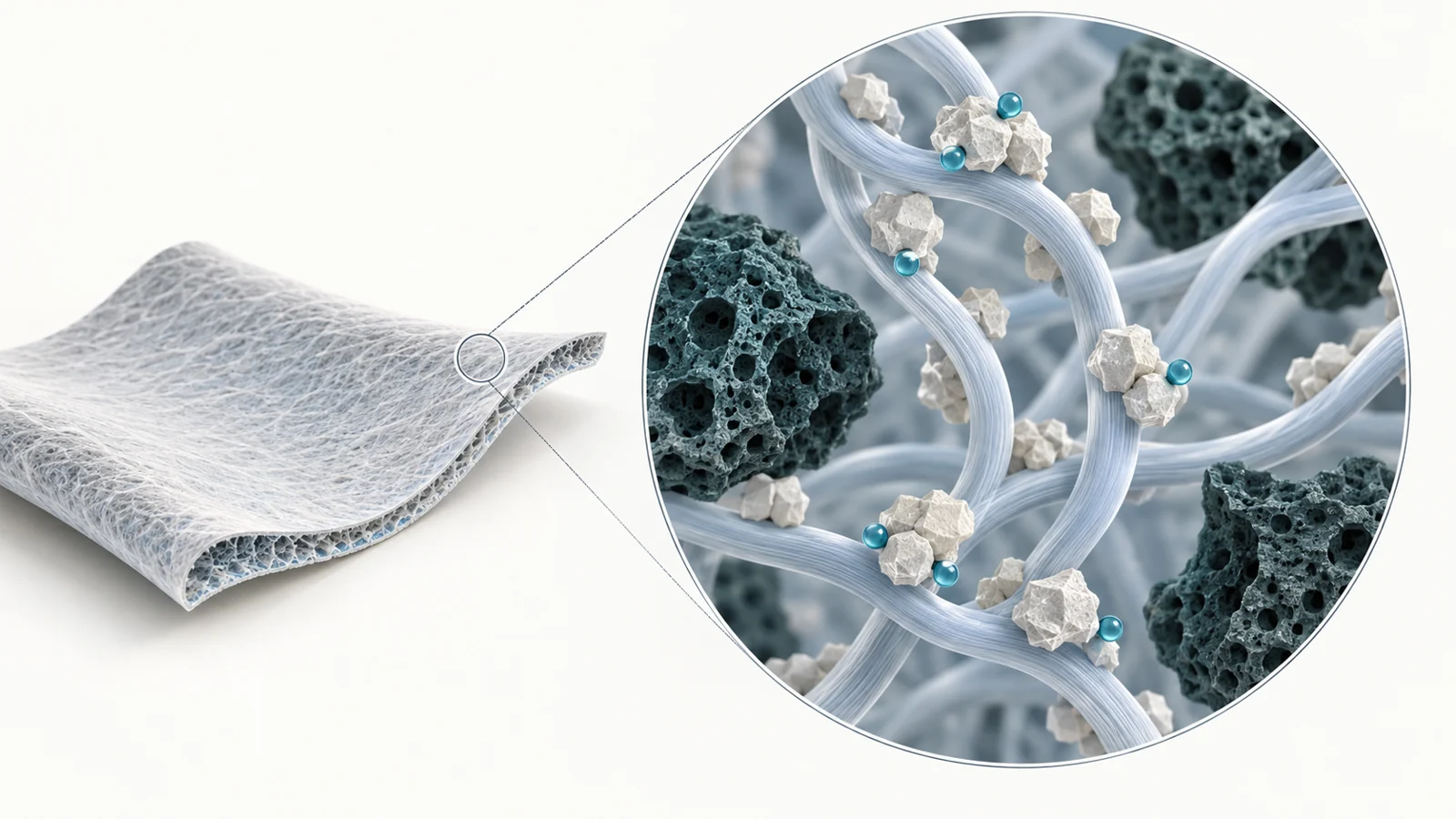
For water treatment, the fibers can provide a surface on which other useful materials are distributed. Their long, narrow shape and numerous binding sites make them suitable supports for inorganic particles.
One study summarized in the review used β-lactoglobulin fibers to anchor zirconium dioxide nanoparticles in a fluoride-removal composite. The particles were approximately 10 nanometers across. Attaching them to the charged protein scaffold helped prevent them from clustering together, preserving more exposed particle surface. The resulting hybrid was incorporated with activated carbon into a filtration material.
The division of labor matters. Zirconium dioxide supplied the fluoride-binding component, while the protein scaffold helped keep those particles dispersed and accessible. Activated carbon was another constituent of the finished composite. Calling the result an “amyloid filter” can obscure how much its function depends on the combination.
The cited study reported 99.5% fluoride removal with that composite under its experimental conditions. That percentage belongs to the tested formulation and setting; it cannot be transferred to bare protein fibers or to a different pollutant. Its explanatory value lies in the design. Small particles offer useful surfaces, and a supporting network can help keep those surfaces available for contact with dissolved fluoride rather than buried within particle clusters.
Acidity can control the connections
Environmental responsiveness can be built into the interactions between fibers and added components. A change in the surroundings can then alter a material’s properties without requiring a new batch of protein.
The review describes a gel combining β-lactoglobulin fibers with modified carbon nanotubes. At pH 2, an acidic condition, the protein fibers carried a positive charge, while the nanotubes carried a negative charge. Attraction between the two helped connect the network into a gel.
Raising the pH to 7 changed the protein’s charge to negative. The attractive interaction with the negatively charged nanotubes weakened, and the components dissociated. The study reported a roughly 100-fold decrease in the gel’s modulus, indicating substantial softening.
Here, the environmental change acted on the connections holding the network together. The example explains how a material can be designed to respond to acidity through charge-dependent interactions. Responsiveness is not a universal feature supplied by the amyloid structure alone; it comes from the particular protein, partner material, and conditions chosen. A stiff fiber can therefore participate in a gel whose overall stiffness changes dramatically.
Cells need somewhere to attach
A scaffold intended to support living cells has a different requirement. Mechanical support gives it a physical form, but cells also need to interact with its surface. Researchers can add short protein sequences that provide attachment sites—small molecular features that cells can recognize and grip.
The review describes approaches that join such sequences to proteins capable of assembling into amyloid fibers. The aim is to combine a structural network with surface chemistry that supports cell attachment. Those two functions have to work together in the same material.
In one study summarized by the authors, a lysozyme fibril network supported fibroblast or epithelial cell lines. A short sequence within lysozyme resembles a known cell-attachment motif, helping explain the observed interactions. Cells remained viable for up to seven days on the fibrillar matrix, and they showed more focal adhesions—the contact points where cells anchor to a surface—than on unassembled lysozyme.
This is evidence about a particular cell-culture support. Keeping cells alive and helping them attach are meaningful experimental outcomes, but successful tissue repair would require substantially more. The biological result belongs to the tested matrix, cells, and conditions, just as the fluoride-removal result belongs to its particular composite.
Adding a function can disrupt the structure
The authors identify a central design problem: researchers cannot yet reliably predict a finished amyloid material’s properties from its protein sequence. Strategies such as adding chemical groups that favor attraction between proteins can work, but many remain empirical. A useful modification may also change how the protein assembles or how its fibers connect.
That creates a demanding requirement for engineered proteins. An added segment must retain its intended activity while the rest of the molecule still forms the required fibers. Even successful fiber formation leaves the larger network to be controlled. Sharing a cross-β structure does not make different proteins interchangeable as filters, responsive gels, or cell scaffolds.
Production raises a separate obstacle. Making enough peptide or protein at an acceptable cost is especially important for applications that consume large quantities of material. The review proposes engineered microbes as one possible production route. The authors also state that some amyloid materials had already been produced industrially and were ready for commercialization. That statement applies to some materials, rather than establishing broad adoption or readiness across the applications discussed.
Biological compatibility likewise has to be assessed for each formulation and use. Natural functional amyloids demonstrate that the structure is not inherently synonymous with disease, but they do not guarantee the safety of an engineered material. The review discusses a proposed role for incompletely assembled protein clusters, called oligomers, in toxicity. This remains an explanation under investigation, not a universal account of amyloid harm or a guarantee that completing assembly eliminates it.
For water-treatment composites, practical judgments would also depend on durability, particle retention, regeneration, operating cost, and performance in the intended water conditions. A high removal percentage answers one performance question. Establishing a dependable treatment material requires those other properties to fit its intended use, including any applicable drinking-water requirements.
What this could change
If reliable design and affordable production become possible, amyloid scaffolds could give water-treatment developers a way to build membranes that keep contaminant-binding particles dispersed and accessible. The causal advantage would be concrete: more of the useful particle surface could remain available to contact selected pollutants, supporting more effective removal in a manageable filtration material.
For that benefit to reach practical water treatment, the composite would also need to retain its components, remain durable, and meet safety requirements under the conditions where it is used. The prospect is a membrane whose protein network helps its active ingredients do their job efficiently, with the chemistry chosen for the pollutant being targeted.
Key Sources
- Primary source: Amyloids as Building Blocks for Macroscopic Functional Materials: Designs, Applications and Challenges.
DOI or Journal Page · Review or Meta-Analysis · 2021-10-02
Keep exploring