
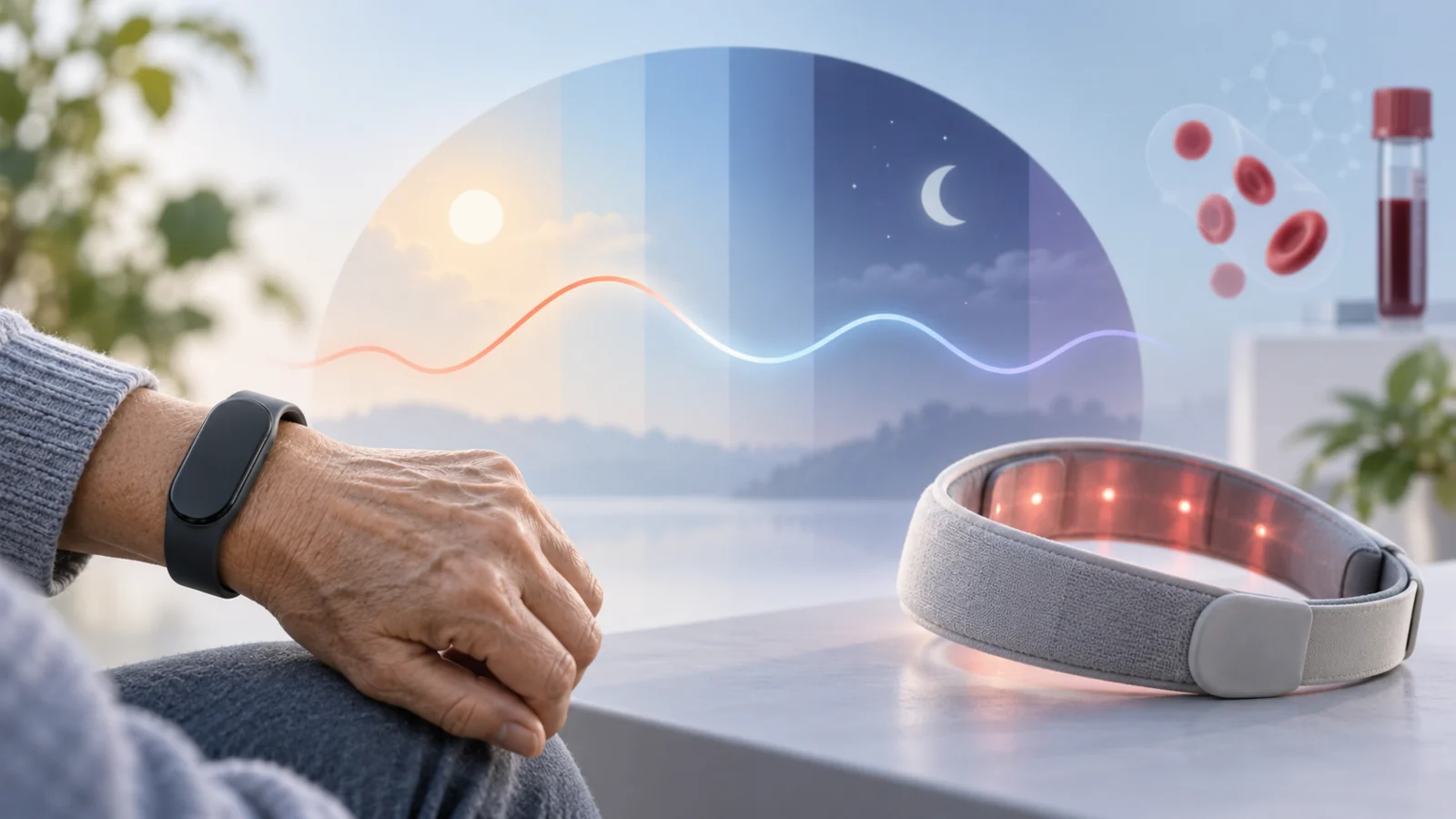
Research Signal – Source date 2025-10-29
Nighttime wakefulness, irregular sleep and other circadian disruptions can make Alzheimer’s dementia harder to manage for both the person living with the condition and the people providing care. They are part of the broader group of behavioural and psychological symptoms of dementia, which can also include agitation and other non-cognitive changes. These symptoms affect daily life, while night-time care can add to caregiver strain and medical costs.
ClinicalTrials.gov registration NCT07222449, published from the supplied record’s perspective on October 29, 2025, describes a project intended to approach this problem in stages. It begins by asking whether people with Alzheimer’s dementia in Taiwan can use research-grade wearable devices. It then proposes a randomized test of a wearable near-infrared light headband, followed by longer-term analysis of wearable measurements, clinical symptoms and blood-based Alzheimer’s biomarkers.
The study does not offer demonstrated help from the headband in the evidence supplied here. No results are posted in the supplied registry snapshot. A later registry record reports that the study actually started on May 11, 2026 and currently describes it as enrolling by invitation. It lists primary completion for September 30, 2027 and overall completion for July 31, 2029 as estimated dates. Those later status details describe the study’s lifecycle; they do not turn the registration into an efficacy report.
Why circadian disruption is hard to see
Sleep and daily activity are often assessed through caregiver questionnaires. Such reports can be valuable, but they may capture a person’s experience at particular points in time and can be shaped by how closely someone was observed or how difficult a night was to recall. The registry narrative also highlights a specific challenge in Taiwan: caregivers may themselves be older adults with cognitive decline, making consistent assessment more difficult.
A wearable could add a different kind of observation. Actigraphy devices generally record activity and rest patterns over time, allowing researchers to examine when movement and inactivity occur across ordinary days and nights. In this project, actigraphy is a monitoring tool. It is not the treatment being tested.
The treatment device is a separate wearable headband described in the current record as delivering near-infrared photobiomodulation, or PBM. The study’s practical starting point is therefore important. Before continuous measurements can become useful in dementia care, participants must be able to wear the devices, and caregivers must be able to incorporate them into daily routines. The project’s use of the term “digital inclusivity” refers to this feasibility question: can the technology work for the people whose symptoms and routines it is meant to capture?
Patient and caregiver experience matters alongside the technical readings. A device that produces detailed data but is uncomfortable, confusing or difficult to maintain may not provide a workable route to better care. The registry describes the combined approach as a possible form of digital therapy, but the study still has to evaluate whether the arrangement is acceptable and usable in this population.
The treatment test has a built-in comparator
The interventional portion is described as randomized, parallel and treatment-focused, with estimated enrollment of 162 participants. The registry narrative describes the trial as double-blind. The supplied record does not provide the masking procedures in enough detail to explain exactly how that blinding will be maintained, but it does identify the basic comparison: a wearable headband delivering the intervention versus a sham headband providing negligible photobiomodulation.
Both arms are described as using their headbands for up to eight weeks. That comparison matters because wearing a device, receiving regular study attention or expecting improvement could all influence how sleep is perceived or reported. A sham headband gives the investigators a way to compare the active device with a similar experience that is not intended to deliver the active light treatment.
The purpose is not simply to ask whether participants can tolerate a headband. It is to estimate whether the active treatment is associated with a better sleep outcome than the sham condition under the study’s planned design. The estimated enrollment is a target, not evidence that 162 people have enrolled, completed treatment or contributed results.
Sleep is scored separately from the wearable signals
Despite the project’s emphasis on continuous monitoring, the listed primary sleep outcome is questionnaire-based. It uses the Pittsburgh Sleep Quality Index, or PSQI, measured eight weeks after treatment. The score ranges from 0 to 21, with lower scores indicating healthier sleep quality.
This timing should be kept distinct from the intervention duration. The headbands are described as being used for up to eight weeks, while the primary outcome is specified at eight weeks post-treatment. The registration therefore creates a defined point at which the investigators can compare sleep-quality scores between the treatment and sham groups.
Wearable measurements may provide additional detail about activity and rest patterns, but they answer a different measurement need from a global sleep-quality questionnaire. The questionnaire can summarize a participant’s reported sleep experience. Actigraphy can supply repeated observations of daily patterns. The project is designed around the possibility that these kinds of information will complement one another, not around treating every sensor reading as proof of a clinical improvement.
Four years of data ask a different question
The project extends beyond the short randomized comparison. Over four years, the investigators intend to combine wearable observations, clinical assessments and blood-based Alzheimer’s biomarkers. The goal is to explore how circadian disruption, cognitive decline rates and biological measurements may relate to one another over time.
Here, “digital phenotype” means a pattern assembled from digital measurements rather than a diagnosis produced by a device. For example, repeated activity and rest observations might reveal a pattern that can be compared with changes in symptoms or functioning. The value of such a pattern would depend on whether it is consistent, interpretable and useful alongside clinical assessment.
This longitudinal work asks a different question from the headband trial. Finding that a person’s rhythm, symptoms and biomarker measurements change in related ways could help researchers describe dementia progression more precisely. It would not by itself show that disrupted sleep caused cognitive decline, that a biomarker caused a rhythm disturbance or that treating sleep slows Alzheimer’s disease. Nor would a longer-term pattern replace the randomized comparison needed to assess the headband’s treatment effect.
The proposed three-dimensional view brings together clinical symptoms, including cognitive and non-cognitive features, lifestyle and functionality, and biological markers. Its promise lies in connecting information that is usually collected at different times and in different ways. Whether that produces a useful management model depends on the quality of the measurements and on whether clinicians can apply the results without adding an impractical burden to patients or caregivers.
What better nights could mean for dementia care
For people living with Alzheimer’s dementia, a meaningful improvement in sleep could make nights more manageable and reduce the disruption that reaches into the following day. For caregivers, a safe and workable approach could mean fewer difficult nights and less demanding overnight supervision. Those benefits remain conditional on the headband producing a useful improvement and on both devices proving acceptable in everyday use for this population.
The monitoring component could offer a second practical benefit if its measurements prove useful in care. Continuous observations might help clinicians notice changes between scheduled assessments, when a questionnaire alone may provide only a limited snapshot. The study’s longer-term biomarker work could then add biological context to those patterns, without turning association into proof of cause.
NCT07222449 is therefore best understood as an investigation of whether monitoring and treatment can be connected in a careful sequence: first establishing that the technology fits the lives of people with Alzheimer’s dementia, then comparing an active light headband with a sham device, and finally exploring what repeated digital and biological measurements may reveal. The registration identifies a possible route toward more informed dementia care; the study results will determine whether that route is clinically meaningful.
Key Sources
- Primary source: Wearables-and Blood-based Biomarkers-incorporated Modernisation of Circadian Rhythm Disruption Management in People Living With Alzheimer's Dementia: A Stepwise Study From Digital Inclusivity, Digital Therapy, to Digital Phenotyping and Biomarker Exploration
Government or Regulator · Clinical Trial · 2025-10-29
Keep exploring