
Research Signal – Source date 2025-06-18
A filling has a basic job: replace damaged tooth structure and hold up under the pressure of chewing. Alkasites are designed to do that while also releasing ions that might affect the tooth tissue around the repair. A review published on June 18, 2025, examined nearly a decade of research on these pH-responsive dental materials. It describes promising material properties and a possible chemical benefit, while leaving open whether that benefit translates into less decay for patients.
A filling still has to do the everyday work
Alkasites are restorative materials used to fill cavities. Their proposed extra role does not replace the need for a dependable repair: if a filling cannot tolerate ordinary use, a potentially helpful effect on nearby tissue would matter little.
The review reports that studies found alkasites’ physical and mechanical properties comparable to, and in some cases better than, those of commonly used restorative materials. It also describes their ability to withstand chewing forces, their appearance, and a bulk-fill method of placement. On that basis, the authors consider them a suitable option for certain cavity restorations in primary and permanent teeth.
Those findings make alkasites a candidate for doing both jobs. They are the review’s summary of varied studies, however, not a universal ranking that shows every alkasite restoration outperforms every alternative in every situation.
The proposed benefit happens around the filling
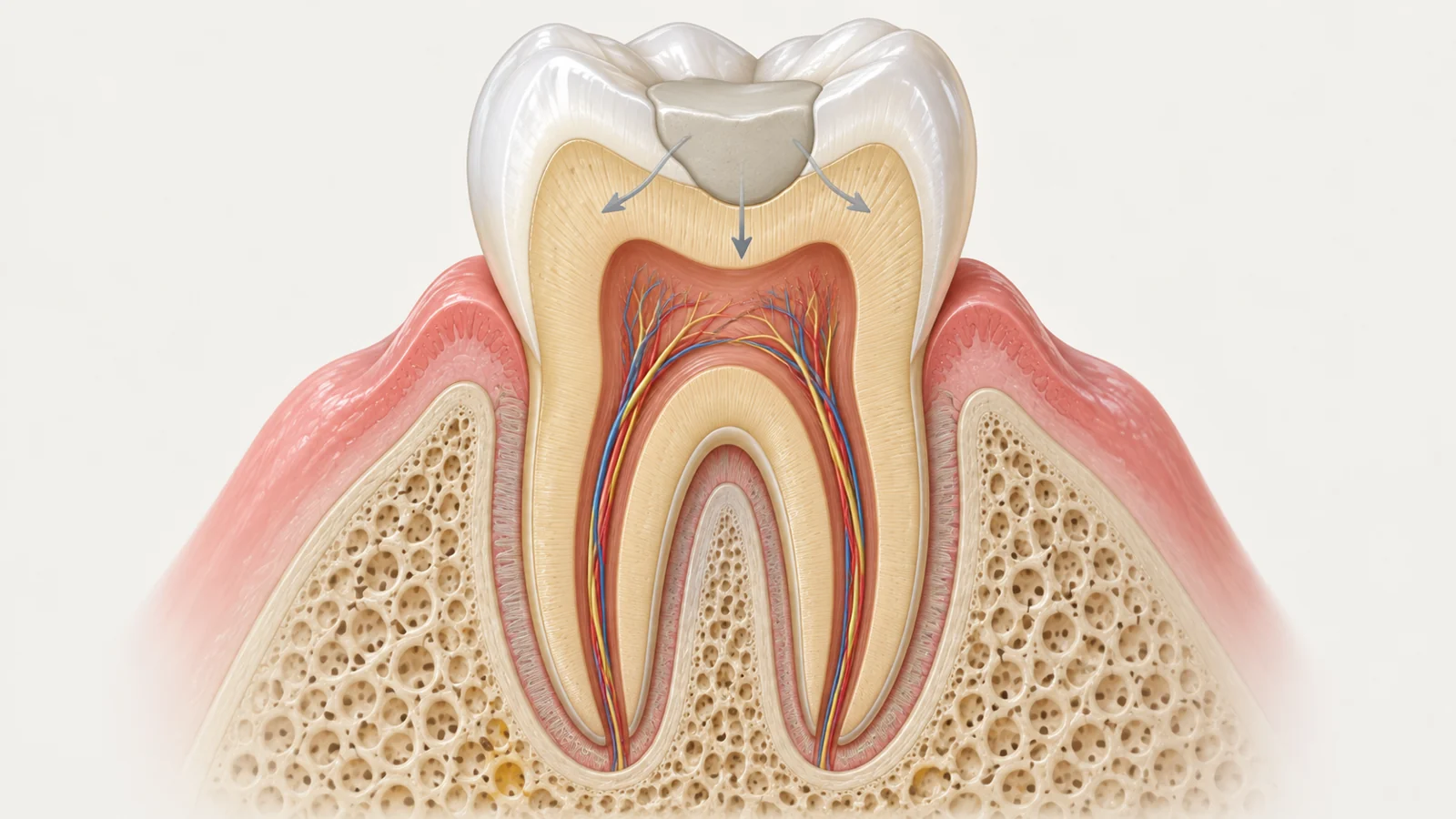
Alkasites can release hydroxide, calcium, and fluoride ions. The review describes how these released particles might influence the local environment: hydroxide may raise pH, making the area less acidic when acids produced by cavity-causing bacteria are present. Calcium and fluoride, along with a less acidic environment, may help create conditions favorable to remineralization—the replacement of minerals in tooth tissue.
This is a proposed contribution to the tooth environment, not evidence that a filling seals off the tooth from future decay. The potential value is that the material could combine mechanical support with chemistry that favors mineral retention near the repair. Whether that local process prevents new cavities in people is a separate question.
What the studies can and cannot show
Two reviewers searched PubMed, Web of Science, and Scopus for literature published through March 2025, then critically reviewed in vitro and in vivo studies. Laboratory work can examine material properties and ion release under controlled conditions. Studies in living subjects can address how a material behaves in a biological setting. Together, these types of evidence help describe performance and possible mechanisms, but they do not by themselves establish a patient-level advantage over conventional fillings.
The review’s abstract provides broad conclusions rather than study-level estimates or a pooled comparison of future decay. It therefore supports interest in alkasites’ physical properties and possible ion-related effects, but not a numerical durability advantage, a claim of proven long-term benefit, or a recommendation for an individual patient. The practical question is whether both jobs hold up together in routine care.
What this could change
For someone prone to cavities, a filling that remains dependable under ordinary chewing and also helps protect nearby tooth tissue from mineral loss would offer a useful combination. The review points to two parts of that possibility: reported physical and mechanical performance, and a proposed ion-release pathway that may favor remineralization. Alkasite fillings already existed when the review was published; what remains to be demonstrated is dependable patient-relevant protection, not the invention of an ion-releasing filling.
A meaningful nearer milestone would be comparative clinical evidence that follows both restoration survival and new decay around restorations. If future evidence supports both outcomes, alkasites could become a more substantiated option for people at higher risk of caries.
Key Sources
- Primary source: Alkasites in restorative dentistry: a review of their performance and properties.
DOI or Journal Page · Review or Meta-Analysis · 2025-06-18
Keep exploring