
Research Signal – Source date 2021-03-22
A composite part can begin to fail before a strength calculation predicts if the calculation leaves out tiny manufacturing voids. These pockets matter because they can change where stress concentrates and how damage develops. A 2021 review of vacuum-assisted resin transfer molding, or VARTM, argues that designers need to account for voids when estimating a part’s strength. It brings together earlier studies and illustrates one approach with a finite-element simulation; it does not establish a universal void penalty or test prediction accuracy across production parts.
Why voids can enter a cost-effective process
VARTM makes composite parts by arranging reinforcing fibers or fabric in a mold, sealing them beneath a flexible vacuum bag, and drawing resin through the fibers. The process can produce large, lightweight structures at relatively low cost, which helps explain its appeal for production. The manufacturing sequence includes material and tool preparation, resin infusion, and post-infusion handling. Conditions at each stage can affect the finished material, including how much void space it contains and where that space sits.
The review identifies voids as a common defect in VARTM composites. It points to changes in resin-flow pressure and temperature among factors associated with their formation. Fiber misalignment is another possible defect, but the paper focuses on voids and their role in failure theories. Since completely defect-free manufacturing is impractical, the design question is how to estimate performance when a part contains them.
A calculation that treats the material as if it had no voids may place failure later than it occurs in a defective part. The size of that discrepancy depends on the material and conditions. In the studies surveyed by the review, strength effects varied with loading direction, void content and configuration, and the composite’s constituents. A single percentage penalty would hide those differences and could mislead a design.
Matching a calculation to the damage
The review suggests beginning with a strain-based check for an initial estimate. Strain describes how much a material deforms under load. This simpler check can help screen a design, while more detailed methods represent particular features of damage and voids.
One option, discrete damage mechanics, tracks cracks as they appear and their density as damage accumulates. In this approach, cracks and voids affect the stiffness of a laminate, changing how stress is distributed as loading continues. The review favors this method for more advanced analysis and notes that it does not depend on mesh details in the same way as some other damage calculations. It still requires a suitable representation of the material and damage behavior.
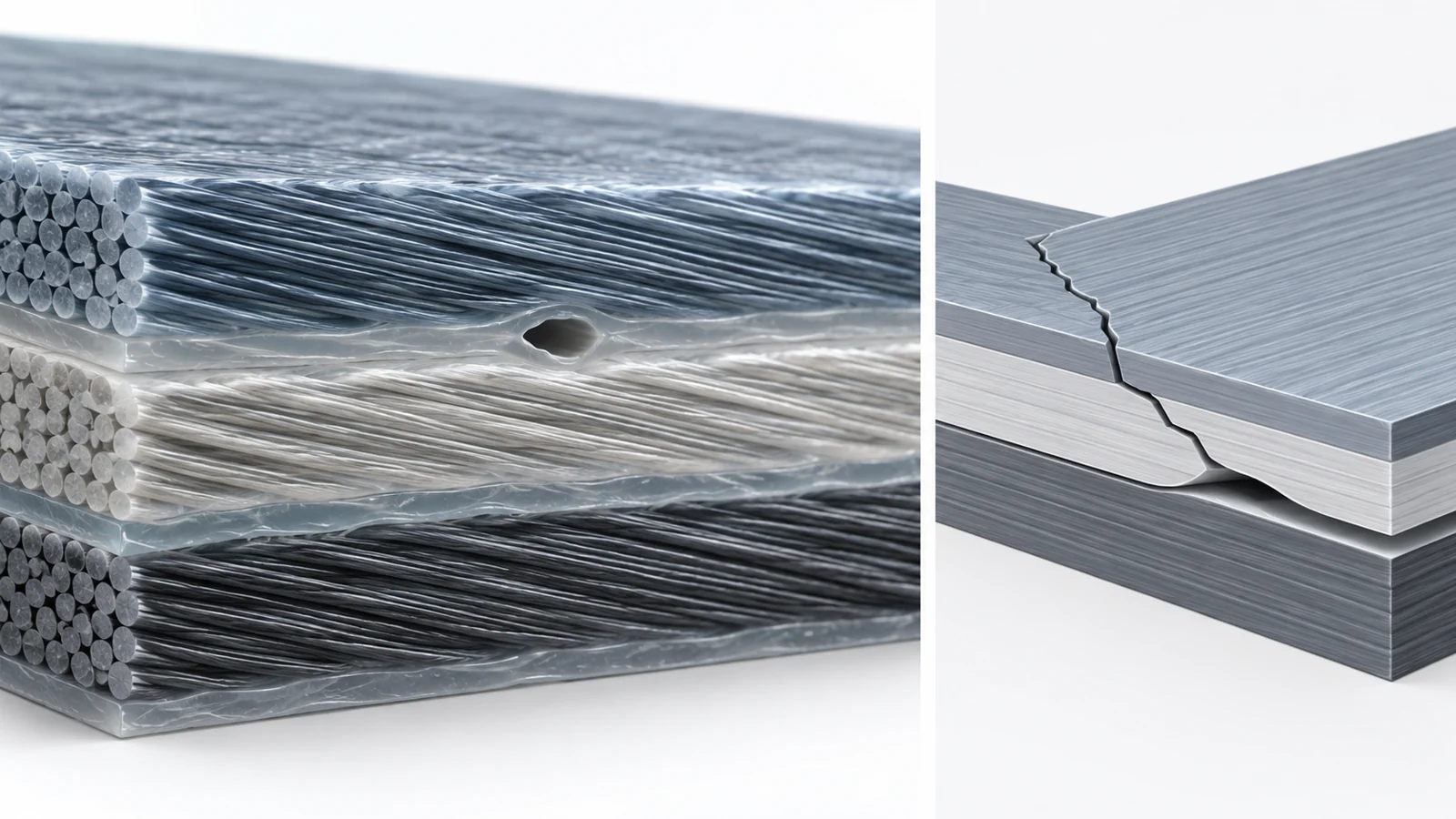
For separation between bonded layers, the review discusses the virtual crack closure technique, or VCCT. It estimates the energy associated with a crack extending, helping model delamination: damage in which neighboring layers begin to separate. Voids may be represented as cracks that can initiate or contribute to that separation. VCCT therefore addresses a different question from an initial strain check: how a crack at a layer boundary may grow.
Micromechanics looks at the material’s local structure. A representative volume element, or RVE, is a small modeled patch containing fibers, resin and voids. By representing their arrangement, an RVE can help explore how local features affect stiffness and failure. Its usefulness depends on having a reasonable account of the void distribution and fiber structure; the internal arrangement is not necessarily uniform or predictable.
These methods are not interchangeable labels for one calculation. A strain-based check can provide a first estimate, crack-density modeling can represent accumulating damage, VCCT can examine delamination, and an RVE can represent local structure. Which is useful depends on the failure mode, manufacturing information and loading relevant to the part.
A nearby void changes the modeled delamination
To illustrate crack-growth modeling, the authors simulated a two-dimensional, two-layer carbon-fiber composite laminate. The model fixed the bottom edge and pulled on the top layer with a 4-kilonewton force to examine separation between the layers. One case contained a single void; the other added a nearby void. The authors used VCCT to estimate delamination behavior.
In this modeled setup, the added void was associated with more separation between the bonded layers. The authors also reported higher crack-energy values for two ways the layers can separate: from 6 to 16 joules per square meter for opening (mode I), and from 0.91 to 4.45 joules per square meter for sliding (mode II). These are outputs of the simulated crack model, not measured losses of part strength. They apply to this laminate, geometry and loading; they cannot predict the effect of a nearby void in other composites or manufactured parts.
What the review can and cannot tell designers
The paper’s contribution is a synthesis of earlier experimental, analytical and numerical work, alongside an illustrative simulation. The studies it surveys cover different composites, loads and void configurations, so their results do not collapse into one rule for how much strength a given void content removes. The two-case simulation demonstrates behavior within its setup; it does not show that the suggested methods accurately predict failure across production parts.
Applying a void-aware calculation to a real design would depend on measuring or otherwise representing the part’s defects, using relevant material properties, and modeling the load and failure mode of concern. An estimate is only as useful as that match between the model and the material it is meant to represent. The review offers options for making that match more explicit, not a guarantee that any one method will make a component safe.
What void-aware design could change for composite parts
If engineers can represent the actual voids in a vacuum-infused composite and validate the calculation for its material and loading, they could make more dependable strength estimates for lightweight structures made by a lower-cost process. That would help them judge whether a manufactured part suits its intended load, while retaining the production advantages that make VARTM useful.
Key Sources
- Primary source: Review and Suggestion of Failure Theories in Voids Scenario for VARTM Processed Composite Materials.
DOI or Journal Page · Review or Meta-Analysis · 2021-03-22
Keep exploring