
Research Signal – Source date 2024-02-15
Finding genes associated with a disease takes more than asking a computer to spot a pattern. Researchers must choose suitable datasets, prepare them for analysis, account for other factors that might influence the results, and decide which findings deserve closer investigation. A mistake in those connecting steps can undermine an otherwise sophisticated analysis.
A February 2024 preprint introduces a Team of AI-made Scientists, or TAIS, to coordinate that work. Separate language-model agents take on the roles of project manager, data engineer, and domain expert. Their assignment is to analyze gene expression—measurements of how active genes are in cells—and identify genes that help predict disease status under different conditions.
The results reveal a consequential gap. The team achieves substantial task success on parts of the authors’ benchmark, but its selected genes overlap only weakly with the benchmark’s reference results. This is an early demonstration of organizing a research workflow, with a much harder question still attached to the output: how dependable are the genes it identifies?
How the AI team organizes an investigation
The system divides work among simulated professional roles represented by large language models, the type of AI used to interpret and generate text and code. The project-manager, data-engineer, and domain-expert arrangement gives the agents different responsibilities within a shared investigation. The scientific calculations still depend on data-processing and statistical operations; the agents organize and carry out the surrounding work.
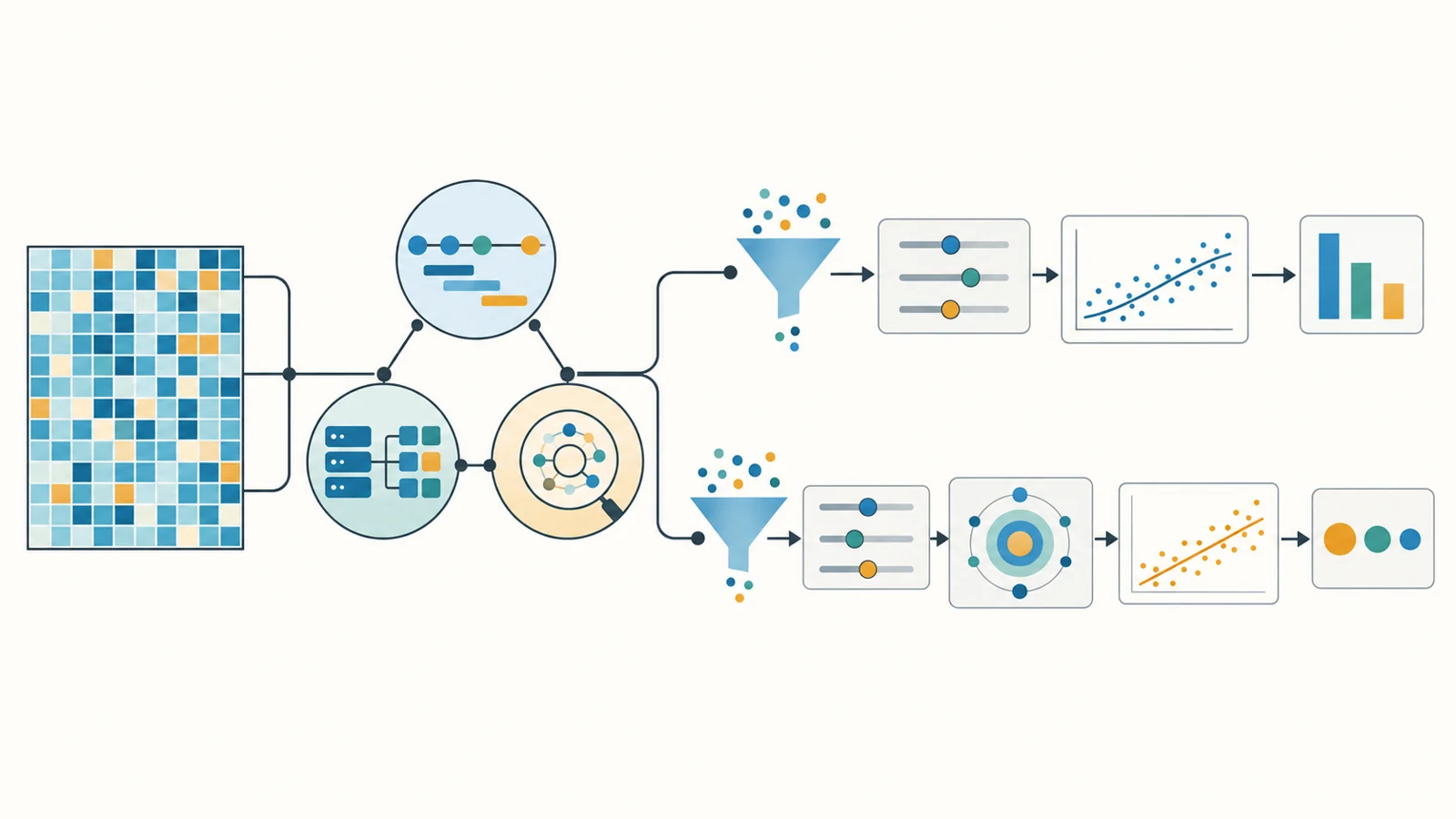
The pipeline includes dataset selection, preprocessing, correction for confounding factors, prediction of conditions, and analysis to identify disease-predictive genes. Preprocessing makes the inputs usable for the chosen calculations. Confounder correction addresses factors that could complicate the relationship being studied. This matters because a pattern in gene activity may reflect more than the disease or trait the researcher wants to investigate.
For conditions such as age and gender, the paper describes residualization, a statistical approach that accounts for a condition’s contribution to the measurements being analyzed. In plain terms, the analysis tries to separate out that contribution before examining the relationship of interest. Including such an operation in the workflow requires more than producing plausible scientific prose. The system must connect the question to the appropriate data and executable analysis.
The task becomes more demanding when the needed condition information is missing. The authors describe a two-step regression strategy that uses genes shared between datasets to estimate the missing condition, enabling trait and condition data to be analyzed together. Regression is a way of estimating statistical relationships between variables. Here, an additional estimation step stands between the available data and the final gene analysis.
That difference gives the study a useful test of difficulty. A system may handle a more direct analysis reasonably often yet struggle when it must first infer information that the next stage needs. Organizing those dependencies is part of what an automated research team has to accomplish.
What the 457 questions test
To evaluate TAIS, the researchers built the Genetic Question Exploration benchmark, abbreviated GenQEX. It contains 457 selected questions, with public genetic datasets, preprocessing and regression code, and corresponding reference results. Those materials provide a concrete basis for comparing the system’s outputs with an established analysis of the same questions.
The questions concern disease or trait relationships under particular conditions. The authors selected pairs using inclusion and exclusion criteria and ranked their associations using overlap among related genes in the NCBI Gene database. Gene-expression and clinical data came from the Gene Expression Omnibus and the Cancer Genome Atlas, with the latter accessed through the Xena platform.
These choices define the territory in which the system is being tested. The 457 questions are a curated collection, rather than a random sample of everything a biomedical researcher might ask. Their value is that they turn a broad ambition—automating parts of scientific discovery—into specific tasks with inspectable inputs, code, and expected outputs.
The reference results also need careful interpretation. The paper calls them a gold standard, but they function here as the benchmark’s comparison target. Matching them measures agreement with that reference analysis. It does not, by itself, establish that a gene causes a disease, or that a candidate would survive independent biological testing.
The authors evaluate the process from raw datasets to identified genes and also examine preprocessing and regression separately. That distinction helps locate different kinds of difficulty. Preparing data successfully and choosing the same genes as the reference analysis are related achievements, but they answer different questions.
Task success and gene agreement tell different stories
The central results are easier to read side by side. The paper reports the following percentages for single-step and two-step regression tasks.
| Reported measure | Single-step tasks | Two-step tasks |
|---|---|---|
| Success rate | 67.74% | 42.28% |
| Precision | 9.20% | 6.49% |
| Recall | 10.40% | 6.78% |
| Jaccard index | 6.73% | 4.18% |
Success rate is the paper’s measure of task success. It should not be read as the percentage of genes that were correctly identified, the accuracy of a diagnostic test, or the likelihood that a scientific conclusion is true. The gene-level measures address agreement with the reference results more directly.
Precision asks what fraction of the genes selected by the system also appear in the reference set. Recall asks what fraction of the reference genes the system recovers. The Jaccard index measures the overlap between the two sets relative to all distinct genes appearing in either. The reported precision and recall values therefore indicate limited agreement, even in the easier single-step tasks.
For a reader, the crucial distinction is between getting through an analysis task and reproducing its reference gene findings. A success rate of 67.74% can sound reassuring in isolation. Alongside 9.20% precision and 10.40% recall, it describes a workflow whose ability to produce useful gene selections remains a substantial challenge.
Every reported measure falls on the two-step tasks. Success drops from 67.74% to 42.28%, while precision falls to 6.49% and recall to 6.78%. This is consistent with the additional difficulty of estimating missing condition information before the final analysis. The comparison does not isolate the cause of every failure, but it shows why a single headline score would conceal an important difference among tasks.
Low overlap also does not prove that every gene outside the reference set is biologically irrelevant. The benchmark measures agreement with its target, while biological relevance is a further question. Conversely, a gene’s presence in a plausible-looking output cannot substitute for evidence that the analysis identified it reliably.
How much support comes from collaboration and comparisons?
The authors report that iterative collaboration among agents improves performance. That finding supports the practical idea behind the team structure: repeated exchanges among agents can help them work through an analysis more effectively. For this kind of system, coordination is part of the method being tested, alongside the statistical code it produces and executes.
A qualitative case study offers a different kind of support. For one question, the paper reports that genes identified by TAIS align with findings in biomedical studies. Such corroboration makes the output more scientifically interesting than a list assessed only for whether the code ran. Its scope is nevertheless specific to that example; it cannot establish comparable validity across all 457 questions.
The comparison with other agent systems has a narrower interpretation. The authors tried MetaGPT and AutoGPT and report that those methods could not generate bug-free preprocessing code in their experiments. They therefore do not report benchmark results for those methods. This highlights executable data preparation as a serious obstacle, but it does not provide a numerical performance ranking against those systems across the full benchmark.
Taken together, these observations support investigating TAIS as a way to coordinate exploratory analysis. Generalizing beyond the benchmark would require dependable handling of different datasets and questions, together with external validation of the gene-level findings. Prediction from gene activity is also distinct from demonstrating a causal gene–disease relationship. The reported results do not establish clinical benefit or a system ready to guide treatment.
What this could change
If a coordinated AI team can make these workflows reliable across datasets, and its gene findings validate independently, it could reduce the manual coordination burden of exploratory gene-expression research. Researchers could spend less effort moving between dataset selection, preparation, condition adjustment, and regression, while retaining responsibility for judging whether a question and its results make biological sense.
The downstream opportunity is to investigate more disease–condition questions with the same research resources. A workflow that can consistently assemble and execute those analyses could let a team examine relationships it would otherwise leave unexplored, then direct its experimental effort toward candidates with stronger support. The path to that capability runs through both dependable computation and meaningful gene selection. Improving them together could turn an automated analysis team into a useful means of expanding scientific exploration.
Key Sources
- Primary source: Toward a Team of AI-made Scientists for Scientific Discovery from Gene Expression Data
arXiv · Preprint · 2024-02-15
Keep exploring