
Research Signal – Source date 2022-02-02
Fitting a model to measurements usually starts with a decision already made: which relationships should the model contain? A scientist might choose an equation describing motion, then use observations to estimate its unknown coefficients. Searching for the relationships themselves is a different task. It asks which quantities belong in an explanation and how they should connect.
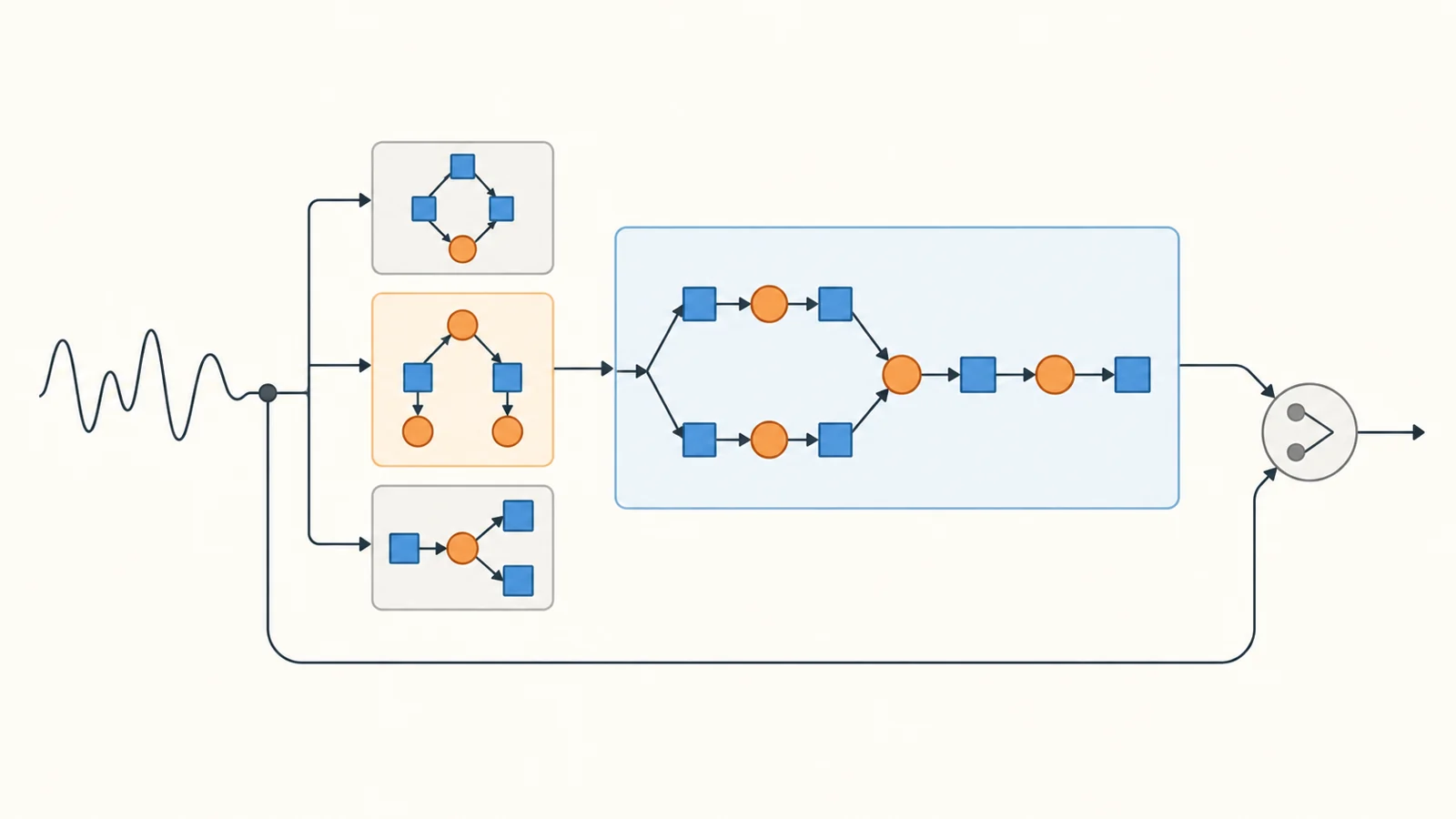
A February 2022 preprint, AI Research Associate for Early-Stage Scientific Discovery, proposes an assistant for that earlier stage of scientific reasoning. Called CyPhy, the system constructs candidate physical hypotheses and translates them into calculations that can be fitted to data. Its central contribution is the connection between proposing a structured explanation and making that explanation computationally testable.
The proposal gives “hypothesis generation” a concrete meaning. A hypothesis is a network of physical quantities and relationships, including quantities that may not be directly measured. The system searches among these networks, then uses measurements to assess how well their adjustable relationships can account for observations.
Turning an explanation into a calculation
CyPhy starts with a mathematical vocabulary for describing physical systems. This vocabulary distinguishes quantities and the kinds of relationships that can connect them. It also encodes structure associated with an assumed description of space and time, including built-in conservation relationships.
That creates two different jobs inside a candidate model. Some connections follow from the mathematical representation and its assumptions. Others describe how a particular physical system behaves and need to be learned from measurements. A material’s response law, for example, belongs to this second category. Conservation structure alone does not specify every material’s behavior.
The system automatically compiles each viable hypothesis into a computation graph. Here, “compiles” means translating the high-level relationships into an executable sequence of mathematical operations. The graph uses tensors—arrays of numbers—and operations that calculate changes, accumulated quantities, and local physical responses. The paper describes differentiation and integration operations alongside functions representing the relationships to be fitted.
This is what makes the proposed hypotheses trainable. Measurements enter the calculation, adjustable parameters are varied, and the resulting mismatch is used to guide fitting. Researchers can trace the calculation back to the relationships that generated it, giving individual parts of the model a physical interpretation.
The distinction also clarifies what learning contributes. Fitting can estimate parameters in a response function while the surrounding mathematical structure stays fixed. Hypothesis search can change which relationships and hidden quantities are present. CyPhy connects these two levels, so a proposed model structure can become a calculation without being separately implemented by hand.
Keeping the search manageable
Allowing a system to introduce new quantities and connections quickly creates many possible explanations. Some additions contribute little: a new variable does not automatically make a meaningful claim about physics. The search therefore needs ways to control complexity and favor useful candidates.
The preprint describes several such controls. Users can cap the number of latent variables, meaning quantities introduced by a hypothesis rather than directly supplied as observations. They can also provide heuristic rules that remove possibilities or prioritize paths resembling the structure of existing theories. Within a candidate, the functions available for fitting can be restricted to selected families.
These choices create a practical tradeoff. A smaller search is easier to explore, and restricted functions can reduce overfitting. But a relationship outside those choices cannot emerge merely because the measurements might support it. The range of explanations available to CyPhy depends on its representation, its search rules, and the flexibility granted to its fitted functions. Describing the approach as minimally biased expresses an ambition to reduce unnecessary commitments; it does not make the search assumption-free.
What the angular-motion example recovers
The paper’s angular-motion example shows how a candidate relationship becomes something that can be evaluated. The observed quantity is an angle changing over time. A candidate connects a function of that angle with another function applied to its rate of change, together with the mathematical operations needed to relate them.
For the candidate to hold, the two sides of its equation should agree. Their difference is the equation residual. A residual close to zero means that the proposed relationship is approximately satisfied at that point in the observations. The fitting procedure minimizes the mean of squared residuals across the time period being evaluated, adjusting the functions within their permitted families.
The reported fitted forms are specific. One function is proportional to the sine of the angle, written as `f₁(θ) = c₁ sin θ`. The other is proportional to angular velocity, written as `f₂(ω) = c₂ω`. The paper reports the coefficient ratio `c₂/c₁ = −g/r` and identifies latent quantities in the construction with angular momentum and torque.
Those interpretations give the result more substance than a curve that merely resembles the observations. Angular momentum describes rotational motion, while torque describes the action that changes it. The example connects a measured changing angle to a recognizable physical relationship involving these quantities.
It illustrates the full path from a candidate structure through parameter fitting to an interpretable result. Recovering a familiar relationship is useful evidence that these steps can work together. It does not establish discovery of a previously unknown physical law.
How far the example takes the claim
An equation can fit the observations used to adjust it and still perform poorly on independent measurements. Minimizing residuals over a recorded period therefore answers a narrower question than showing that a model predicts new behavior. Physical interpretability helps researchers inspect an explanation, but it does not replace that further test.
The preprint’s broader ambition reaches across classical and relativistic physics and includes learning from sparse, possibly noisy measurements. The angular-motion fit illustrates the proposed mechanism; by itself, it cannot establish that breadth. Nor does that fit alone establish advantages in accuracy, speed, data requirements, or tolerance of noise over competing approaches.
The contribution to assess at this stage is a method for joining hypothesis construction, executable calculations, and data fitting. Extending that connection to more demanding physical systems would require showing that the resulting models remain useful beyond the observations used to fit them.
What this could change
If the approach generalizes to more demanding measurements and physical systems, physicists and engineers could gain help at a difficult point in modeling: when they have some observations and mathematical constraints but lack a reliable equation for the system’s response.
An assistant that proposes inspectable relationships and fits them from limited data could help turn those observations into usable material models. Once validated, the learned response laws could supply missing components of simulations, allowing researchers to explore behavior in settings where the relevant law is still uncertain. The potential payoff is a shorter path from measurements to a physical model whose assumptions, calculations, and predictions can be examined.
Key Sources
- Primary source: AI Research Associate for Early-Stage Scientific Discovery
arXiv · Preprint · 2022-02-02
Keep exploring