
Research Signal – Source date 2026-06-01
Ask a predictive model about a crystal, and it might estimate the structure’s properties. Inverse materials design reverses that direction. Researchers specify the properties they want, and a model proposes compositions and atomic arrangements that might deliver them. A promising output is a candidate for investigation. Establishing whether its atoms can hold that arrangement—and whether a laboratory can produce it—requires further work.
A June 1, 2026 review preprint, Towards Automated Discovery, examines how that search could work for crystalline solids, whose atomic patterns repeat through space. It brings together generative models, learning from different kinds of scientific information, and workflows that feed assessment results back into the next round of proposals. Its central contribution is to connect these activities around a practical question: how should researchers search when several requirements must be satisfied and detailed testing is expensive?
Different ways to search for an atomic arrangement
Generative models learn patterns in known materials, including relationships between chemical composition and crystal structure. Those learned patterns help define where a search begins and how it moves. The review compares several model families, with different ways of steering proposals toward requested properties.
Latent-variable methods work through a compressed, learned representation of materials. A decoder translates a position in that representation into a candidate structure. Researchers can adjust the position to improve a target score, then decode the revised candidate. This supports a proposal-and-refinement strategy: generate a starting point and move it toward the desired combination of properties. The physical constraints matter during that movement because optimizing the score can carry the search beyond the chemically plausible regions the model learned.
Guided diffusion offers a different search behavior. It can draw a broad variety of crystal candidates while steering sampling toward specified conditions. The review places it toward the exploratory end of the search spectrum, suited to proposing a large pool from which a smaller selection can advance. Diversity has practical value here. A search that repeatedly produces closely related arrangements explores fewer alternatives, even if its output count is large.
The useful choice therefore depends on the scientific task. Refining candidates within a learned representation and sampling broadly under guidance serve different needs. The review does not establish a universally superior model family; it emphasizes how a generator works with constraints, uncertain predictions, and the assessment steps that follow it.
What scientific text adds to a crystal structure
Atomic coordinates describe an arrangement, but materials research contains other kinds of information. Thermodynamic and electronic data, microscopy, spectroscopy, processing conditions, and scientific text each describe aspects that may help interpret a candidate. Multimodal learning attempts to connect these different forms of evidence in a shared representation.
Scientific text has a particularly useful distinction in this account. The review describes work in which text supplies contextual or symmetry-related cues that can be difficult to extract reliably from structure alone. When those cues improve a property predictor, they can help rank candidates and decide which deserve closer attention. Text contributes to the selection decision without directly constructing a crystal.
Text-guided generation is a separate use. There, a description helps condition the structures a model proposes. Keeping these roles clear explains why progress in multimodal prediction can matter to inverse design even when the predictor never generates an atomic arrangement itself. Better information can change which branch of a search receives the next allocation of computational or experimental effort.
How one round changes the next
Consider a candidate entering the workflow described in the preprint. Early checks ask relatively inexpensive questions. Do any atoms overlap? Are their separations and the structure’s density within acceptable ranges? Is the composition internally consistent, and does it meet applicable charge requirements? These checks remove candidates that fail basic conditions before more resources are spent on them.
A surrogate—a cheaper predictive model used in place of a more demanding calculation or experiment—can then help estimate properties and prioritize the remaining candidates. Its uncertainty matters alongside its score. An apparently excellent prediction in unfamiliar chemical territory may deserve a different level of trust from a similar prediction close to well-characterized examples.
Optimization also creates a specific hazard called surrogate exploitation. A search can favor candidates that take advantage of errors in the predictor, producing increasingly attractive scores without a corresponding improvement in the actual target property. Selective, more detailed assessment provides a way to confront those predictions with stronger evidence.
For chosen structures, that assessment can include relaxation, in which atomic positions and the crystal cell are allowed to adjust, followed by stability calculations. The review discusses methods ranging from learned interatomic models to density functional theory, a computational approach to a material’s electronic behavior. Vibrational checks can also probe whether a proposed arrangement is dynamically unstable. Each stage answers a more demanding question and carries its own cost.
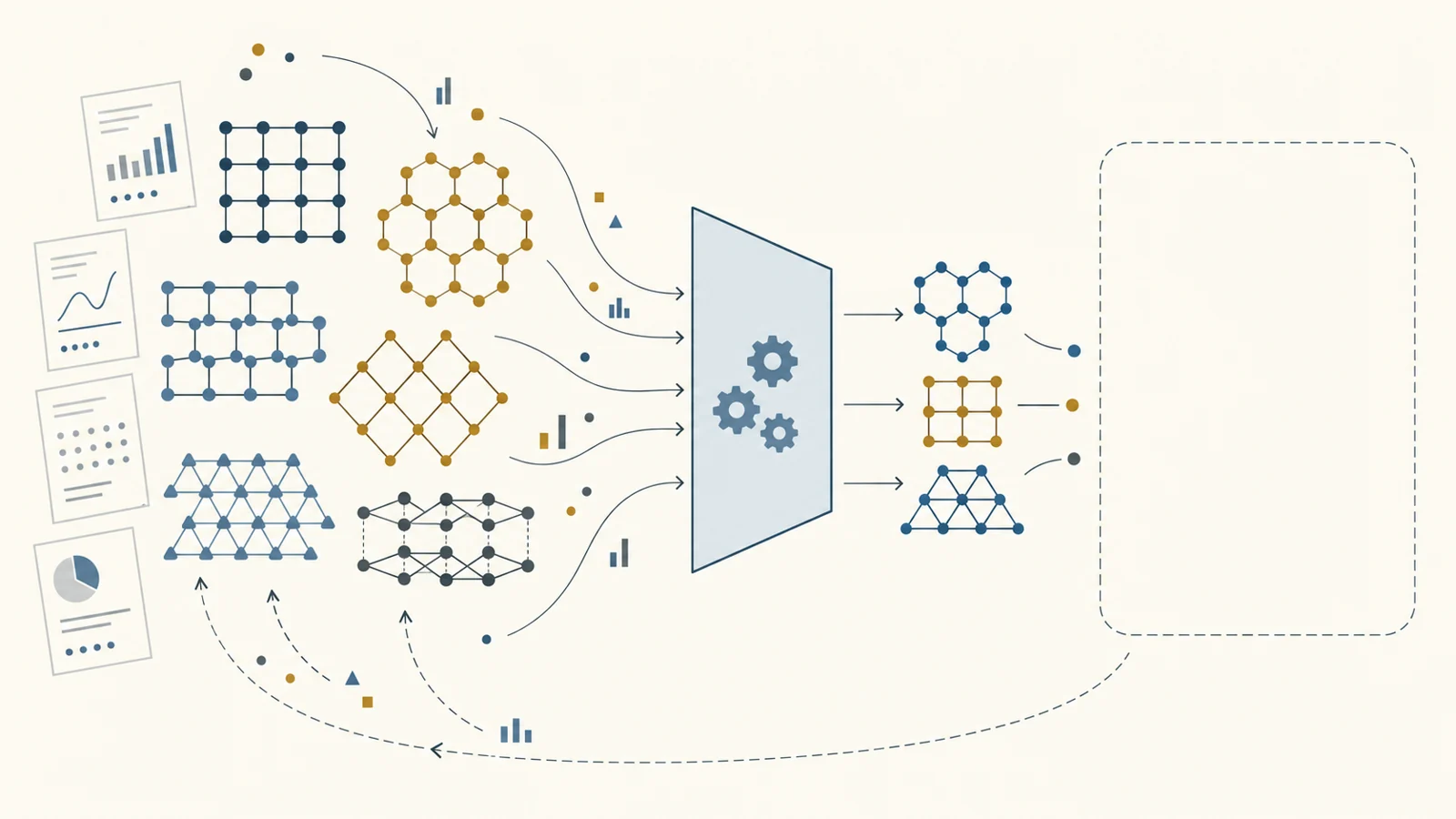
The feedback step makes this a learning process across successive rounds. The dataset receives the assessed objective values, feasibility outcomes, and relevant metadata. That record might include whether relaxation succeeded, the conditions associated with synthesis, the origin of a result, or uncertainty estimates. Proposal models and property predictors can then be retrained, fine-tuned, or recalibrated using the expanded information.
An unsuccessful outcome can therefore change future choices. Recording that a candidate failed a feasibility check preserves a constraint the next search can learn from. Recording a mismatch between a predicted property and a detailed calculation supplies evidence about the predictor’s errors. Keeping the accompanying conditions helps preserve what the result actually applies to. The next round begins with a changed dataset and potentially a changed search policy.
This also explains the review’s emphasis on reporting several stages of performance. Validity, novelty, uniqueness, stability, and cost describe different aspects of a search. Counting all generated structures cannot reveal how many distinct candidates survived demanding assessment or what resources were needed to reach them.
Why a stable calculation leaves a synthesis question
Computational stability and experimental accessibility concern different physical problems. A calculation may favor an arrangement that can form only within a narrow range of growth conditions. Kinetic barriers can prevent atoms from reaching it, while competing phases may form more readily. These obstacles help explain why a promising, computationally stable crystal does not automatically become a material a laboratory can make. Processing conditions also belong in the design problem when the goal includes obtaining the requested properties in practice.
The information available to guide that problem is uneven. A curated computational database can contain orderly structural and property records, while experimental evidence brings noise, missing measurements, and variation in processing. A model trained on the former must cope with a different setting in the latter. This distribution shift can undermine predictions precisely where researchers need them to guide a new experiment.
Combining modalities introduces its own difficulties. Many measurements are expensive or sparsely available, so useful materials rarely come with every kind of evidence attached. A system must work with incomplete inputs. And matching the meaning of scientific text to a structure does not itself establish physical validity or energetic stability. The review treats broadly transferable representations as an ongoing research challenge.
These limits also define how to read the paper’s contribution. It is a review preprint that synthesizes earlier research, rather than a new controlled comparison or an experimental demonstration of the complete integrated workflow. This version has not been peer reviewed. The available evidence does not support a pooled performance estimate across the discussed systems, or a measured reduction in discovery time or cost attributable to bringing them together.
What this could change
If these methods become reliable under experimental conditions, researchers could search for materials that meet several requirements together: desired properties, feasible structures, and accessible processing conditions. The downstream goal would be crystalline materials that laboratories can obtain and that retain their requested properties under practical processing conditions.
Reaching that goal depends on how the parts reinforce one another. Scientific information can improve selection; detailed assessments can expose prediction errors; recorded outcomes can redirect subsequent proposals. With limited validation resources, that learning could help researchers pursue combinations of properties and processing conditions that can be achieved together. Synthesis and property validation would still be required to establish that the resulting materials meet those requirements.
Key Sources
- Primary source: Towards Automated Discovery: A Review of Generative Models, Multimodal Learning and Closed-Loop Workflows in Inverse Materials Design
arXiv · Preprint · 2026-06-01
Keep exploring