
Research Signal – Source date 2026-07-22
Two pieces of a material can have the same chemical ingredients and crystal structure yet behave differently if they were processed in different ways. That makes an AI-proposed crystal an incomplete answer to a practical question: can this material be made in a useful form, and will it keep working under real conditions?
A preprint posted to arXiv on July 22, 2026, sets out a way to separate those questions. Its authors organize materials properties and novelty claims by the evidence needed to support them, then examine how today’s materials data and benchmarks fall short of connecting a proposed structure to practical performance. The paper offers a conceptual framework; the evidence presented here does not demonstrate that a particular AI-designed material has been made or used successfully.
A crystal structure captures only part of a material’s history
Chemical composition tells us which elements are present and in what proportions. An ideal crystal structure describes how atoms are arranged. Those details can help predict properties that are closely tied to composition and structure, but they leave out how a sample was made and what internal features that process produced.
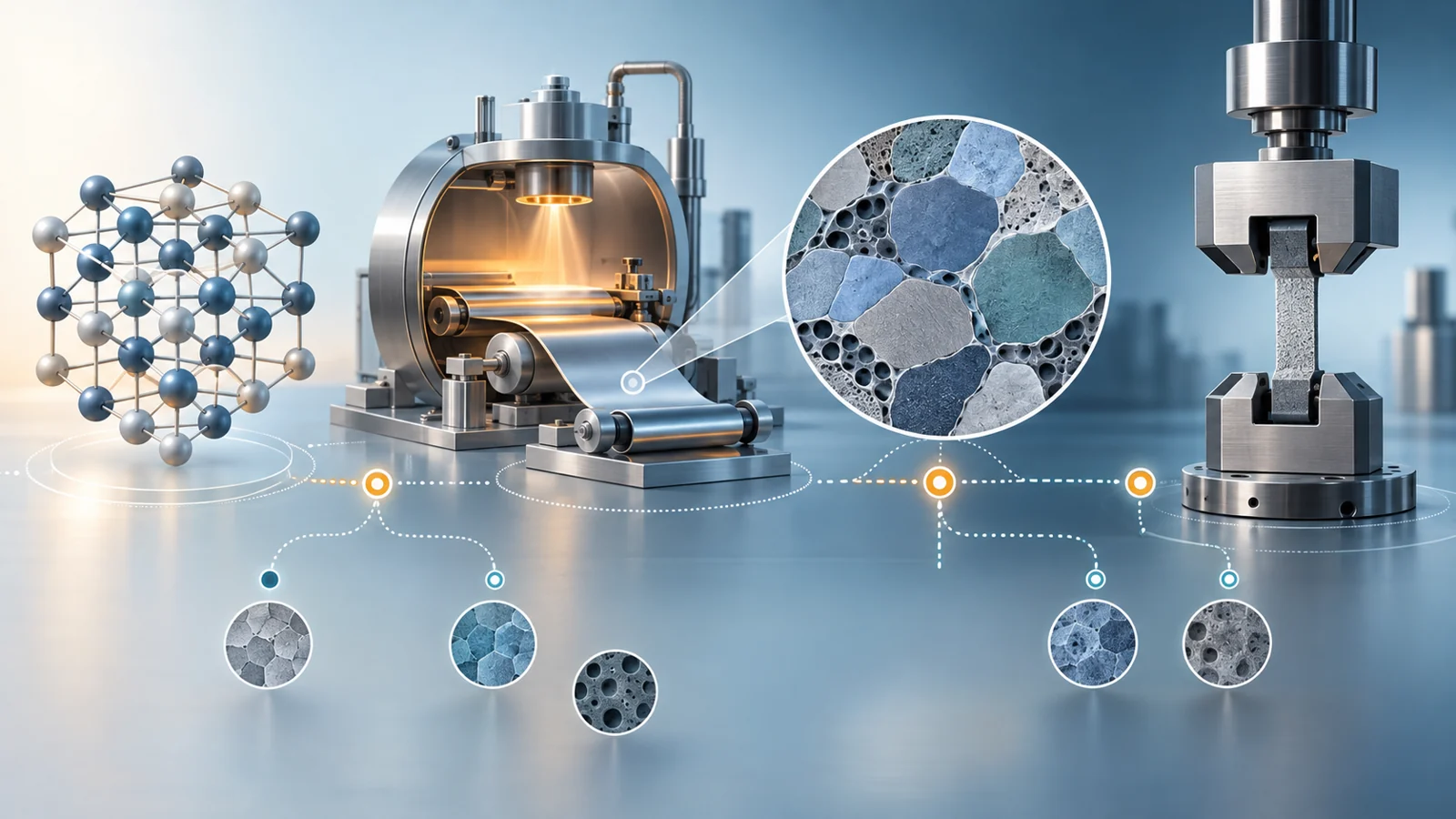
Processing can shape a material’s microstructure: features such as the distribution of phases, grain shapes, and defects. These features, in turn, can affect mechanical or functional behavior. A model that sees mainly composition or an idealized structure may therefore miss relationships between manufacturing choices and the performance of the resulting material.
The authors arrange this problem as a hierarchy. At its lower levels are atomic-scale descriptions and properties that are closely linked to composition and ideal crystal structure. Higher levels include microstructure, processing history, and engineering performance. Predictions generally become harder as these levels rise, while the questions become more directly relevant to use.
This is also why a stability calculation is useful but limited. One common screen estimates how far a proposed crystal lies above the convex hull, a reference used to assess stability. A candidate far above it is less promising as a material that could be synthesized. But stability is only one part of whether a material can be produced: some useful materials exist in metastable states, reached and retained through processes such as vapor deposition or rapid quenching. For those cases, the design target includes a process-accessible state, not just a stable ideal crystal.
Three kinds of novelty call for different evidence
The paper distinguishes structural, physical, and deployment novelty. Each asks a different question, so a single distance score or property prediction cannot stand in for all three.
Structural novelty asks whether a proposed composition or atomic arrangement differs from known materials. Comparisons in a defined composition or structure space can help identify candidates that are not near-duplicates. A basic stability screen adds useful context, but neither establishes that the candidate will be accessible through a synthesis route.
Physical novelty concerns whether a material has a noteworthy property, rather than whether its input structure is unusual. That claim calls for evidence about the property itself, supported by a trusted measurement or prediction approach. A composition far from known examples could still have unremarkable properties; a familiar composition might behave differently when processed differently.
Deployment novelty concerns useful performance in conditions of use, including whether functionality is retained as the material ages. The authors point to service exposures such as oxidation, fatigue, and corrosion as relevant to that question. Evidence about an initial measurement alone cannot answer whether the material will continue to work in service.
These categories make novelty a claim that must be matched to its evidence. A structure may be new without being useful, and a promising property estimate does not by itself show that the material can be produced and retain its function in use.
The missing links are often in the records
To connect a proposed composition to practical behavior, researchers need records spanning four broad categories: chemical composition, microstructure, processing, and testing or characterization. A single category can contain different kinds of data, and one measurement may inform more than one part of the chain. The important point is to link records that describe the same material and its history.
Those connections are difficult to build. Relevant information can be scattered across papers, tables, and figures rather than stored in a consistent, machine-ready form. Materials data also vary across laboratories, instruments, sample preparation, and analysis procedures. If those differences are not captured, apparent differences between samples may be hard to interpret or compare.
Coverage is uneven, too. Synthesis records and long-duration performance measurements are less available than many other kinds of data. Some tests take a long time, so they are costly to collect at scale. As a result, a dataset may cover many simulated compositions or idealized structures while containing much less information about processing, microstructure, or behavior over time.
A model trained on the available records can only learn relationships those records capture. Linking the categories could help reveal how process and structure relate to measured outcomes, while poorly aligned or missing records leave those relationships difficult to learn. More data alone will not solve the problem if the data do not say clearly what was processed, how it was characterized, and which results belong together.
A high benchmark score may answer a narrower question
Materials AI benchmarks make comparisons possible by defining tasks, datasets, data splits, and performance measures. But a score is informative only to the extent that the benchmark resembles the discovery decision researchers want to make.
Many prediction tasks use computational labels. These can support comparison on a defined task, but they are not the same as experimental measurements. Generative systems are also often judged with proxy measures, including distances in composition or structure space. Such measures can identify unusual candidates, yet they do not directly show that a candidate has a useful measured property or can be made through a workable process.
How a benchmark separates training examples from test cases also matters. If both sets contain very similar materials, a model can score well without showing how it handles unfamiliar cases. Testing on materials or conditions unlike those used for training gives a better check of that ability, though it still does not show whether the predictions will prove useful in experiments.
Practical discovery workflows also consider groups of candidates under constraints. Researchers may need to know how often a batch meets target requirements, or how useful the best candidates are within a fixed screening budget. That is a different question from whether one generated sample scores well on an isolated metric. Benchmarks that include such constraints can better reflect the decisions a search process must support.
Toward materials designed to be made and used
If composition, processing, testing, and long-term performance records can be linked reliably, generative AI could help researchers narrow the search for materials that can be made in a useful form and keep their properties when exposed to oxidation or fatigue. For engineers, that could mean better candidates for parts expected to remain functional in service. The preprint does not show that any AI-designed candidate has passed those tests; fabrication, measured properties, and performance over time still have to establish the claim.
Key Sources
- Primary source: Generative and multimodal AI for materials prediction and design: Progress, challenges, and perspectives
arXiv · Preprint · 2026-07-22
Keep exploring