
Research Signal – Source date 2026-06-26
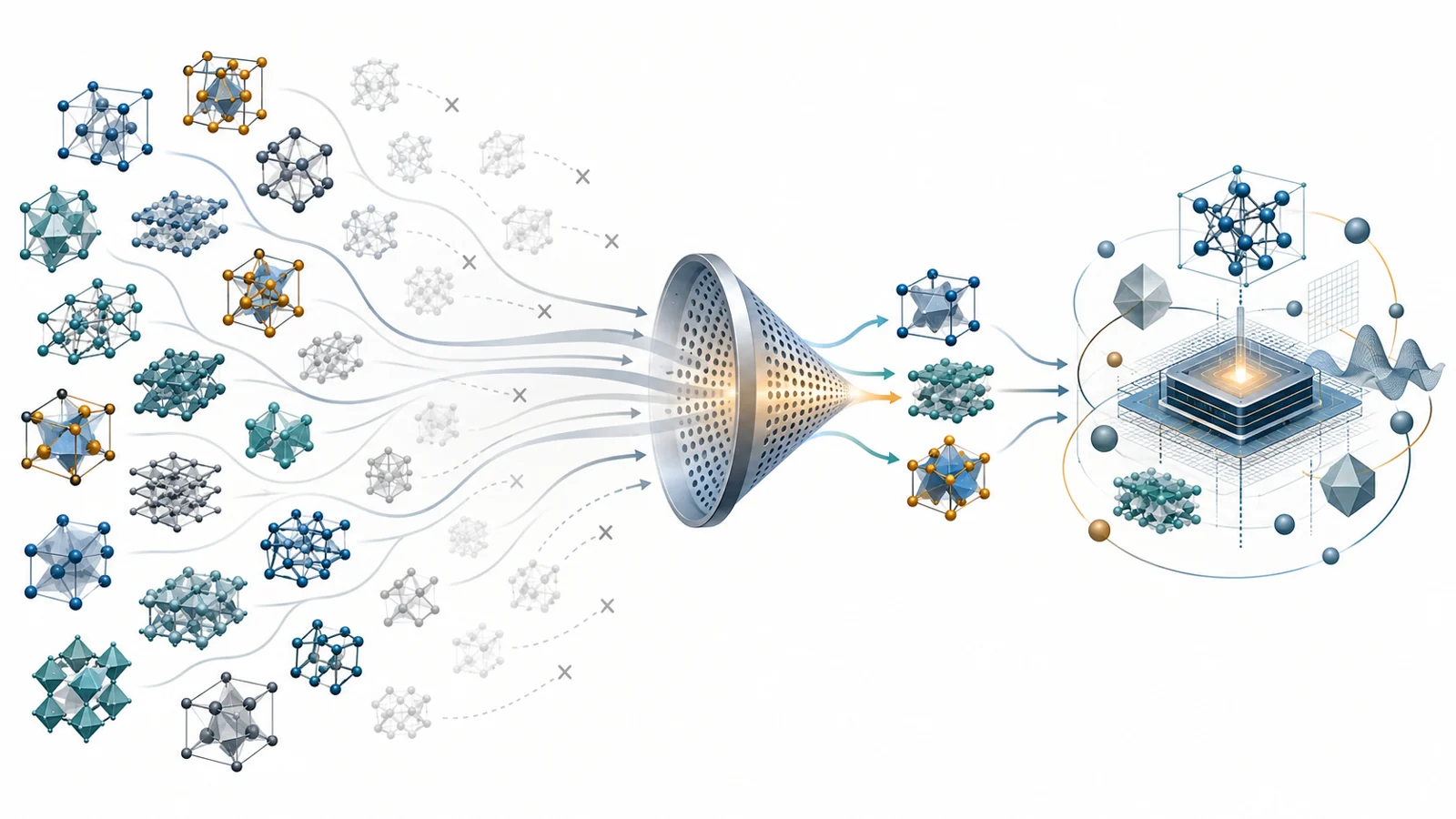
A computer can generate many possible crystal structures, but evaluating each one’s properties may be the costly part of a search. A June 26, 2026 arXiv preprint asks whether a model can screen those generated candidates first, so a limited number of expensive calculations go to the most promising structures.
The clearest test gave two selection strategies the same budget: four calls to a property oracle. Choosing candidates by the model’s ranking outperformed choosing them arbitrarily. That result isolates the gate’s contribution: with the number of evaluations held fixed, the selected candidates mattered.
Four checks make the selection test concrete
The study places a probabilistic surrogate between a crystal generator and a property oracle. The generator proposes structures; a stability, uniqueness, and novelty filter removes candidates that do not pass its checks. A Gaussian process, or GP, then estimates how promising the remaining structures are and how uncertain those estimates are. Its acquisition rule uses expected improvement, with a diversity term, to rank candidates. Only the top few proceed to the more expensive oracle.
The oracle supplies the property evaluation used in the search. The GP acts as a cheaper guide to where those evaluations may be most useful. In the budget-matched ablation, the gate and arbitrary selection each sent four candidates to the oracle. The ranked choices did better, so the result cannot be explained simply by using fewer calls. It indicates that the surrogate’s ordering carried useful information in this tested setting.
That is a narrower claim than saying four checks will always be enough. It is evidence that, for these generated candidates and this workflow, choosing which four to evaluate beat selecting four without using the ranking.
The gate was tested with three generators
The authors inserted the gate into an existing reinforcement-learning-steered generative workflow. They compared gated and ungated fine-tuning using three pretrained diffusion models with different architectures: MatterGen, CrystalFlow, and ADiT. The targets were room-temperature heat capacity and bulk modulus, and each policy was run over five seeds.
Across those reported comparisons, the gated loop matched or exceeded ungated fine-tuning while keeping oracle calls within a fixed per-cycle budget. In the strongest efficiency comparison, the gated approach came within about 9% of the performance achieved with exhaustive oracle spending while using roughly one-fifth as many oracle calls. This describes a particular comparison in the paper; it is not a general conversion rate between calls saved and performance retained.
The budget matters because each oracle evaluation is the costly step the gate is intended to conserve. If a search can preserve much of the result while evaluating fewer candidates, researchers could spend a fixed computing budget across more proposals. The four-call ablation explains why selection may help; the broader loop comparison estimates how much performance the gate retained in the tested cases.
A useful gate depends on how crystals are represented
A model cannot rank structures unless it has a numerical representation to work with. The paper therefore also compares combinations of crystal embeddings and probabilistic surrogate models in a separate benchmark covering mechanical, electronic, and vibrational properties.
The cross-factorial study varied four embedding methods, three GP-based surrogate families, three representation dimensions, and three training-set sizes. Across five random splits and the properties in the three datasets, this amounted to 8,640 model fits. Pretrained ORB embeddings paired with a Gaussian process were the most reliable combination among those tested across the benchmark’s three property domains. The authors then used that pairing in the closed-loop workflow.
This benchmark addresses a different part of the question from the four-call test. The ablation asks whether the gate’s choices help; the benchmark asks which tested representation-and-surrogate combination offered a dependable basis for making those choices. Its result supports the selected building blocks within these datasets and configurations, not a universal ranking of every possible crystal representation.
A second calculation checked bulk-modulus candidates
The closed-loop search relies on a learned property oracle, so the authors also checked bulk-modulus discoveries with density-functional-theory calculations. For the candidates checked, the DFT values agreed with the learned oracle to within 2.5% on average. The surrogate’s ranking of the generated structures had a Spearman correlation of 0.94 against the comparison ranking.
These measures answer related but distinct questions. The average agreement compares property values from the learned oracle with a separate computational method. Spearman correlation measures how similarly the surrogate and comparison order the candidates, rather than how close every individual value is. Together, they support the computational credibility of the checked bulk-modulus results and the usefulness of the surrogate’s ranking there.
DFT is still a calculation. This cross-check is not a laboratory measurement or evidence that a candidate crystal was synthesized. It tests computational predictions against another computational approach, for the bulk-modulus discoveries examined in the paper.
The evidence has a defined reach
The central closed-loop results concern three pretrained generators and two targets, under the study’s computational setup. The 8,640-fit benchmark covers separate mechanical, electronic, and vibrational property datasets. The DFT comparison is specific to checked bulk-modulus candidates. These pieces of evidence strengthen different parts of the case, but they do not show that the same call savings, rankings, or accuracy will carry over to arbitrary generators, properties, datasets, or search conditions.
The work is a preprint reporting computational comparisons. It does not establish an experimentally confirmed material or a deployed discovery service. Its practical promise depends on whether the ranking remains useful as candidate pools and research settings broaden, and whether promising computed structures can withstand later physical validation.
What cheaper crystal searches could enable
If the ranking and property checks remain useful in broader searches, researchers could screen more candidate structures within the same research-computing budget. That could make searches for properties such as stiffness or room-temperature heat capacity more productive by directing costly calculations toward a smaller, better-ranked set. Whether that leads to useful materials depends on reliable property evaluation and later validation of the candidates in the physical world.
Key Sources
- Primary source: Surrogate-Gated Generation and Foundation-Model Embeddings for Bayesian Materials Design
arXiv · Preprint · 2026-06-26
Keep exploring