
Research Signal – Source date 2022-02-01
How much can a crown material’s shine reveal about its surface? A study published on February 1, 2022, explored that question by measuring both gloss and roughness before and after an acidic fluoride treatment. Its findings show why an exception on one measurement deserves a closer look at the others.
Researchers assessed prefabricated resin composites—resin-based restorative materials intended for crowns made using computer-aided design and manufacturing, or CAD/CAM. Ten materials were intended for premolars and four for molars, the teeth toward the back of the mouth. One ceramic block was also included. These were material-surface tests, rather than observations of crowns in patients.
Three measurements of a changing surface
The treatment was acidulated phosphate fluoride, abbreviated APF. The researchers compared the materials before and after its application using gloss measurements, two measures of roughness, and electron microscopy.
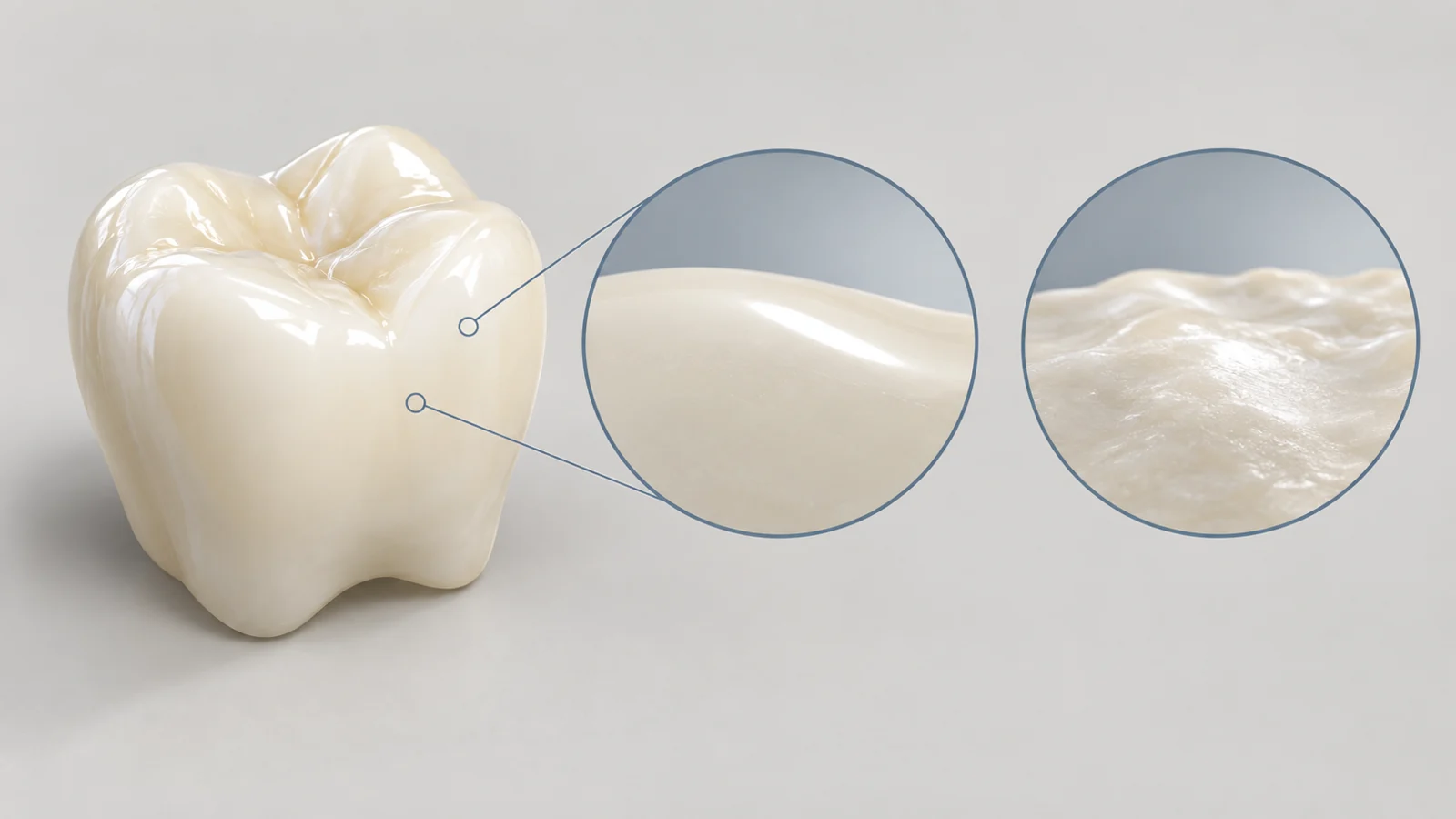
Gloss describes reflected shine. Roughness describes variations in surface height. The two roughness measures offer different views: Ra summarizes height variation along a measured profile, while Sa summarizes it across an area. A surface can therefore produce different results depending on which property is measured and how it is sampled.
After APF application, gloss was significantly lower for 13 of the 14 resin composites. Ra increased significantly for 11, while Sa increased significantly for all 14. Electron microscopy also revealed irregular surface topography after application, with features that differed among materials. Together, these findings led the authors to conclude that APF application may be detrimental to the surface properties of these crown composites.
The exceptions depend on the measurement
Three materials make the distinction especially clear. The table describes whether the researchers reported a statistically significant change, not whether a material changed at all.
Material Gloss decreased significantly Ra increased significantly Sa increased significantly Artesano No No Yes Dentcraft HR Block Yes No Yes Estelite P Block Yes No Yes
The first material was an exception for both gloss and profile roughness, yet its area roughness still increased significantly. The other two lost gloss and showed an increase in area roughness without a significant increase in profile roughness.
That disagreement matters. An exception in the gloss results does not establish that a material retained an unchanged surface. Likewise, an exception in Ra does not establish overall resistance. The measurements describe different aspects of the surface, and none of these exceptions alone establishes a clinically preferable material.
From a detectable change to a meaningful one
Statistical significance does not tell readers how large a change was or whether someone would notice it. The numerical effect sizes needed to assess those questions are unavailable in the abstract-based evidence used here. A significant result cannot, by itself, establish a visible loss of shine or a texture difference someone could feel.
Connecting these findings to dental care would also require the full exposure and measurement protocol, including treatment concentration and application duration. Those details would help establish how closely the experiment represents clinical use. The observed surface patterns alone do not establish the chemical mechanism responsible.
The evidence supports a concern about treatment–material compatibility, but it cannot establish patient discomfort, decay, crown failure, or a shorter restoration lifespan. It also cannot support a treatment recommendation or extend the results to every fluoride formulation. Although a ceramic block was tested, its response is not specified in the abstract, so it provides no basis here for ranking ceramic against resin composites.
What this could change
If further work confirms which treatment–material combinations preserve surfaces under clinical exposure, dental teams could use that knowledge to help maintain the shine and smoothness of resin composite crowns during care. The practical benefit would come from matching treatment to the restoration material with confidence about both appearance and texture.
This study offers a reason to develop that compatibility evidence using more than gloss alone. A fuller understanding of how a crown surface responds could make surface preservation a deliberate part of caring for the restoration.
Key Sources
- Primary source: Gloss and surface roughness of pre-polymerized composite materials designed for posterior CAD/CAM crown restorations corroded with acidulated phosphate fluoride application.
DOI or Journal Page · Peer-Reviewed Paper · 2022-02-01
Keep exploring