
Research Signal – Source date 2026-08-03
A model asked to generate porous oxides produced some chemically plausible crystals with no oxygen. The example, discussed in an August 3, 2026 arXiv perspective, exposes a gap between making structures that look possible and designing materials for a particular job: the model could learn patterns in crystal structures without reliably learning what “porous oxide electrode” meant as a scientific target.
That gap matters because a battery material is not useful just because its atoms fit into a stable crystal. Its pores, chemistry, ion movement, reactions during charging and discharging, mechanical behavior, and fit with the rest of a cell all shape whether it can work. The authors propose a seven-tier approach to bring these demands into AI-assisted design. It is a roadmap for research, not a report of a completed autonomous system or a newly tested electrode.
Porosity creates a design trade-off
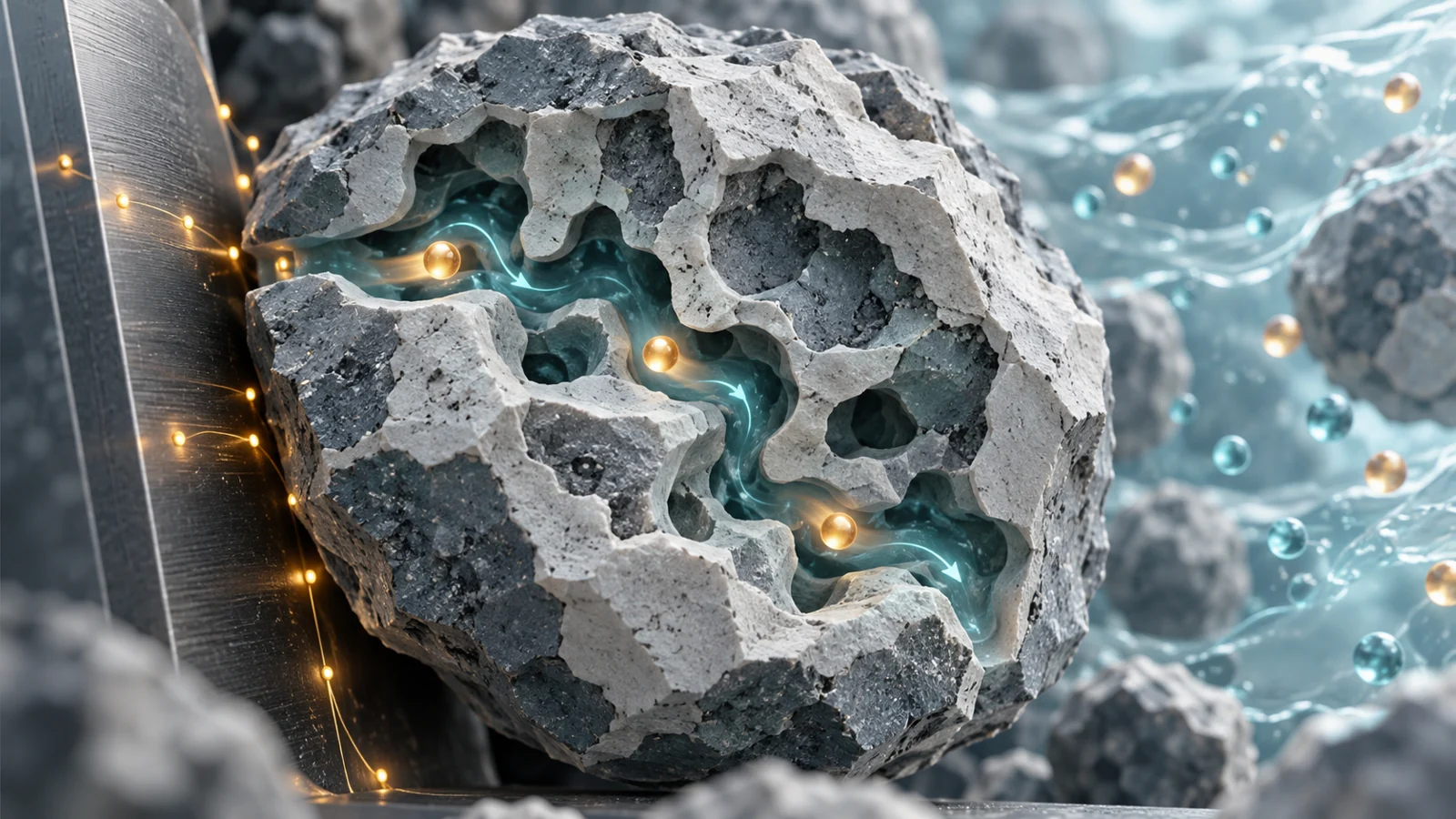
Porous transition-metal oxides are considered as possible battery electrodes partly because connected channels can give ions pathways through a material. Such routes may help address transport limits that arise when ions must travel longer distances. But open space is not automatically an advantage. Too much pore volume leaves less solid material in a given volume, which can reduce volumetric energy density—the energy stored per unit of electrode volume. Channels that do not connect well may offer little help with long-range transport, while highly open structures can be mechanically fragile or electrochemically unstable.
The design problem is therefore a balance. A candidate needs accessible pathways while retaining enough framework to store energy and withstand the conditions of battery operation. It also needs chemistry that supports useful reactions, and it must be possible to make and use the material in an electrode and cell. Optimizing a single measure, such as how open a structure is, can miss the compromises that determine its practical value.
A plausible structure can miss the assignment
In the case study discussed by the perspective, generative models produced candidate crystal structures that were then assessed for structural validity, predicted properties, and stability using computer-based checks. Those checks cannot show whether a candidate can be made or will work as an electrode in a battery.
One lesson from that case study was that training on oxide-rich data did not keep every output within the intended material family. Both a diffusion model and a language model generated some chemically plausible compounds that lacked oxygen. The models had learned statistical patterns in crystal structures, but those patterns did not reliably enforce the design objective.
For an AI system, the difference between “a plausible crystal” and “an oxygen-containing porous oxide” has to be represented in a way the model can use. The authors point to explicit compositional constraints, oxidation states, and physically reasonable coordination environments as part of that challenge. Generating candidates is only an early step: computational screening can narrow the field, while synthesis and experimental characterization would be needed to establish what can actually be made and how it behaves.
The proposed design widens beyond the crystal
The authors propose seven tiers that bring battery requirements into the search for new materials. The progression begins with chemistry and thermodynamic stability: a candidate must have sensible composition and charge balance, and its structure must be energetically plausible. It then brings in transport and electrochemistry, asking whether ions and electrons can move usefully and whether the material offers suitable, reversible redox activity—the electron-transfer reactions that store and release energy.
The later tiers extend the target to durability, cell compatibility, and manufacturability. Durability asks whether the material can tolerate repeated electrochemical and mechanical demands. Cell compatibility recognizes that an active material does not operate alone; it has to function alongside the other parts of an electrode and battery. Manufacturability brings the route to making the material into the design problem itself.
These requirements can change the meaning of earlier successes. A stable crystal with promising transport is less compelling if its open structure is fragile. A material with attractive intrinsic properties still may not be a useful electrode if it does not fit cell requirements or cannot be manufactured in a workable form. The seven tiers are the authors’ proposed way to make those links part of generation and evaluation, rather than treating crystal validity as the finish line.
The missing ingredient may be organized knowledge
The perspective identifies a “Missing Data Problem” behind the limits of application-aware AI. Relevant scientific results may already exist, but they are spread across papers, figures, tables, equations, supplementary files, and experimental records. Researchers report materials, synthesis procedures, measurements, and interpretations in formats designed for people to read. Differences in terms, units, and protocols make it harder for software to connect evidence consistently.
The authors propose a Porous Oxide Energy Materials Ontology: a structured vocabulary for representing relationships among materials, properties, processes, and evidence. They pair it with a continually updated knowledge base and an autonomous knowledge-generation approach. In the proposed loop, organized evidence could help guide candidate design; computational and experimental results could then add to what the system knows.
That architecture depends on more than collecting text. Information must be linked and represented well enough that a model can distinguish comparable results, understand how a material was made or measured, and use relevant evidence in a new design decision. The ontology and feedback loop are proposals in the perspective; the supplied evidence does not show an implemented end-to-end system using all seven tiers.
How AI could find battery electrodes worth making
A synthesis-aware search could help researchers prioritize porous oxide candidates that balance ion pathways with energy stored per volume, durability, and real cell demands. If structured scientific evidence can guide that search, and candidates survive coupled computational checks, synthesis, and battery testing, the approach could help researchers pursue electrodes suited to faster charging or longer-lasting batteries. Those are potential research benefits, not gains demonstrated by the case study or the proposed framework.
Key Sources
- Primary source: Physics-Informed and Knowledge-Driven Generative AI for Autonomous Discovery of Porous Oxide Energy Materials: Opportunities and Challenges
arXiv · Preprint · 2026-08-03
Keep exploring