
Research Signal – Source date 2021-01-01
A 2021 analysis of 14 studies found that people with acute lymphoblastic leukemia (ALL) who received antibody-based treatment had higher measured odds of survival and remission than people treated with chemotherapy alone. They also had lower odds of febrile neutropenia, a fever occurring while infection-fighting neutrophils are dangerously low. The findings bring a potential benefit and a serious treatment risk into the same picture, but they do not show that every antibody works equally well for every patient.
The pooled odds of being alive at a study’s measured follow-up were about twice as high in the antibody groups: odds ratio 2.11, with a 95% confidence interval of 1.76 to 2.53. The odds ratio for febrile neutropenia was 0.22 (95% confidence interval 0.08 to 0.58), meaning the event’s odds were lower in the antibody groups. These are comparisons between groups, not individual survival probabilities: an odds ratio of 2.11 does not mean a person is twice as likely to live or will live twice as long.
Fourteen studies covered different treatment settings
The researchers combined five randomized trials and nine retrospective cohort studies. Across them, 1,596 patients received a CD-targeted antibody as part of induction or salvage treatment, and 2,764 received chemotherapy without one. Induction is treatment given at the start of care to try to bring the leukemia into remission. Salvage treatment is used when the disease has returned or has not responded adequately to earlier treatment.
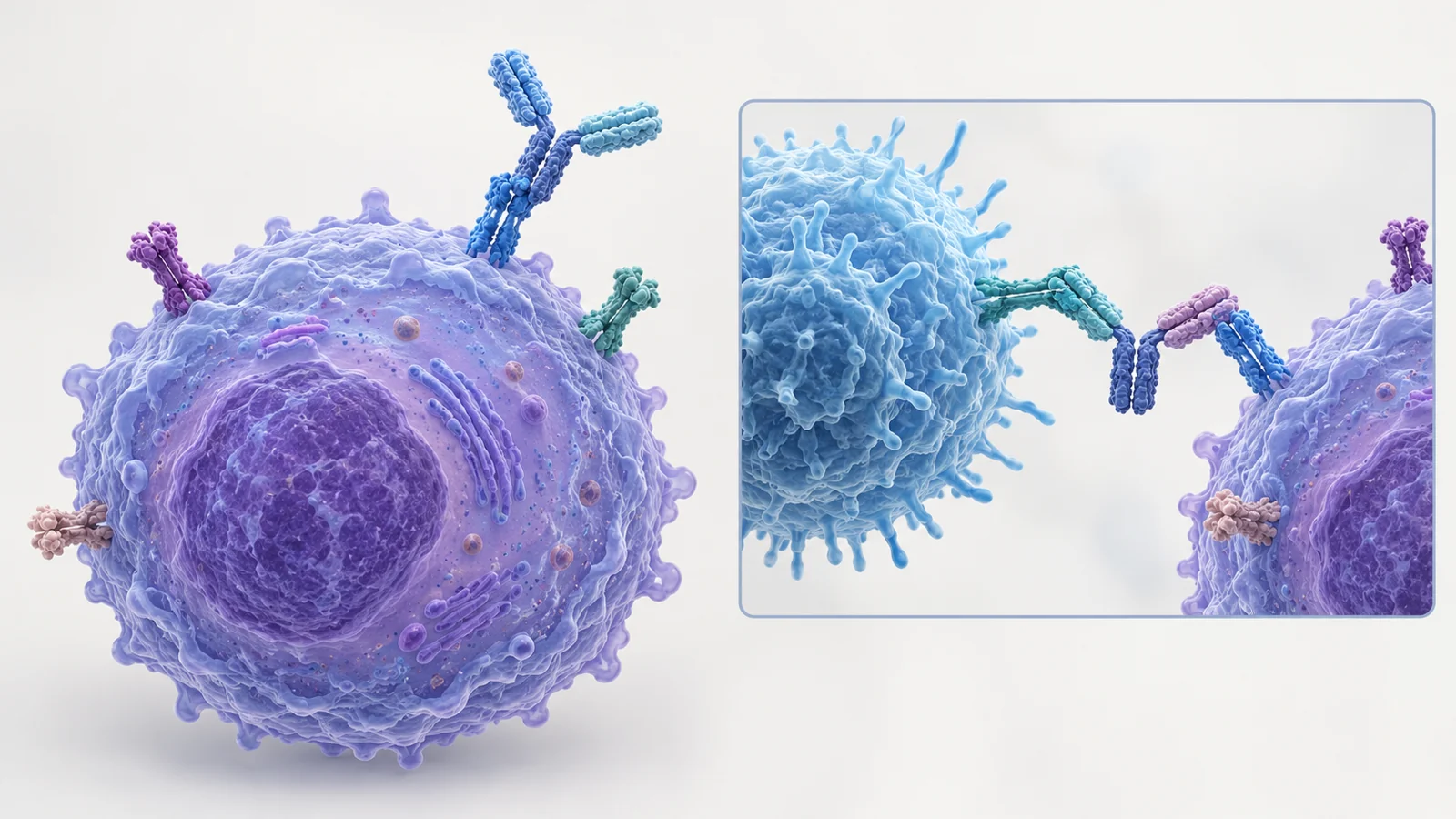
The antibodies recognize proteins on the surface of leukemia cells. These markers, called cluster of differentiation proteins, include CD19, CD20 and CD22. The review covered four treatments aimed at those markers: blinatumomab, rituximab, epratuzumab and inotuzumab ozogamicin. They do not all work in the same way. Blinatumomab can connect a T cell, an immune cell, to a leukemia cell bearing CD19. Inotuzumab ozogamicin carries a cell-killing drug payload to cells bearing CD22. The shared feature is a targeted antibody approach, not a single identical treatment.
Most included studies focused on B-cell precursor ALL, but participants ranged from children to older adults and differed in disease status. The combined estimate therefore describes a broad set of comparisons, not one uniform patient group receiving one uniform regimen.
Survival, remission and residual disease are different measures
Overall survival (OS) describes whether patients were alive at a specified follow-up point. The studies reported it at different times, from six months to four years. Relapse-free survival (RFS) asks a narrower question: among patients in complete remission, what proportion remained alive without relapse at the measured point? The pooled odds also favored antibody treatment for RFS, at 2.25 (95% confidence interval 1.62 to 3.14).
Complete remission (CR) means the review’s remission criteria were met, including fewer than 5% immature leukemia cells in the bone marrow, with no such cells circulating in the blood and no disease outside the marrow. The pooled odds of achieving CR were 1.70 times as high with antibody treatment (95% confidence interval 1.07 to 2.69). Minimal residual disease (MRD) negativity is a more sensitive measure: bone marrow testing found fewer than 0.01% lymphoblasts under the review’s definition. Its pooled odds ratio was 2.98 (95% confidence interval 1.17 to 7.58), but results varied substantially between studies.
That variation matters when interpreting the apparently large MRD estimate. The studies differed in design, patient mix and treatment regimens, and the statistical variation was high for MRD negativity (I² 90%), CR (79%) and RFS (61%). By contrast, variation in the pooled OS estimate was low (I² 0%). These statistics describe how consistently study results aligned; they do not tell an individual patient what outcome to expect.
Drug findings reflect different patient groups
In analyses by antibody type, blinatumomab was associated with higher odds of OS and RFS than chemotherapy in the included comparisons. The blinatumomab evidence included patients with relapsed or refractory ALL, meaning disease that had returned or had not responded to treatment. Rituximab comparisons also favored the antibody for OS and RFS, but the relevant studies involved newly diagnosed patients. The two patterns therefore arose in distinct clinical settings.
The anti-CD22 analyses also found higher OS odds with antibody treatment than with chemotherapy. For several other outcomes—including CR and MRD negativity in some drug-specific analyses—the estimates had wide confidence intervals or did not reach statistical significance. These are separate comparisons against chemotherapy. They are not head-to-head trials that establish which antibody is best, and differences between the patient groups make a simple drug ranking misleading.
The fever finding is one part of the safety picture
Across the pooled comparisons, febrile neutropenia was less likely in the antibody groups by odds (odds ratio 0.22). The review also found lower odds of thrombocytopenia, a low platelet count (0.38; 95% confidence interval 0.25 to 0.57). But estimates for infection and treatment discontinuation did not establish a difference between groups: their confidence intervals included the possibility of higher or lower odds. The fever result is a specific safety finding, not evidence that antibody treatment reduces infections or all serious adverse effects overall.
Historical comparisons limit what the pooled result can settle
About half of the 14 studies were retrospective cohorts that used historical patients as the chemotherapy comparison group. Such comparisons can be affected by differences between patients treated at different times. The studies also varied in age, disease status, chemotherapy regimens and follow-up duration. The review used a random-effects model to combine results across studies, but pooling cannot remove those underlying differences.
The authors also noted that the number of studies was limited for some outcomes and subgroup analyses, and that direct comparisons between antibodies were scarce. The findings are best read as evidence that CD-targeted antibodies were associated with favorable outcomes across the studied comparisons, with the clearest consistency in overall survival. They do not establish the same effect for every age, ALL subtype or treatment setting.
How antibody therapy could widen leukemia treatment options
If the survival and remission patterns hold up across more comparable patient groups, antibody treatment could help more people with ALL reach remission and remain alive without relapse, while reducing the burden of febrile neutropenia in the settings studied. That would make targeted treatment a meaningful option within leukemia care. Realizing that benefit depends on knowing which patients and treatment settings gain from each antibody, and on evidence that can distinguish the effects of the drugs from the differences among the studies that compared them.
Key Sources
- Primary source: Efficacy of Targeted Immunotherapy as Induction or Salvage Therapy in Acute Lymphoblastic Leukemia: A Systematic Review and Meta-Analysis.
DOI or Journal Page · Review or Meta-Analysis · 2021-01-01
Keep exploring