
Research Signal – Source date 2021-01-01
A cancer vaccine can prompt immune cells to recognize a tumor, yet recognition alone does not ensure that the tumor will shrink. For children, that gap matters: conventional treatment has improved survival, but chemotherapy, radiation and surgery can leave lasting harm, and some cancers remain difficult to control.
A 2021 review of therapeutic cancer vaccines in pediatric malignancies describes early clinical studies that show the promise and the limits of the approach. Some studies reported immune responses, and a few reported clinical responses. Others found little or no clinical benefit. Across these different cancers and vaccine designs, the central challenge is turning an immune response into reliable control of a child’s tumor.
Choosing a target without putting healthy tissue at risk
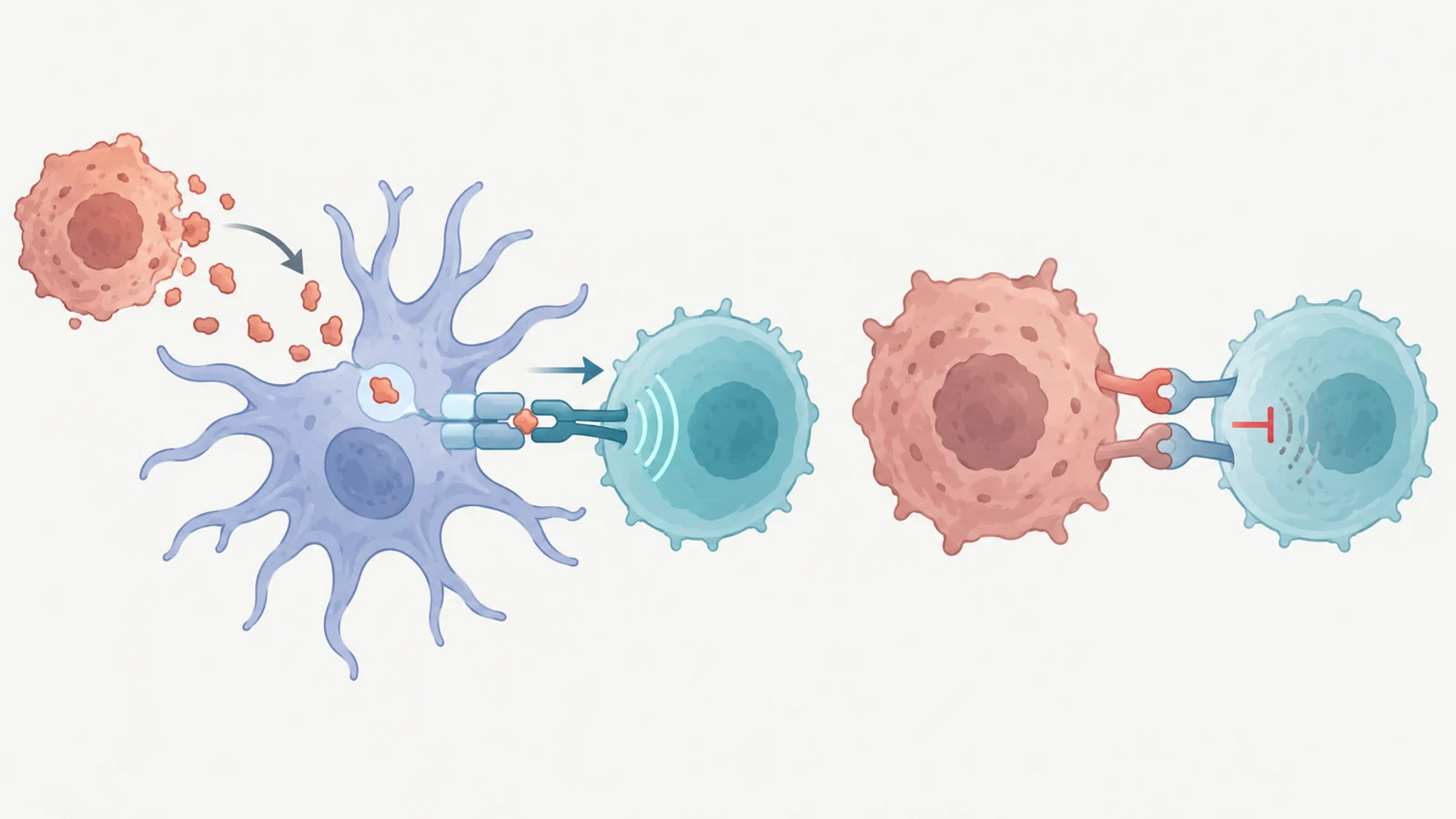
A therapeutic vaccine introduces a tumor-associated target, or instructions for making one, so the immune system can learn to recognize cancer cells. The intended effect is targeted killing by immune cells, especially cytotoxic T cells. This differs from a preventive vaccine, which trains the immune system to respond to an infectious threat before disease develops.
Finding a suitable target is difficult because tumor cells often resemble healthy cells more closely than viruses or bacteria do. One option is a tumor-associated antigen: a normal protein that a particular tumor type produces in unusually large amounts. These shared targets can make vaccine design more practical, because the same antigen may be relevant to many patients with that cancer.
But a target that is also present in healthy tissue comes with a safety question. The immune system may have already removed many T cells that react strongly to the protein, a process called central tolerance. The remaining cells may recognize it weakly. And although the review says vaccine studies had not reported off-target toxicity, severe toxicity from engineered T cells aimed at certain tumor-associated antigens shows why researchers must consider the risk of healthy tissue damage.
Neoantigens offer a more individualized alternative. They are proteins created by mutations in a tumor and are not found in healthy cells. Because the immune system has not been trained to ignore them in the same way, they may prompt stronger, more specific T-cell responses with less risk of autoimmunity. The tradeoff is that most neoantigens differ from one patient to another. Identifying useful ones requires tumor profiling and selection, making a ready-made vaccine for many patients difficult. Advances in genomic analysis were making that personalized process more feasible, the review noted.
Four vaccine approaches, four practical tradeoffs
The vaccine platform determines how the target reaches the immune system and what must be prepared or delivered. Each approach brings different choices about control, manufacturing, the number of targets it can carry and whether it can be given again.
Dendritic cells are immune cells that collect and display antigens to activate T cells. In a dendritic-cell vaccine, a patient’s cells are collected, prepared outside the body and loaded with a tumor antigen before being returned. This gives researchers control over the antigen and cell preparation, and the cells can be engineered or paired with immune stimulants. It is also labor-intensive and costly. The process may yield too few cells, or cells that do not activate T cells effectively; even well-prepared cells can face a suppressive tumor environment.
Peptide vaccines use short, synthetic pieces of a tumor protein. They can be made quickly and relatively inexpensively, with immune stimulants added to shape the response. Their compact design can carry fewer targets than platforms that encode whole proteins. Still, a small, carefully chosen set may be enough: adding more targets does not guarantee a stronger response and can lead to competition between them.
DNA and RNA vaccines carry genetic instructions that cells use to make tumor antigens. A single design can encode several targets, and the instructions can be adjusted to influence how much antigen is made and how strongly the immune system is alerted. Manufacturing can be faster and less costly than making cellular or viral-vector vaccines, though it still requires specialized production. Delivery matters: the instructions must reach the right cells, and the balance between antigen production and immune stimulation can affect the response.
Viral vectors use engineered viruses to deliver tumor-antigen instructions. They can carry many targets, produce high levels of antigen and stimulate innate immune defenses through properties of the virus itself. Their manufacturing and storage can be simpler than preparing patient-specific cells, but more involved than making synthetic peptides. The immune system may also develop antibodies against the vector, limiting repeat use.
These differences are not just technical details. A platform that is easy to manufacture may not deliver a strong enough signal to T cells; a potent one may be hard to repeat or tailor. The tumor still has to display the selected target, and the activated T cells still have to function where the cancer is growing.
Pediatric studies show different kinds of early signals
The review describes a small and varied set of pediatric studies, many at an early stage. Their observations are useful for understanding safety, feasibility and immune activity, but they cannot be treated as a single test of whether vaccines improve survival. The studies involved different cancers, targets, treatments and designs, often without randomized comparisons.
Dendritic-cell vaccines were generally described as well tolerated in phase I and II studies involving children with several types of cancer. Some studies reported temporary clinical improvements alongside cytotoxic T-cell responses. In one phase II study of children with metastatic or relapsed sarcomas, the review reported a 12% increase in overall survival for a tumor-lysate-loaded dendritic-cell vaccine group compared with children receiving standard chemotherapy. In a subgroup with Ewing sarcoma or rhabdomyosarcoma, five-year survival was reported as 77%, compared with historical figures of 30% to 50%.
Those figures are notable, but the comparison with historical controls cannot establish that the vaccine caused the difference. The comparison was not randomized, and the review also describes early dendritic-cell studies in which temporary clinical improvements were followed by progression. The findings support further study; they do not show that this approach reliably improves survival for children with sarcoma.
Other early observations illustrate why outcomes need to be described precisely. In a five-patient study of a peptide vaccine targeting WT1, one patient had a reported complete remission and another had a period of stable disease. The review also reports progression or death in four patients; these are not mutually exclusive outcomes. In a larger study of 26 children and young adults with relapsed cancers, no clinical responses were observed. These small studies used different patient groups and designs, so they cannot establish a general response rate. They do show that an occasional remission, stable disease and progression are distinct outcomes—and that early evidence can include all of them.
A brain-tumor peptide study reported another kind of observation: five children developed pseudoprogression, a temporary increase in swelling and scan enhancement associated with an immune response, followed by stabilization or regression. Those patients had a higher median survival in the study than patients without that scan pattern. This association does not show that pseudoprogression improves survival; scan changes and outcomes in a small study cannot establish cause and effect.
The studies therefore offer several kinds of early information. A measurable immune response shows that a vaccine can engage the immune system. Stable disease or a remission describes what happened to the cancer in particular patients. Neither observation alone answers whether a vaccine will produce durable tumor control across a broader pediatric population.
Activated T cells still face the tumor environment
Even when a vaccine prompts T cells to recognize cancer, tumors can make those cells less effective. Some cancers create an immunosuppressive environment, including by expressing checkpoint molecules such as PD-L1 that inhibit T-cell killing. Tumor cells can also evade recognition if they reduce or lose the antigen the vaccine targets. A strong initial response can therefore fall short of tumor control.
That is why combination treatment is being explored. A vaccine may help generate tumor-directed T cells, while other treatments could address mechanisms that restrain them. The review describes research combining vaccines with other treatments, including drugs that block inhibitory checkpoint signals and radiation. These approaches are under investigation; their rationale does not establish that a particular combination benefits children.
The surrounding treatment regimen may also affect the immune response. In a pediatric study of a peptide vaccine for diffuse midline glioma, dexamethasone use was negatively associated with the expansion of vaccine-reactive CD8 T cells over time. Steroids such as dexamethasone can suppress immune activity, but the reported association does not establish that changing steroid treatment would improve vaccine outcomes. The review also notes that some chemotherapy may aid vaccination by promoting tumor-cell death in ways that stimulate immunity or by reducing suppressor cells. The effect depends on the treatment and context, not simply on whether chemotherapy is present.
Packaging a peptide can change its immune effect
Choosing a promising antigen is only part of vaccine design; how the antigen is delivered can matter too. A peptide can be paired with an immune stimulant, but simply mixing the ingredients may not ensure that the right antigen-presenting cells take them up and activate T cells.
The review highlights a preclinical approach in which peptide antigens were chemically linked to immune stimulants and designed to assemble into small nanoparticles. The particles were intended to reach dendritic cells in lymph nodes. In mouse tumor models, this packaging improved antigen uptake and immune activation and was associated with stronger T-cell responses and tumor clearance.
A key finding was that the peptide’s physical form mattered. Water-soluble peptides could be weakly immunogenic even when combined with a potent stimulant; making them particulate improved their ability to provoke an immune response. This offers an engineering lesson for vaccine design, but the reported tumor clearance occurred in mice. It is not evidence that the same formulation controls cancer in children.
What better vaccines could change for children with cancer
If better target selection, more reliable activation of tumor-targeting T cells and ways to overcome tumor suppression can be combined, therapeutic vaccines could become a more targeted part of pediatric cancer care. The hoped-for benefit is stronger, more durable tumor control alongside existing treatments, potentially with less lasting harm than conventional approaches alone.
That possibility remains conditional. The early pediatric studies in the review show that vaccination can be feasible and can activate immune responses, with occasional clinical responses, but they do not establish reliable or lasting benefit. Adult findings and mouse-model results cannot fill that gap. The clinical value of these approaches will depend on pediatric studies demonstrating meaningful tumor control with acceptable toxicity.
Key Sources
- Primary source: Therapeutic cancer vaccines for pediatric malignancies: advances, challenges, and emerging technologies.
DOI or Journal Page · Review or Meta-Analysis · 2021-01-01
Keep exploring