
Research Signal – Source date 2026-08-13
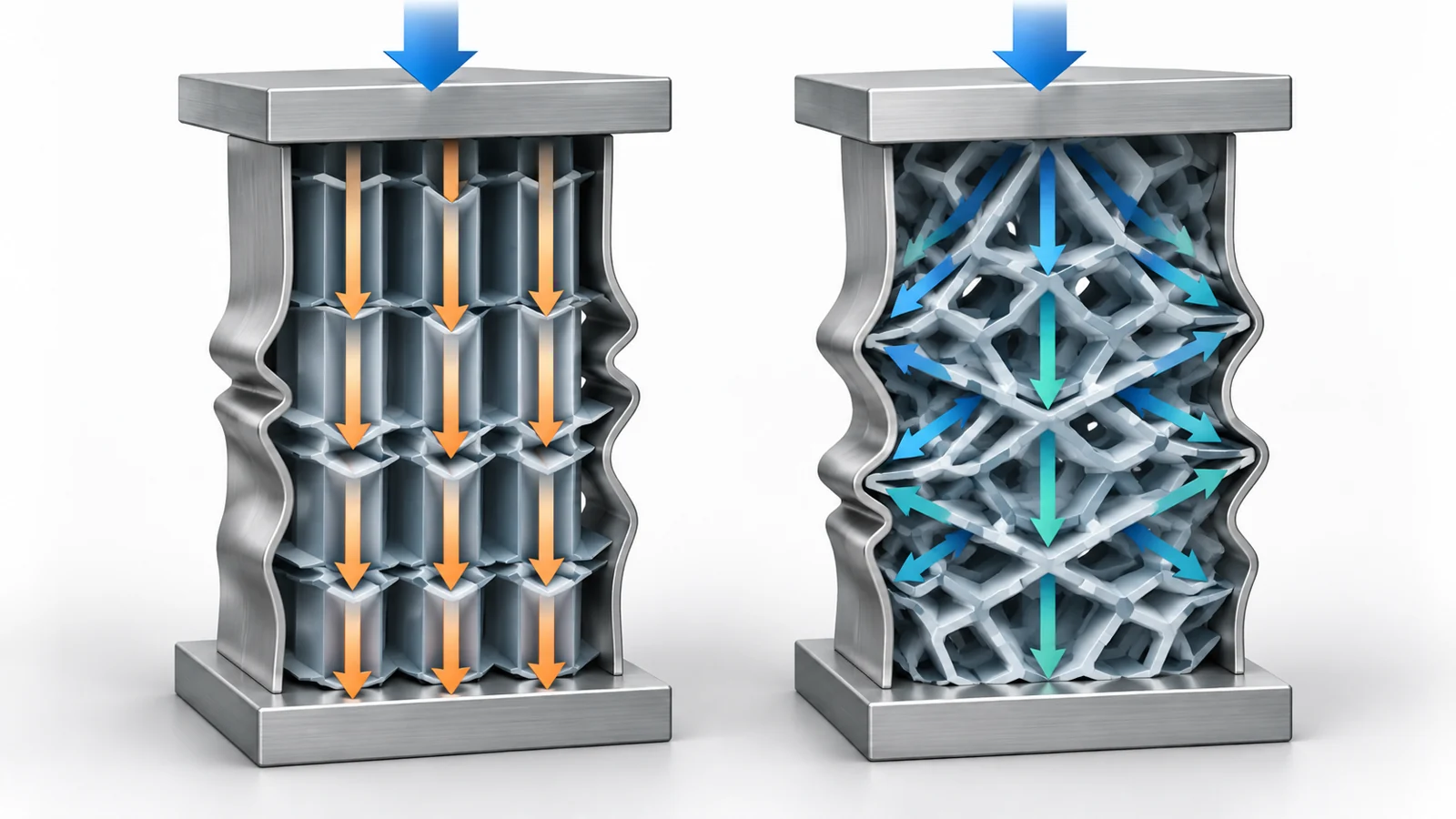
In one reviewed crash-box experiment, an ordinary honeycomb filler absorbed more energy than either of two auxetic fillers of equal mass. The honeycomb increased energy absorption by 79.1% over an empty tube; the auxetic-strut and re-entrant fillers increased it by 62.6% and 64.0%, respectively.
That result challenges an easy assumption: a more unusual cell shape is not automatically a better crash absorber. These structures are mechanical metamaterials—materials whose deliberately designed internal patterns help determine how they deform. Their performance depends on how forces travel through that pattern, how it folds or buckles, and how it interacts with the surrounding part. The comparison is one example gathered in a 2026 review of hierarchical and fractal-inspired designs, not a universal ranking of cell shapes.
The route a force takes matters more than the pattern’s appearance
Relative density—the fraction of a structure’s volume occupied by solid material—is useful, but it cannot predict mechanical performance on its own. Two structures with similar density can have different stiffness, strength and failure behavior because their geometry sends load along different routes.
In a bending-dominated structure, slender walls or struts flex under load. This can make a lightweight structure compliant, but the members may bend or buckle before the material is fully engaged. A stretching-dominated structure directs more of the load along the length of its members, improving load transfer. That advantage depends on features such as sound connections between members, their alignment and the conditions at the structure’s edges. Slender members can still buckle, and manufacturing flaws can redirect the intended load path.
Surfaces can carry force differently again. In plate- or shell-like structures, load spreads across a continuous surface instead of passing mainly through separate struts. This can use material efficiently, particularly in a lightweight design. Thin shells, however, may buckle locally or become sensitive to small variations in thickness, shape or support. A structure that performs well in an ideal compression model may respond less reliably when its shape or loading is less controlled.
The relevant question is therefore not simply which geometry looks most advanced. It is which deformation mechanism the design activates, and whether that mechanism suits the task. The review groups architectures by whether they rely mainly on bending, stretching, surface action or buckling. Their appearance can suggest how they might work, but the load path and failure sequence determine what they actually do.
Smaller scales need distinct mechanical jobs
A hierarchy adds smaller structural features inside larger ones. Those levels can share work: one may transfer load, another redirect damage, and another accommodate deformation or dissipate energy. This is the mechanical purpose behind borrowing ideas from nested natural materials such as bone or nacre. Their organization is not useful merely because it is complex; different levels contribute different functions.
Engineered versions face the same test. Smaller cells may help redistribute stress, delay local collapse or extend the stage during which a structure absorbs energy. But repeated geometry without a distinct job at each scale can add weak junctions, stress concentrations and manufacturing difficulty without improving performance. More levels can also make the structure overly compliant or more sensitive to defects.
Many engineered lattices are finite: they contain a limited number of nested levels, with a smallest feature set by manufacturing resolution. They are often better called fractal-inspired than mathematical fractals, which have self-similar structure across scales without such a finite cutoff. Measures such as scale ratio, iteration depth and fractal dimension can describe geometry, but a number alone does not explain strength or energy absorption. It becomes mechanically useful only when it is connected to a response—for example, a change in how strain spreads or collapse progresses.
A useful crush has stages
Under compression, cellular structures commonly pass through three stages. At first, struts or walls bend and the stress rises. Then local regions buckle and collapse in sequence. This creates a plateau: the structure continues to shorten while absorbing energy, rather than resisting only at one initial peak. Near the end, the remaining voids close and the structure densifies. Contacts between walls make the stress rise sharply.
A longer, steadier plateau can provide more usable crush stroke and reduce fluctuations in the force carried during collapse. The review describes studies in which greater hierarchical depth delayed densification, extended the plateau and made progressive collapse more stable. These findings link multiple scales to a particular mechanical sequence; they do not show that adding hierarchy always produces the same benefit.
Buckling can be useful when it triggers a planned sequence of deformation instead of sudden loss of load-bearing capacity. Some designs use instability to produce switchable or recoverable behavior. Plastic deformation offers another route: it can help set the order in which parts collapse and dissipate energy, but it leaves residual deformation and can reduce reusability. Whether that trade-off is acceptable depends on whether the structure is meant to absorb a one-time impact or recover for repeated use.
Energy absorbed is only one part of crash protection
Crash absorbers must manage several outcomes at once. Total energy absorption describes how much energy a component takes up; specific energy absorption adjusts that amount for the absorber’s mass. Peak crush force is the highest force reached, while mean crush force describes the average force over the crushing stroke. Crush force efficiency compares mean force with peak force, indicating how evenly the load is sustained. Intrusion—the extent to which the structure pushes into protected space—also matters, as does the integrity of whatever it is meant to protect.
A design that absorbs a large amount of energy can still produce an undesirable initial force peak or collapse in a way that uses too little stroke. Raising sustained force while limiting the peak, mass and intrusion can require competing trade-offs. That is why no single measure settles whether a filler is suitable for a crash box or battery-protection member.
The reviewed comparisons illustrate how topology and surrounding structure affect those trade-offs. In one study of square metal crash boxes, two differently shaped auxetic fillers improved on an empty tube by different amounts. One raised energy absorption per unit mass by 28.5%, versus 20.6% for the other; its gain in how evenly force was sustained was also larger (50.6% versus 40.27%). In another line of work, lattice-filled thin-walled tubes showed that the interaction between the outer shell and inner lattice can matter: one reported hybrid absorbed 43.40% more energy than the sum of its shell and filler tested separately. These are results from particular designs and test conditions, not a common head-to-head ranking across all architectures.
Auxetic designs have a negative Poisson’s ratio: when compressed along one direction, they contract laterally rather than expanding outward. That behavior can help constrain deformation in some structures. Yet the equal-mass comparison at the opening shows why this property alone does not establish an advantage. How the cells interact with shell folding, contact and local instability matters more than the label “auxetic.”
Lab performance still has to survive real components
The review brings together theoretical models, simulations and experiments, but the methods and reported measures vary. Many results come from small specimens or simplified compression tests. Real components may encounter impacts from different directions, changing loading rates, adjoining structures and manufacturing imperfections. Defects such as uneven wall thickness, rough surfaces, misalignment or weak connections can shift where a structure buckles or fractures.
These differences complicate direct comparisons and limit what a small laboratory specimen can tell us about a vehicle part. A strong result under idealized compression does not show that an architecture will retain its performance at larger scale, tolerate production variation or protect occupants in a complete vehicle crash. The review’s automotive case study organizes findings from prior work; it is not a demonstration that an optimized lattice has already improved whole-vehicle safety.
For component design, evidence has to cover the relevant force peaks and sustained loads, collapse stability, intrusion and protected-part integrity together. Manufacturing and testing at realistic scale are part of that question because flaws and interfaces can change the load path that gave the design its promise in the first place.
What controlled crumpling could change for crash protection
Internal architecture could eventually help crash boxes or battery-protection members absorb impact through a stable, extended crush stroke while limiting peak force and intrusion. That could support lighter protective components whose deformation is deliberately managed by their internal structure. The capability depends on designs that keep working under realistic impact directions and rates, and that can be manufactured at scale with defects kept within tolerable limits. The review points to a design opportunity; reliable performance in vehicle components remains to be demonstrated.
Key Sources
- Primary source: Hierarchical and Fractal-Inspired Mechanical Metamaterials: A Mechanics-Oriented Review of Multiscale Design, Strength, Deformation, and Energy Absorption.
DOI or Journal Page · Review or Meta-Analysis · 2026-08-13
Keep exploring