
Research Signal – Source date 2026-07-02
An electric vehicle’s battery case has two jobs that can pull in different directions. It must protect cells from impacts, vibration, heat and moisture while supporting cooling and other systems. At the end of the vehicle’s life, its construction also affects whether the case can be separated, repaired or recycled into useful material.
A review published on July 2, 2026, examines the materials used in these housings and the recycling routes available for them. It describes why fiber composites can make a strong, lighter case, yet be difficult to recover as valuable materials. The practical answer depends on more than the material itself: the way parts are joined, coated and labeled can preserve or close off options later.
The case is part of the battery’s safety system
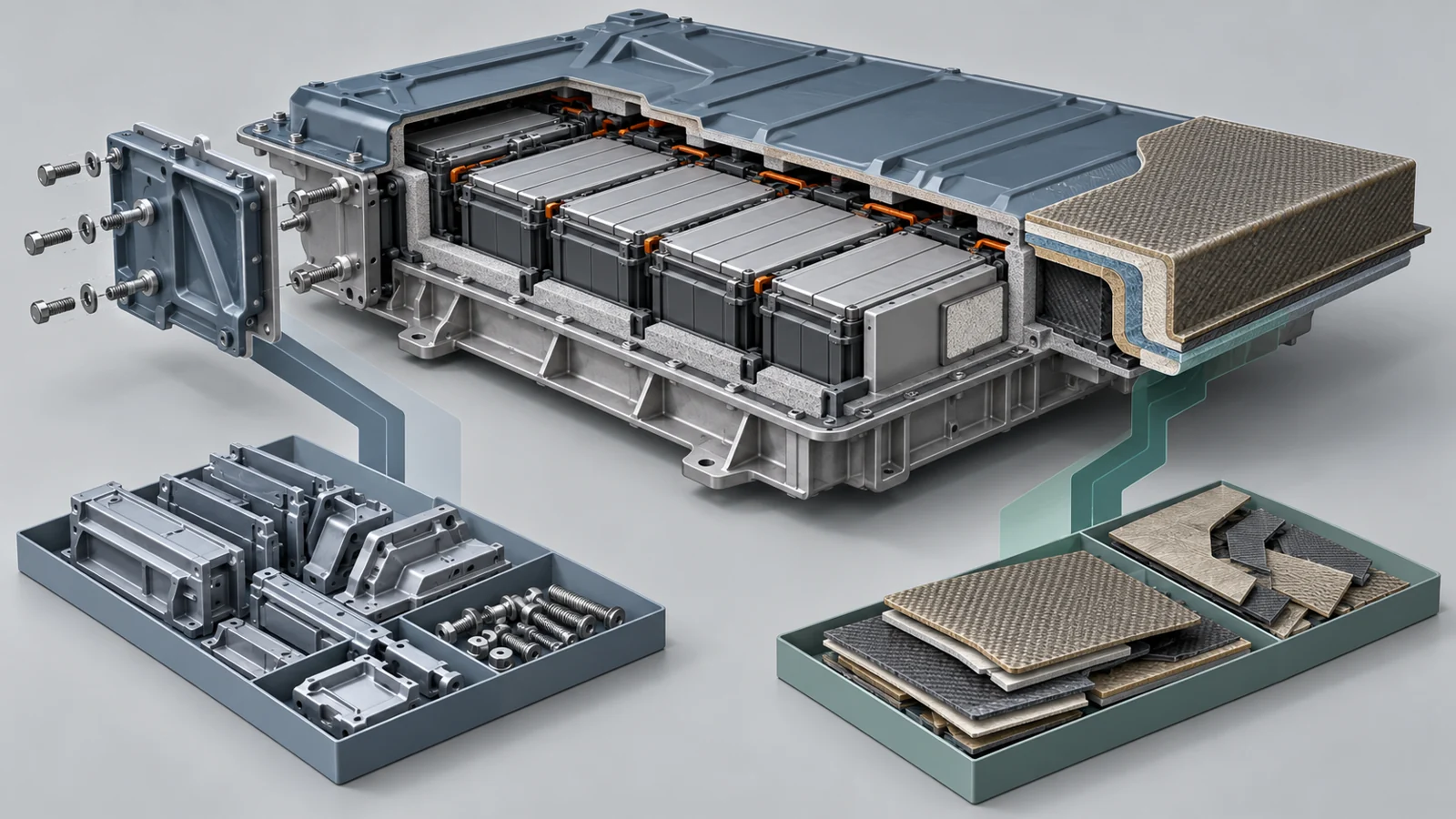
A housing is not simply a shell around the cells. It contributes to structural rigidity and crash protection, and helps shield the battery from vibration, moisture, contaminants and electrical hazards. It also has to work with cooling hardware that helps keep cells within safe operating temperatures. Some designs include sensors and space to accommodate swelling or gas release.
These functions complicate material choices. A case has to withstand its operating environment and help protect the battery during an impact, while allowing the pack’s components to be assembled and integrated into the vehicle. A material that looks attractive by weight alone may not satisfy every structural, thermal, electrical and manufacturing requirement in the finished design.
Fiber composites save weight by combining materials
A fiber composite combines strong reinforcing fibers with a polymer matrix, the material that holds the fibers together. Carbon fiber composites can offer high strength and stiffness for their weight; glass fiber composites can also reduce weight while retaining useful strength. Sandwich panels, which place a lightweight core between stronger outer layers, are another way to achieve rigidity with less material than a solid metal panel.
The review cites composite systems with weight reductions of up to 56% compared with steel. That figure applies to the cited component comparisons, not to every battery housing or to an entire electric vehicle. Reducing structural weight can help energy efficiency, but the size of any vehicle-level benefit depends on the design and the broader life cycle, including the energy and materials used to make the housing.
Production is another part of the tradeoff. Carbon fiber and the processes used to form complex composite parts can be expensive. The review describes manufacturing approaches such as molding and pressing, but scaling them for high-volume vehicles requires suitable equipment, tooling and production costs. Lightweight potential alone does not settle whether a composite is practical for a given vehicle.
The polymer matrix changes the recycling route
The fibers are only part of a composite. Its polymer matrix affects what can happen to the material when a housing is discarded. Thermoplastic matrices can be softened and reshaped, offering a more direct route to making new parts. Thermosetting matrices form bonds that do not remelt, so returning them to a useful material stream is more difficult.
That difference helps explain why the review sees thermoplastic composites as the more promising direction for circular battery enclosures. It does not make them automatically easy to recycle. A housing can combine polymers, fibers, metal inserts, coatings, adhesives and other integrated features. Separating those layers and materials may require several processing steps, and strong adhesive bonds can make disassembly slow or costly.
The matrix also matters because recovering fibers is not the same as recovering the whole composite. The review notes that research has often focused more on fiber recovery than on preserving the polymer matrix. When that matrix is burned or decomposed in thermal processing, its material value is lost instead of being carried into another product.
Recovered fibers may not suit the same job
Mechanical recycling is described as the most mature and economically attractive route for large-scale use. It can reduce composite waste into material for other applications, but the process can shorten fibers and leave them contaminated with matrix material. Heating or chemically treating the composite can recover higher-value fibers, though cost and processing infrastructure limit wider adoption.
Processing can also change the fibers themselves. Heat may alter their surface, while mechanical treatment can damage or shorten them. Those changes can reduce strength, stiffness or impact resistance, making recovered fibers a poor substitute for virgin fibers in a demanding, load-bearing battery case. They may still be useful in secondary or semi-structural products, but recovery does not guarantee a return to the same role.
A mixed housing can further complicate the route. Shredding a complete pack may mix metals, plastics and composites, lowering the purity and value of recovered fractions. What reaches a recycling facility, and how well it is sorted and pre-processed, can shape the result as much as the recycling technology itself.
Joints and labels preserve options at end of life
Design choices can make a case easier to take apart before it reaches a shredder. Accessible detachable connectors, fewer material types, limited coatings and modular construction can help separate parts for repair, reuse or recycling. Adhesives may simplify assembly, but large or inseparable bonds can block access to materials that would otherwise be recovered.
Modularity can also keep options open while a battery is in service. A design that allows modules to be tested, replaced and reconfigured can support repair or reuse without damaging the surrounding case. Safety requirements may still require permanent connections in some places, so the design challenge is to make joints separable where practical and to plan for joints that cannot be removed intact.
Information about materials matters too. Digital records or labels can identify a housing’s composition and configuration, helping people sort it and choose a suitable end-of-life route. Without consistent design and labeling, dismantlers may have difficulty identifying materials or deciding how to separate them. A label cannot compensate for an inseparable assembly, but it can help preserve the value of parts that are accessible.
Metals offer a useful comparison, with their own tradeoffs
Aluminum and steel remain widely used housing materials, with established recycling routes. Steel can be separated magnetically, while aluminum scrap generally needs sorting by alloy and attention to surface contaminants before it is remelted. Producing secondary aluminum can use much less energy than producing primary aluminum; the review gives an estimate of about 95% less energy for fully recycled alloy. In one comparison cited by the review, steel made from recycled scrap had lower emissions per unit weight than steel made from new raw materials.
Those advantages do not make every metal housing circular by default. Mixed or poorly sorted scrap can lose alloy quality, and steel recovered from vehicles may be used in lower-value applications rather than returned to similar automotive parts. Aluminum can offer weight savings over steel, but its primary production is energy-intensive. A meaningful comparison therefore has to include both the weight and production burden of a material and the quality and destination of what is recovered.
The review does not establish one housing design that simultaneously meets crash, fire, cost and recycling requirements. Its examples draw on different components and study contexts, so a cited material or weight comparison should not be read as proof that a complete vehicle will gain a particular range or emissions benefit.
What a recyclable battery case could change
If a lighter housing can meet proven safety requirements and be built with joints that allow modules and materials to be separated, it could make repair and reuse easier while reducing the weight carried by a vehicle. If useful material quality can also be retained and recycling processes can handle the design at scale, more of the case could return to productive use instead of becoming a mixed, lower-value waste stream.
That outcome depends on several pieces working together: crash and fire performance, separable construction, reliable material information and practical processing capacity. The review identifies thermoplastic composites and circular design choices as promising directions, while leaving the combined performance of a real housing design to be demonstrated.
Key Sources
- Primary source: Materials Used in Electric Vehicle Battery Housings: Recycling Pathways and Circular Design-A Review.
DOI or Journal Page · Review or Meta-Analysis · 2026-07-02
Keep exploring