
Research Signal – Source date 2026-06-06
In mouse wound studies, removing one population of cells marked by p16 delayed wound closure, while targeting cells marked by p21 accelerated resolution and limited fibrosis. The findings may sound contradictory. They point to a central question about senescence: which cells are present, what are they doing, and does the immune system clear them at the right time?
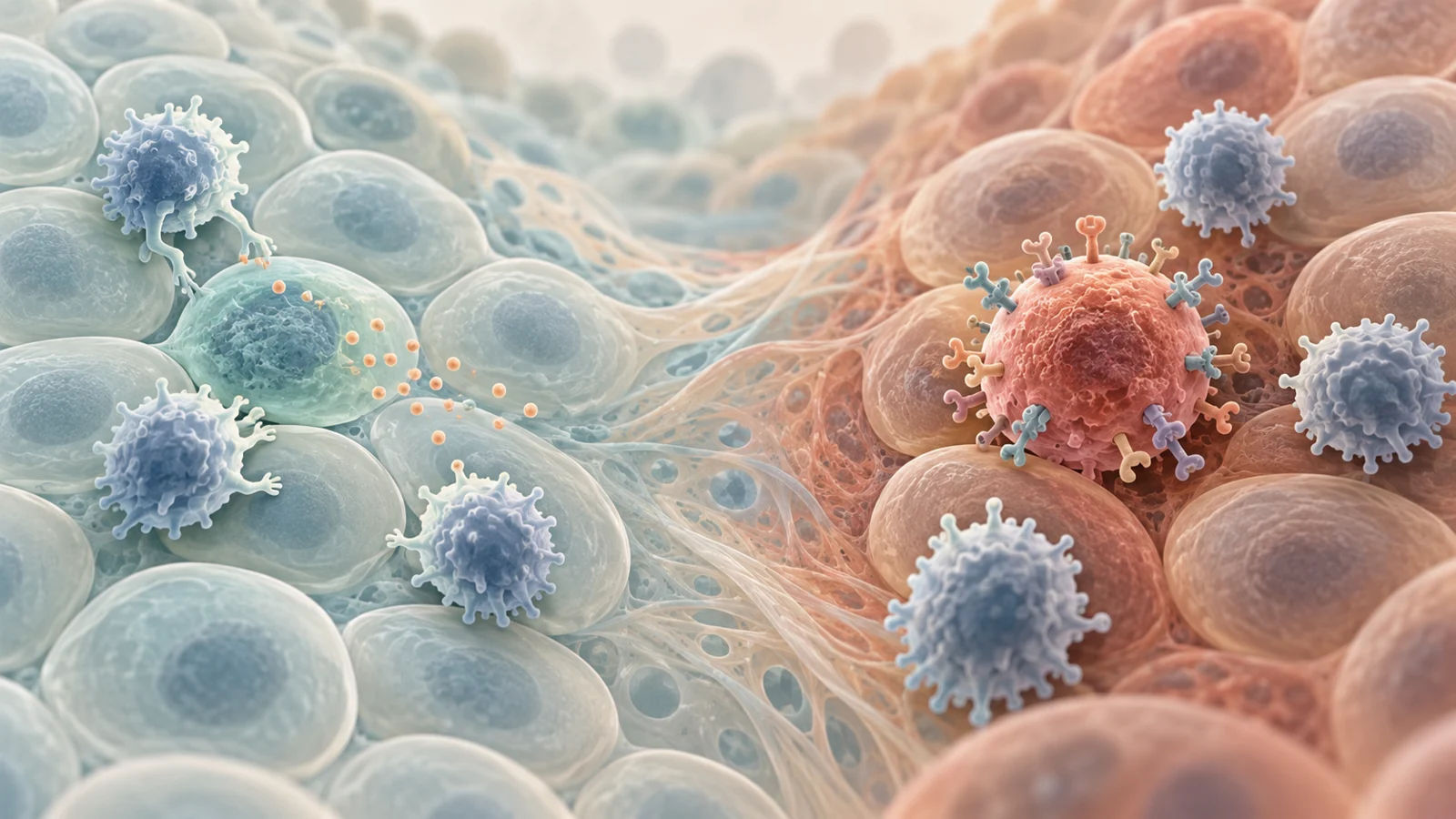
Cellular senescence is a stress response in which a cell durably stops dividing. Senescent cells can also release a changing mix of signals, known as the senescence-associated secretory phenotype, or SASP. In a short-lived response, those signals can help organize repair and bring immune cells to the area. If senescent cells remain, continued signaling can instead feed inflammation and tissue changes associated with disease.
The June 6, 2026 review Immunological consequences of senescence in physiology and pathology brings together research on this two-way relationship. Its examples span different cell types, tissues and kinds of evidence. They help explain why senescence can support repair in one setting and contribute to dysfunction in another, without making p16 or p21 universal labels for either role.
A wound needs a repair signal that can end
After skin injury, p16-marked senescent fibroblasts and endothelial cells appear near the wound edge in the mouse studies discussed by the review. They release factors including platelet-derived growth factor-AA, or PDGF-AA. The review describes evidence that PDGF-AA supports myofibroblast differentiation and granulation tissue formation, steps involved in closing the wound. Removing p16-marked cells delayed closure and hindered myofibroblast differentiation in a genetic mouse experiment.
Other mouse wound research in the review focused on p21-marked cells. These cells were prominent during the inflammatory phase and amplified signaling involving NF-κB, a regulator of inflammatory activity. Targeted inhibition of that signaling in p21-positive cells, or removal of those cells, accelerated wound resolution and limited fibrosis.
These results concern separately studied, marker-defined populations and interventions. They do not show that the same cells were first helpful and then harmful, or that either marker alone identifies a fixed cell type. They do show why the timing and location of a senescence response matter: cells and their secretions can take part in repair, while a different or prolonged program can hold inflammation in place. The wound findings are from mice and do not establish a treatment for human wounds.
Immune cleanup depends on the changing message
Senescent cells do not simply switch on one signal that summons a uniform immune response. Their secretions and surface molecules together shape how nearby immune cells encounter them. Early SASP activity can help recruit immune cells and promote clearance. When signaling persists or becomes dysregulated, the surrounding environment can shift toward chronic, immunosuppressive inflammation, which may allow senescent cells to remain.
Successful immune clearance helps close this loop. Removing a temporary population limits its continued exposure of surrounding tissue to SASP factors and helps restore homeostasis. In development, tissue repair and acute tumor suppression, the review describes senescence as a transient program whose resolution can depend on immune surveillance. Persistence changes the balance: prolonged inflammation and tissue remodeling are linked in the reviewed research to fibrosis, metabolic impairment, defective repair and tumor progression.
Surface brakes can help cells evade removal
Some senescent cells display inhibitory proteins that dampen the immune cells capable of killing them. PD-L1 is one example. In research summarized by the review, PD-L1-positive senescent cells were more resistant to T-cell-mediated clearance than PD-L1-negative counterparts, and these subsets were associated with stronger SASP activity. In aged mice and mouse models of liver aging and non-alcoholic steatohepatitis, PD-1 blockade reduced p16-positive cell burden in some studies, alongside activation of CD8-positive T cells.
The results are not consistent across every model. A blinded, cross-laboratory replication described in the review did not find that PD-1 blockade reduced p16-positive cells or improved aging-related measures in mice. In a separate mouse lung-inflammation context, blocking PD-L1 reduced p16-positive cells and improved inflammation, but blocking PD-1 did not reproduce that effect. The review notes that antibody-dependent killing, rather than restored immune surveillance, may explain the lung result. These differences caution against treating a checkpoint result in one setting as a general route to senescent-cell clearance.
HLA-E offers another example of an immune brake. In laboratory studies, senescent dermal fibroblasts increased HLA-E in response to inflammatory cues. HLA-E can engage NKG2A on natural killer cells and highly differentiated CD8 T cells, reducing their cytotoxic activity. Elevated HLA-E in aged human skin supports the relevance of this pathway in human tissue, while disruption of the HLA-E–NKG2A interaction restored killing in the studied systems. These observations do not make HLA-E a universal marker of harmful cells; they describe one route by which particular senescent cells may resist immune attack.
Aging immune cells can weaken surveillance
The relationship runs in both directions. Immune cells can acquire senescence-associated features, including reduced ability to proliferate or kill targets. That can weaken the surveillance that would otherwise clear senescent cells, while inflammatory immune cells may also help sustain a tissue environment in which senescent cells persist.
The review describes causal mouse experiments in which DNA damage limited to blood-forming cells led immune populations—including T cells, B cells, macrophages and natural killer cells—to show senescence features. Transferring aged or DNA-repair-deficient immune cells into young mice propagated organ damage; transferring young immune cells reversed those effects. These experiments support a causal role for damaged immune compartments in those mouse models.
Human observations offer a different kind of evidence. CD8 effector-memory T cells can show senescence-associated signatures with age and disease, alongside impaired proliferation, cytokine production and reduced ability to eliminate senescent targets. Those findings connect immune-cell state with weaker clearance, but they do not by themselves show that the same transfer effects seen in mice occur in people.
A marker does not tell the whole story
The p16 examples also show why cell identity and context matter. In bone marrow, removing p16-positive macrophages did not prevent age-related bone-density decline in mice, while targeting p16-positive mesenchymal populations had a protective effect. In another setting, senescent p21-positive macrophages dampened CD8 T-cell activity and limited kidney-graft rejection.
Some p16-positive immune cells may support disease tolerance: a form of host defense that limits tissue damage even when it does not directly clear a pathogen. In mouse studies summarized by the review, these cells helped protect against severe inflammation, sepsis and radiation injury. Their features and functions differed from the familiar picture of a persistently damaging senescent cell.
So a marker such as p16 can identify populations with different roles in different tissues. Removing every cell that carries it could disrupt useful immune or repair functions as well as eliminate harmful cells. A useful target would need to distinguish a disease-promoting population from cells that help maintain tissue function.
Engineered immune cells remain a research direction
Researchers are testing whether immune cells can be directed toward markers found on senescent cells. In mouse models, engineered CAR-T cells targeting uPAR cleared senescent cells in studies of lung cancer and liver fibrosis, with reductions in tumor burden, fibrosis and inflammatory signals. Other mouse work reported effects on metabolism, physical function, intestinal regeneration and colitis. NKG2D-based CAR-T approaches also reduced senescence measures in accelerated-aging mouse models; a study in aged nonhuman primates reported lower senescence signatures without overt toxicity.
These are preclinical findings, not evidence that such treatments benefit people with senescence-related disease. CAR-T therapies are used in oncology for some blood cancers, and research in solid tumors is underway, but that experience does not establish safety or effectiveness when the target is senescence. The review reports no clinical trials evaluating CAR-T therapy specifically for senescence at its publication date.
Immune therapies can also activate the immune system beyond the intended target. CAR-T treatment can cause severe inflammatory reactions and neurological toxicity; checkpoint blockade can trigger inflammation affecting organs such as the bowel, lungs, liver and endocrine glands. Because senescent cells and their markers vary by tissue and condition, future approaches would need selective targets and ways to control where and how strongly immune cells act.
What selective clearance could make possible
If researchers can identify disease-promoting senescent cells and safely direct immune clearance toward them, immune-based treatment might reduce persistent inflammation and tissue damage in conditions such as fibrosis while preserving cells needed for repair. That capability remains conditional: targets must distinguish harmful populations from useful ones, and controlled benefit must be established in people before the promise can become a treatment.
Key Sources
- Primary source: Immunological consequences of senescence in physiology and pathology.
DOI or Journal Page · Review or Meta-Analysis · 2026-06-06
Keep exploring