
Research Signal – Source date 2026-05-26
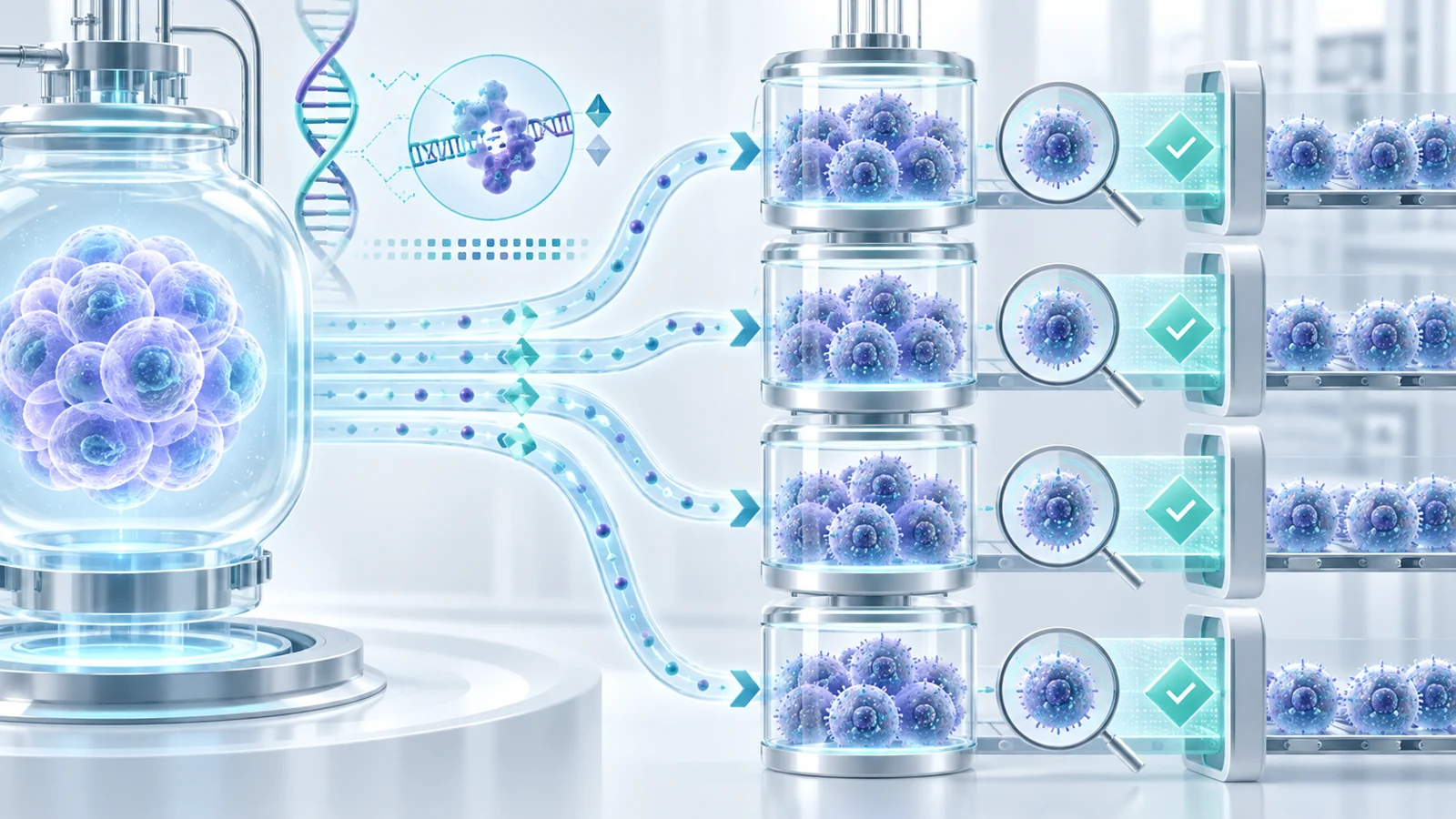
Natural killer (NK) cells are immune cells that can attack cancer. A review published on 26 May 2026 considers whether NK cells made from induced pluripotent stem cells (iPSCs) could become an off-the-shelf treatment: a renewable starting supply could be used to produce batches of cells, instead of preparing a separate starting-cell product for each patient. The idea is promising because batches might be more uniform and easier to engineer. Whether they can be manufactured consistently and keep working in people remains central to the question.
One platform among several
The review compares iPSC-derived NK cells with NK cells from peripheral blood and umbilical cord blood, as well as NK cell lines, including clinically explored NK-92-based platforms. It also distinguishes NK-cell therapies from CAR-T approaches. These alternatives matter because the practical promise of a renewable supply can only be understood alongside other ways researchers are developing cancer-fighting cells. The review presents iPSC-NK as one complementary option, not a demonstrated winner over those platforms.
A renewable starting material could make it possible to plan production around repeatable batches. Uniformity matters because a treatment intended for use beyond one patient needs doses that can be made to consistent standards. That promise depends on the cells produced from the starting material being sufficiently mature and functional; the source alone cannot ensure that.
Turning stem cells into usable NK cells
Making an off-the-shelf product requires a process that reliably guides iPSCs into NK cells and can be repeated at manufacturing scale. The review covers feeder-based and feeder-free systems, embryoid-body approaches, and scalable methods designed for good manufacturing practice (GMP). These are broad approaches, not a single prescribed recipe. The review does not establish one as preferred.
The manufacturing challenge continues beyond differentiation. Incomplete functional maturation and limited persistence can affect how well a prepared cell dose performs after delivery. Standardization and quality control must also establish that batches meet consistent requirements, while cryopreservation—the freezing and storage of cells—must fit a product intended to be prepared and supplied in advance.
Engineering several functions at once
Genetic engineering could add capabilities or tune how the cells respond, but the review describes this as a balancing problem. Its genetic-tuning approach considers CAR signaling, responsiveness to cytokines, and the balance between activating and inhibitory signals together. The aim is to improve antitumor activity while preserving functional stability and safety. Changing one part of that system may have implications for the others, so the goal is coordinated tuning rather than simply maximizing activation.
Early clinical signals, with important gaps
The review describes early clinical studies of iPSC-NK products as showing a favorable safety profile and preliminary antitumor activity in selected hematologic malignancies, or blood cancers. This is an encouraging early clinical signal, but the supplied account does not establish lasting benefit. Nor does it establish how these products perform against solid tumors or whether they outperform other NK-cell sources or CAR-T therapies.
Those questions matter because engineered potential and results in patients are different kinds of evidence. The review’s early-study account supports continued investigation; it does not settle how durable the effects are or how broadly they may apply. A comparison across platforms would also be needed before drawing conclusions about relative performance.
Why a reliable immune-cell supply could matter for cancer care
A dependable, programmable supply of cancer-fighting cells could make it possible to prepare doses without building a separate starting-cell product for each patient. For that possibility to matter in care, large-scale manufacturing would need to produce consistent cells that retain useful function in people over time. Renewable starting material makes the supply model plausible; reproducible production and durable performance will determine whether it becomes practical.
Key Sources
- Primary source: Induced Pluripotent Stem Cell-Derived NK Cells as an Off-the-Shelf Platform for Cancer Immunotherapy: Opportunities, Challenges, and Clinical Translation.
DOI or Journal Page · Review or Meta-Analysis · 2026-05-26
Keep exploring