
Research Signal – Source date 2026-05-25
CAR-T cells have changed treatment for some blood cancers, but their success has not removed hard problems: serious immune-related toxicities, labor-intensive production and difficulty working in solid tumors. A review published on May 25, 2026, examines a different engineered immune cell, the invariant natural killer T cell, or iNKT cell. Its early patient reports suggest that CAR-iNKT treatment can reach tumors and produce responses. The human evidence remains small and comes from different diseases, so it shows a treatment worth investigating rather than a proven safer or more accessible alternative.
One cell, two ways to recognize a target
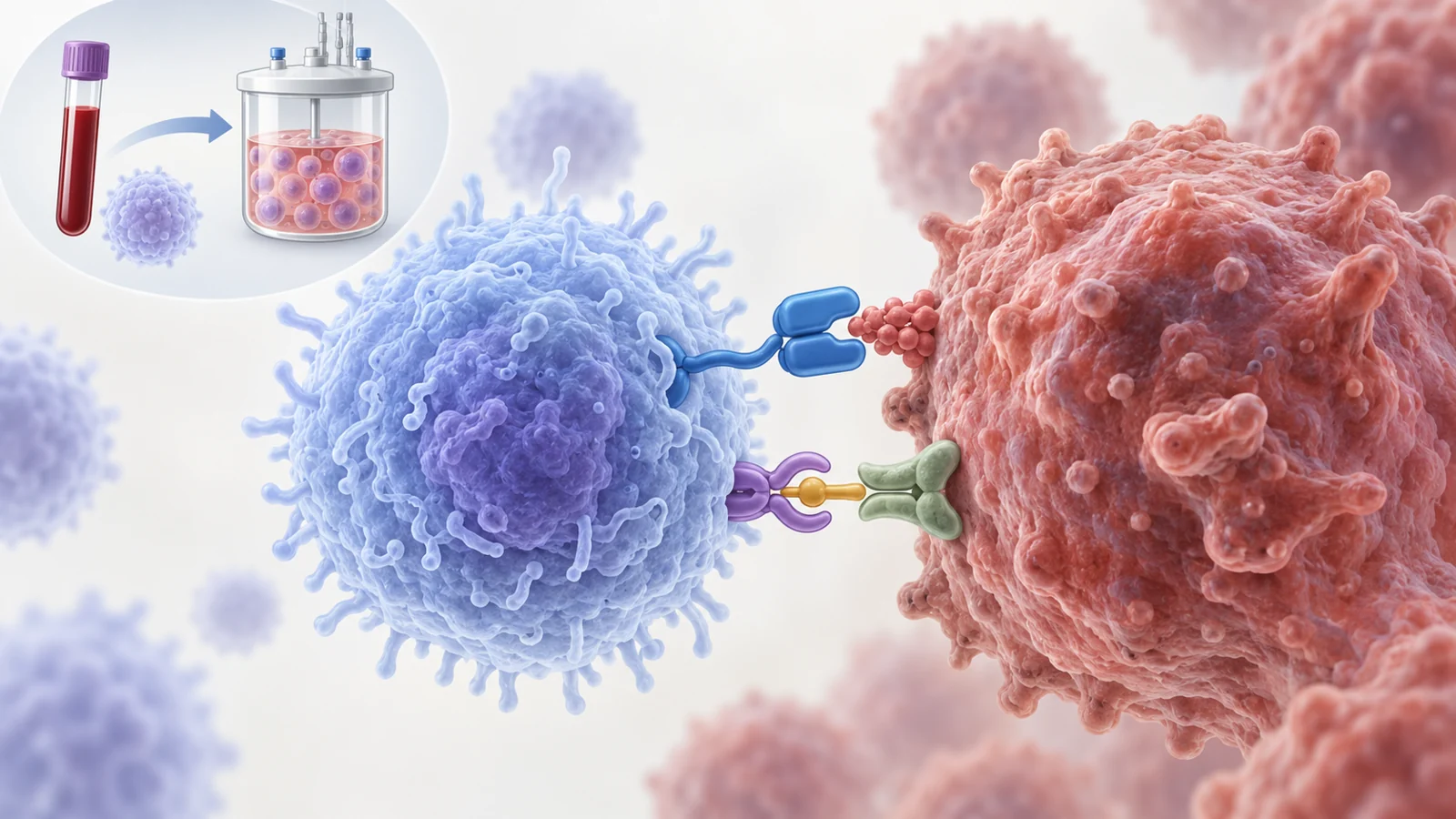
A chimeric antigen receptor, or CAR, is an added receptor designed to recognize a chosen marker on a cancer cell. In a CAR-iNKT cell, it gives the cell an additional route to find and attack a tumor.
The iNKT cell also retains its own recognition machinery. Unlike conventional T cells that recognize many targets through major histocompatibility complex (MHC) molecules, iNKT cells recognize lipid and glycolipid antigens presented by CD1d. This native route can complement the CAR: the engineered cell may respond to its selected tumor marker while also recognizing CD1d-presented material through its natural T-cell receptor and using receptors associated with natural killer cells.
The combination matters because iNKT cells can affect more than the cancer cell they directly attack. They release signaling proteins called cytokines and interact with other immune cells. In the studies summarized by the review, iNKT-cell signals could help activate dendritic cells, natural killer cells and macrophages. Dendritic cells, in turn, can produce IL-12 and support interferon-gamma production, reinforcing a type of immune response associated with tumor control. The intended effect is therefore both targeted killing and a wider change in the local immune response.
Making enough cells is part of the problem
The production route resembles other engineered-cell therapies: collect cells, activate them, add the CAR gene, expand the modified cells, then administer them, either intravenously or into a tumor. Cells can come from the patient or a donor. A donor-derived supply could eventually make treatment more readily available than making a separate batch for each patient, and iNKT cells’ recognition does not rely on the same MHC restriction as conventional T cells. That feature is one reason researchers are exploring them for so-called off-the-shelf therapies.
There is a practical obstacle at the first step. The review describes iNKT cells as rare in peripheral blood and reports that their numbers can fall in people with cancer. Isolating and expanding enough cells requires a reliable process. Researchers are also exploring ways to generate iNKT cells from hematopoietic stem and progenitor cells or induced pluripotent stem cells, which could support more consistent production. The review describes promising approaches, but also says there is no unified manufacturing standard. It does not establish that donor-derived products can already be made at scale, at lower real-world cost, or on demand.
Engineering choices change how cells behave
A CAR is not just an address label. Its internal signaling design can influence how strongly a cell responds, how long it persists and whether it expands or dies after activation. Animal experiments in the review illustrate why no single design choice can yet be called best for every use.
In early work targeting GD2, a marker associated with neuroblastoma, CAR-iNKT cells with a 4-1BB signaling component showed a Th1-like shift. A design combining CD28 and 4-1BB was associated with better persistence in mice. Later experiments added IL-15, a cytokine that can support cell growth and survival. Yet one comparison found that a 4-1BB and IL-15 combination caused more activation-induced cell death than a CD28-based counterpart, reducing cell expansion. The result is a reminder that adding signals to improve persistence or activity can also alter survival in unexpected ways.
Cytokine engineering is another approach. The review describes preclinical work with IL-15, IL-12, IL-21 and IL-18. These additions were associated in different studies with changes such as greater persistence, reduced exhaustion markers, or enhanced proliferation and tumor-killing activity. Those findings come from different experimental settings; they do not establish a universally effective combination or show that the same effects will occur in patients.
Early patient reports offer different kinds of evidence
The review summarizes a phase I study of CD19-targeted CAR-iNKT cells in nine people with relapsed or refractory B-cell cancers: seven with non-Hodgkin lymphoma and two with acute lymphoblastic leukemia. Three lymphoma patients initially had partial remissions, and two later reached complete remission. One patient with acute lymphoblastic leukemia had a complete remission at week four, with incomplete blood-count recovery and no evidence of leukemia reported at that point. The review also notes one case of grade 1 cytokine release syndrome (CRS), an inflammatory reaction that can occur after immune-cell treatment, among the early cell-related adverse events it describes.
These observations are encouraging as evidence that treatment and responses are possible, but nine patients across different diseases cannot establish how well the therapy works for a particular cancer. The review reports that cell expansion in the blood depended on dose; in the lowest-dose group, cells were no longer detectable in blood after three hours. Cells were nevertheless found in post-treatment tumor biopsies, indicating that they had reached tumor tissue. Reaching a tumor is a useful sign of access, but it does not by itself show that cells will persist or control disease for long.
A separate report followed three children with relapsed or refractory neuroblastoma treated with autologous CAR-GD2 iNKT cells engineered to express IL-15. The cells expanded in the body and accumulated in the tumor environment. Some lesions were reported to clear, but the small group and the children’s extensive prior treatment make it difficult to attribute clinical benefit to the engineered cells alone. These results are not a direct comparison with the B-cell study: the cancers, targets and treatment settings differ.
Safety claims depend on where the evidence comes from
The review points to cell-culture comparisons in which CAR-iNKT cells released lower levels of some CRS-associated cytokines than CAR-T cells under conditions of comparable tumor killing. It also describes mouse work in which CAR-iNKT treatment had a more favorable safety profile than CAR-T treatment. These experiments offer possible explanations for a safety advantage, including different cytokine patterns and iNKT cells’ interactions with immune cells in the tumor environment.
Patient observations are more limited. In the nine-person blood-cancer report, one grade 1 CRS case was described. The review also cites a small renal-cancer report of CD70-targeted CAR-NKT cells in which one patient developed grade 2 CRS and grade 2 ICANS, a neurologic complication. In the three-patient neuroblastoma account, the review emphasizes expansion and tumor accumulation. Such small, separate reports cannot show whether lower cytokine release in laboratory comparisons translates into fewer serious complications across larger groups. They also cannot establish superiority over CAR-T therapy in people. The review describes early safety signals, not a settled safety profile.
Solid tumors impose more than a navigation problem
iNKT cells’ ability to enter tumor tissue is one reason they are being studied for solid cancers, where engineered cells may struggle to reach and function inside the tumor environment. But arrival is only part of the challenge. Solid tumors can contain suppressive immune cells and create conditions that interfere with the metabolism and signaling needed for immune activity.
The review describes how limited glucose and accumulated lactic acid can disrupt iNKT-cell function. In the research it summarizes, glucose restriction interfered with T-cell receptor signaling and reduced interferon-gamma production, while lactic acid affected pathways involved in cell metabolism and cholesterol production. The combined pressures can shift the cells away from a strong tumor-directed response. Tumor antigens can also vary, allowing some cancer cells to evade a therapy aimed at a single marker. Engineering may help, but better tumor access alone does not remove these barriers.
What ready-made immune-cell treatment could change for patients
If donor-derived CAR-iNKT cells can be produced consistently and remain active in tumors without unacceptable toxicity, they could eventually offer a more readily available engineered-cell option for some cancers, including solid tumors. That would depend on solving two linked problems: making enough reliable cells and enabling them to function within suppressive, varied tumors. The patient reports described so far show that CAR-iNKT cells can be administered, reach tumor sites and coincide with responses in small groups. They do not yet establish routine availability, lower cost, longer survival or an advantage over existing CAR-T treatment.
Key Sources
- Primary source: CAR-iNKT cells for cancer therapy: a comprehensive review of engineering, mechanisms, and clinical progress.
DOI or Journal Page · Review or Meta-Analysis · 2026-05-25
Keep exploring